A small e-commerce owner stares at her order confirmation process, wondering if it’s worth automating. It’s not the flashiest task on her list, but it happens dozens of times a day — she’s not sure if that alone makes it a good candidate, or if she’s about to spend a weekend building something for a task that was never really the problem.
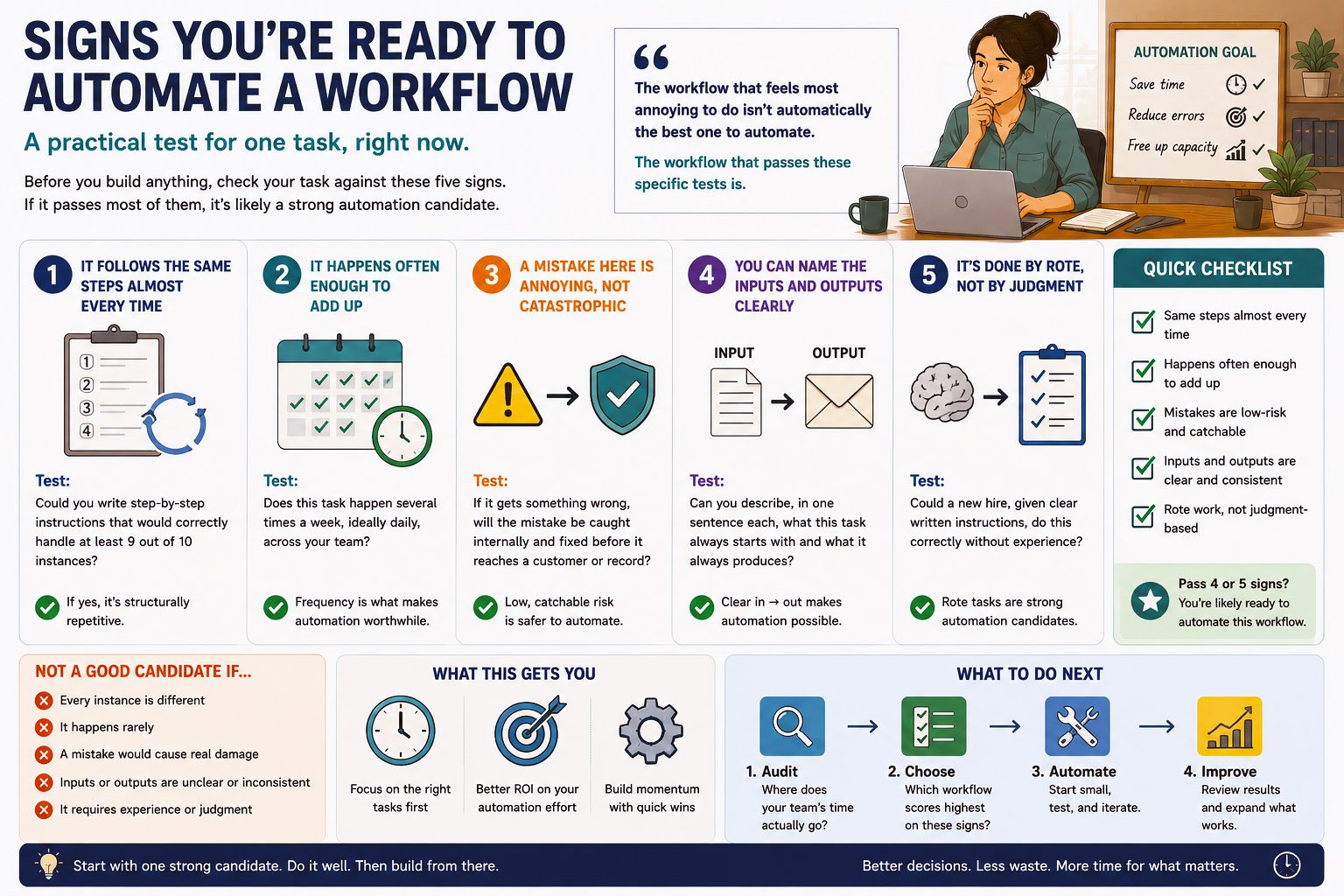
Five checkable tests — not a vague gut check — for whether a specific workflow is actually worth automating: repetition, volume, risk, structure, and judgment.
A small e-commerce store owner is staring at her order confirmation process, wondering if it’s worth automating. It’s not the flashiest task on her list, but it happens dozens of times a day, and she’s not sure if that alone makes it a good candidate, or if she’s about to spend a weekend building something for a task that was never really the problem. She needs a real test, not a gut feeling — and “is this task worth automating” turns out to have a more specific, checkable answer than most advice suggests.
This isn’t about whether your business overall is ready for AI. It’s narrower and more useful than that: given one specific task you’re actually looking at right now, here’s how to tell if it’s a genuinely good automation candidate, using tests you can check against that one task directly rather than a general readiness checklist.
Why This Question Matters
Automating a workflow that isn’t actually a good candidate wastes real time and can leave your team more skeptical of the next attempt. Automating a genuinely good candidate, even a small one, tends to build momentum — a quick, visible win that makes the next automation decision easier. Getting this specific, task-level judgment right matters more than any broader strategy question.
The workflow that feels most annoying to do isn’t automatically the best one to automate. The workflow that passes these specific tests is.
Sign One: It Follows the Same Steps Almost Every Time
The clearest sign of a good candidate is genuine repetition — not “this happens a lot,” but “this happens the same way almost every time.” The checkable test: could you write down step-by-step instructions for this task, right now, that would correctly handle at least nine out of ten actual instances of it? If yes, the task has the structural repetition automation needs. If the honest answer is “it depends heavily on the specific situation each time,” that’s a sign this task resists automation, or at least resists a simple version of it.
Sign Two: It Happens Often Enough to Add Up
Repetition alone isn’t enough if the task is rare — automating something that happens twice a month rarely justifies the setup effort, however repetitive it is each time. The checkable test: does this task happen at least several times a week, ideally daily, across your team? If you struggle to estimate how often it happens because it’s genuinely infrequent, that’s itself informative.
A task that’s perfectly repetitive but happens twice a month is a checklist problem, not an automation problem. Automation earns its cost through frequency, not just consistency.
Sign Three: A Mistake Here Is Annoying, Not Catastrophic
This is the risk test, and it’s worth being specific rather than vague about “low stakes.” The checkable test: if this task’s automated version got something wrong once, would the mistake be caught and fixed before it reached a customer, a financial record, or a legal document — or would it go out the door and cause real, hard-to-reverse damage? A task that fails the first way (caught internally, low cost) is a safer automation candidate than one that fails the second way (external, consequential), even if both tasks are equally repetitive and frequent.
This doesn’t mean high-stakes tasks can never be automated — it means they need a human review step built in for longer, and they’re rarely the right first candidate for a business new to automation.
Sign Four: You Can Name the Inputs and the Outputs Clearly
A task that starts with a consistent kind of information and ends with a consistent kind of output is much easier to automate well than one where both the starting point and the end result vary unpredictably. The checkable test: can you describe, in one sentence each, what this task always starts with and what it always produces? “It starts with a completed order form and produces a confirmation email” is a clear input-output pair. “It starts with whatever the client happens to mention and produces whatever response seems appropriate” is not — and tasks that look like the second description usually need more judgment than a first automation attempt should assume.
Sign Five: It’s Done by Rote, Not by Judgment
This is the sign most often confused with Sign One, but it’s checking something different — not whether the steps are the same, but whether doing the task well requires experience or could be handled from a written checklist by someone new. The checkable test: could a new hire, given clear written instructions and no prior experience with your specific clients or history, do this task correctly? If yes, it’s a rote task, and rote tasks are strong automation candidates. If the honest answer involves “well, they’d need to have a feel for it” or “it depends on knowing this specific client,” that’s a judgment task, and judgment tasks resist automation even when they’re technically repetitive.
In Practice: The Quick Self-Check
- Sign 1 — Repetition: Could you write instructions that handle 90% of cases correctly?
- Sign 2 — Volume: Does this happen several times a week or more?
- Sign 3 — Risk: Would a mistake be caught internally, or would it reach a customer or record unfixed?
- Sign 4 — Structure: Can you name a consistent input and a consistent output in one sentence each?
- Sign 5 — Judgment: Could a new hire do this correctly from a checklist alone?
If most of these come back favorable — clear yes on repetition, volume, structure, and judgment, with risk at least manageable — you likely have a genuinely good candidate.
The One Sign That Overrides the Others
There’s a sixth consideration worth checking separately, because it can override an otherwise strong candidate: does this task meaningfully shape how a specific customer or client feels about their relationship with your business? A task can pass every test above and still be a poor first candidate if it’s also the moment a customer feels most personally attended to — a first automation attempt at that specific touchpoint risks trading a small time savings for a real relationship cost, even if the task is technically well-suited to automation on every other dimension.
A task can be perfectly automatable and still be the wrong one to automate first, if it’s also the moment your customer feels most looked after.
This isn’t a reason to never automate relationship-sensitive tasks — it’s a reason to automate them later, with more care and more human oversight built in, once you’ve built confidence with lower-stakes candidates first.
What If Only Some Signs Apply?
Few real tasks pass every single test perfectly, and that’s fine — this isn’t a strict pass/fail exam. A task that’s highly repetitive and high-volume but only moderately structured (Sign 4 is a bit fuzzy) is still often worth automating, with a bit more upfront work to define the input and output clearly. A task that’s repetitive and low-risk but only happens a couple of times a week (Sign 2 is weak) might be worth a very lightweight fix — a template rather than full automation — rather than a bigger project.
The signs that matter most to get right are Risk (Sign 3) and Judgment (Sign 5) — a task that fails either of these is a genuinely poor candidate regardless of how well it does on the others, since automating a high-judgment or high-risk task without the maturity to handle it well tends to cause real problems.
Testing Against a Real List of Candidates
These five tests work best applied to a specific task you already have in mind, but if you’re starting from scratch and unsure what to even test, commonly automated SME workflows is a useful starting point — a grounded survey of the tasks most small businesses actually consider, which you can then run through the five checkable tests above rather than guessing which ones might be worth it.
In Practice: A Simple Scoring Approach for Multiple Candidates
- Give each candidate task a quick pass/weak/fail on each of the five signs, rather than a detailed numeric score.
- Treat any fail on Risk or Judgment as disqualifying for a first attempt, regardless of how well the task scores elsewhere.
- Among tasks that pass cleanly, favor the one with the strongest Volume score — this is usually the fastest way to see a visible, motivating result.
- Revisit tasks that scored “weak” rather than “fail” once you’ve successfully automated a stronger candidate first — a weak structure score, for example, often improves once you’ve documented more real instances of the task.
Common Mistakes When Evaluating a Candidate
The most common mistake is confusing “this task annoys me” with “this task is a good automation candidate” — frustration is a reasonable prompt to look at a task, but it’s not itself evidence the task passes any of the five tests. A close second is skipping the risk test specifically, because it’s less fun to think about than the repetition and volume tests — this is exactly how businesses end up automating something financially or legally consequential before they’ve built the oversight habits to catch its mistakes. The quieter mistake is testing a task in the abstract rather than against real, recent instances of it — a task that “usually” follows the same steps might, on closer inspection of the last twenty times it happened, actually vary more than assumed.
Testing a task against your memory of how it usually goes is exactly the same mistake as guessing where your team’s time goes instead of auditing it — both replace evidence with impression.
A Worked Example
The e-commerce owner from the opening ran her order confirmation process through the five tests. Repetition: yes, nearly every order follows the same confirmation format. Volume: yes, dozens daily. Risk: moderate — a wrong confirmation is annoying but almost always caught by the customer or support team before it causes real damage, and it’s easy to correct. Structure: clear — a completed order always produces a confirmation with the same core fields. Judgment: yes, a new hire could handle this from a template.
It passed cleanly, and she automated it first, ahead of a more tempting but riskier candidate — automatically responding to customer complaints — which failed the risk and judgment tests clearly enough that she set it aside for later, once she’d built more confidence and oversight habits with the safer win first.
What to Do Once You’ve Confirmed a Good Candidate
Passing these five tests tells you a specific task is a reasonable automation candidate — it doesn’t yet tell you whether it’s your highest-leverage candidate if you have several reasonable options competing for attention. finding the leverage in your operations covers how to rank multiple good candidates against each other once you have more than one. And if you haven’t yet run a broader audit to surface which tasks are actually worth testing against these signs in the first place, auditing where your team’s time actually goes is the step that usually comes first.
How to Know You’re Ready to Apply These Tests
In Practice: Signs You’re Ready
- You have a specific task in mind, not a vague sense that “we should automate something.”
- You can describe recent, real instances of the task, not just a general impression of how it usually goes.
- You’re prepared for the honest answer to be “not yet” — a task failing these tests is useful information, not a failure of the exercise.
- You’re willing to check the risk and judgment tests carefully, even if they’re less exciting than confirming volume and repetition.
Frequently Asked Questions
What if a task passes four signs but clearly fails one? It depends which one — a weak Sign 2 (volume) or Sign 4 (structure) often just means a lighter-weight fix than full automation. A weak Sign 3 (risk) or Sign 5 (judgment) is a stronger reason to hold off or add more human oversight before proceeding.
Can a task become a good candidate later, even if it fails these tests today? Yes — a task that’s currently too judgment-heavy or too variable to automate can become more structured over time, especially once you’ve documented enough real instances to see a clearer, more consistent pattern emerge.
Should I apply these tests to a whole department at once, or one task at a time? One task at a time — testing a single, specific task gives a clean, checkable answer; testing an entire department’s workflow all at once usually produces a vague, mixed result that’s hard to act on.
What if I’m not sure how often a task actually happens? That uncertainty is itself worth resolving before automating — a short logging exercise, even just for that one task, over a week or two gives you a real answer instead of a guess.
Is it possible for a task to look automatable but actually not be worth it? Yes — a task can pass every structural test here and still not be worth the setup effort if its overall time cost is genuinely small; these tests confirm suitability, not necessarily priority, which is a separate question covered in the leverage framework.
How do I test the “inputs and outputs” sign for a task that involves a conversation, not a form? Look at what information reliably needs to be present before the conversation can conclude well, and what the conversation reliably needs to produce — even conversational tasks often have a consistent underlying structure once you look past the specific wording each time.
What if my team disagrees about whether a task is judgment-heavy or rote? That disagreement is useful information on its own — it usually means the task sits in a genuine gray zone, and starting with a lighter, more supervised version of automation is a reasonable way to test which view is closer to correct.
Do these five tests apply the same way to a task done by one person versus a whole team? Yes, though a task done by several people is worth testing against each person’s version of it separately first — sometimes what looks like one task is actually several slightly different versions of it, which affects how cleanly it passes the structure test.
How do I know if I’m being too strict or too lenient when applying these tests myself? Ask a staff member who actually does the task to apply the same five tests independently and compare answers — a meaningful gap between your assessment and theirs is worth investigating before proceeding either way.
Final Thoughts
The e-commerce owner from the opening didn’t need a sweeping AI strategy to make a good first decision — she needed five specific, checkable questions applied honestly to one task she was already looking at. That’s the real value of a workflow-level test like this one: it turns “should I automate this” from a gut call into something you can actually check, task by task, before spending real time and trust on the answer.
This fits within the broader picture of finding the leverage in your operations and AI for SMEs and startups as a whole.
Last updated: September 2026
Related Reads
- AI for SMEs & Startups: A Practical Guide to Getting Started
- Finding the Leverage: What to Automate First
- How to Audit Where Your Team’s Time Actually Goes
- Signs You’re Ready to Automate a Workflow
- The Most Commonly Automated SME Workflows (And Whether They’re Worth It)
- How to Avoid Automating the Wrong Thing First