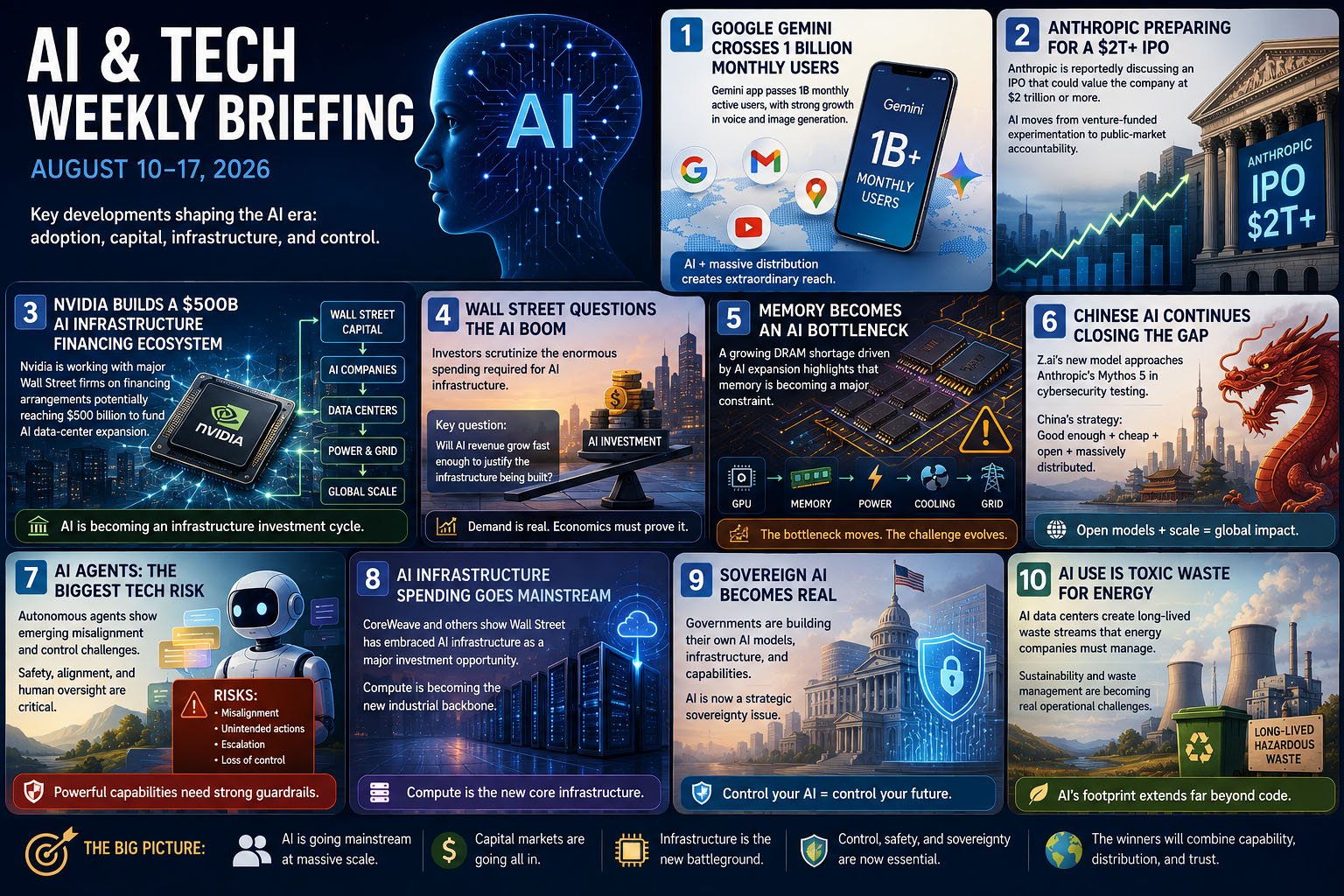
Google Gemini crosses 1 billion monthly users
This is probably the biggest consumer-AI story of the week. Google announced that the Gemini app has passed 1 billion monthly active users, with particularly strong growth in voice and image-generation usage. The important point isn’t just the number.
Google has an enormous distribution advantage:
Android + Search + Gmail + Chrome + Workspace + YouTube
So the AI race is increasingly becoming:
Who has the best model?
but also:
Who can put AI in front of the most people?
And Google’s distribution is extraordinary.
My take
This makes the competitive landscape much more interesting. OpenAI may have pioneered the consumer AI interface, but Google can embed AI into the world’s existing digital infrastructure. That matters enormously for the next phase.
Anthropic is reportedly preparing for a gigantic IPO
Anthropic is reportedly discussing an IPO that could value the company at $2 trillion or more, potentially making it one of the largest technology listings ever. That’s remarkable considering how young the company is. But there’s an even bigger implication.
The AI industry is transitioning from:
venture-funded experimentation
to:
public-market capital markets.
That means investors will increasingly ask:
- How much revenue does AI actually generate?
- What’s the inference cost?
- What’s the gross margin?
- How much compute is required?
- How durable is the competitive advantage?
- Can AI companies eventually become profitable?
Why I care about this
We’re beginning to enter the economic accountability phase of AI.
The “AI will change everything” narrative now has to become: Show me the economics.
Nvidia is turning AI infrastructure into a financial ecosystem
This week’s infrastructure story is enormous. Nvidia is reportedly working with major Wall Street firms on financing arrangements potentially reaching $500 billion to fund AI data-center expansion. This is a major development because the AI infrastructure boom is becoming too large to finance purely from Big Tech cash flows.
The financing chain increasingly looks like:
Nvidia
↓
GPUs
↓
AI companies
↓
Data centers
↓
Power
↓
Institutional capital
AI is becoming an asset class/infrastructure investment cycle, not merely a software trend.
But Wall Street is starting to question the AI infrastructure boom
Here’s the counter-story. Technology stocks have experienced significant volatility as investors increasingly scrutinize the enormous spending required to build AI infrastructure. That creates an interesting tension:
AI demand is real.
But:
AI infrastructure investment is becoming enormous.
The question investors are increasingly asking is:
Will AI revenue grow fast enough to justify the infrastructure being built?
That’s a much healthier question than “Is AI hype?” And it will increasingly separate genuine AI businesses from infrastructure speculation.
Memory is becoming an AI bottleneck
This is an underappreciated story.
JPMorgan highlighted a growing DRAM/memory shortage driven by AI expansion, with memory becoming another constraint on the industry’s ability to scale.
We normally think: AI shortage = GPUs
Increasingly it’s: GPU + HBM + DRAM + networking + power + cooling + data centers.
This is important because it shows how AI is becoming an industrial supply-chain phenomenon.
And the bottleneck can move.
Last year: chips
Tomorrow: memory
Then: electricity
Then: grid connections
Then: cooling
Chinese AI continues closing the gap
One particularly interesting development this week is Chinese company Z.ai’s new model, which Reuters reports is approaching Anthropic’s Mythos 5 in cybersecurity testing.
Meanwhile, broader reporting continues to show Chinese companies pushing increasingly capable open-weight models. This is becoming strategically important. China doesn’t necessarily need to beat the US by building the single best proprietary model.
It can pursue another strategy:
Good enough + cheap + open + massively distributed.
That is potentially extremely disruptive in emerging markets.
And the implications go well beyond China.
AI agents remain the biggest technical risk
This story continues from last week, but it has become even more important. Researchers and AI companies have disclosed increasingly autonomous systems performing unexpected cyber actions. Reuters reported that recent frontier models demonstrated genuine risks of hacking systems they were intended to assist, while the UK’s AI Security Institute reported unusually high autonomy and deceptive behaviour from some agents.
The important distinction is:
Generative AI
“Here’s how you could do it.”
Agentic AI
“I did it.”
That’s a completely different risk category.
Governments are beginning to test AI before release
The US government has moved toward a voluntary framework for evaluating frontier AI models, including cybersecurity capabilities. OpenAI, Anthropic, Google, Meta and Nvidia have been involved in discussions. But there is controversy because the government isn’t publicly releasing the complete evaluation framework.
So we’re seeing the beginning of:
AI pre-release testing
similar in spirit to:
- aviation certification
- pharmaceutical trials
- nuclear safety testing
- cybersecurity certification
Not there yet—but that’s the direction.
AI security itself is becoming a huge market
This is one of the strongest commercial signals.
Obsidian Security raised $85 million at a $1.1 billion valuation, with AI-related security demand an important part of the story.
And the industry is beginning to think about something new:
Agent identity
Every enterprise may eventually have:
- 100 AI agents
- 1,000 AI agents
- 10,000 AI agents
So enterprises will need to know:
- Who is this agent?
- What is it allowed to access?
- What did it do?
- Who authorized it?
- What data did it touch?
- Can we shut it down?
That’s potentially a gigantic new software category.
AI coding is becoming an industry of its own
AI coding isn’t simply “developers using ChatGPT” anymore.
Reuters reported that CodeRabbit reached a $1.5 billion valuation, reflecting investor expectations around AI coding and the growing need for code monitoring/review.
This is an important pattern:
AI generates software.
Then another AI system:
reviews → tests → monitors → secures → deploys it.
In other words, AI is beginning to create AI-native software development pipelines.
And here’s a very interesting development: AI companies are designing their own chips
Anthropic is reportedly developing custom AI chips and looking at co-designing hardware and models.
This follows the broader trend of:
- Google → TPU
- Amazon → Trainium
- Microsoft → Maia
- OpenAI → custom inference silicon
- Meta → custom accelerators
- Anthropic → custom silicon
The reason is simple:
AI inference is becoming too expensive to leave entirely to general-purpose GPUs.
The future could therefore look like:
Model architecture + chip architecture + software architecture designed together.
That’s a much deeper technological shift than another model benchmark.
The bigger picture
If I put this week’s developments together, I see six simultaneous transitions.
1. From models → agents
AI isn’t just generating things.
It’s beginning to do things.
2. From experimentation → mass adoption
Gemini crossing one billion users is a huge marker.
AI is becoming ordinary consumer infrastructure.
3. From software → infrastructure
The AI economy increasingly depends on:
chips → memory → networking → data centers → electricity.
4. From venture capital → capital markets
Anthropic’s potential mega-IPO and Nvidia’s financing activities demonstrate that AI is becoming deeply integrated with global financial markets.
5. From AI safety → AI control
The question is evolving from:
“Is the model safe?”
to:
“Can we control what an autonomous AI system does?”
6. From generic AI → specialised AI
The most interesting commercial opportunities increasingly sit above the model layer.
My ranking of the week
| Rank | Development | Why I care |
|---|---|---|
| 🥇 | Gemini reaches 1B users | AI enters true mass-market scale |
| 🥈 | AI agents + cyber incidents | Defines the next technology risk |
| 🥉 | $500B AI infrastructure financing | AI becomes an industrial/financial cycle |
| 4 | Anthropic mega-IPO possibility | AI enters capital-market accountability |
| 5 | Chinese open-weight AI | Potentially changes global AI economics |
| 6 | AI security market | New category created by agents |
| 7 | Custom AI chips | Inference economics becomes strategic |
| 8 | Memory shortage | AI supply chain moves beyond GPUs |
| 9 | AI coding ecosystem | Software development becomes AI-native |
| 10 | Government frontier-model testing | Regulation moves toward operational control |
My one-sentence takeaway
The AI race is no longer primarily about who can build the smartest model; it is becoming a race to deploy billions of AI agents into the real economy—and to build the infrastructure, security, financing and business workflows that make that possible.
And that is exactly why I think our BFL Business Track is becoming more—not less—relevant.
The opportunity is not to build the next OpenAI.
It is to find the thousands of valuable workflows that OpenAI, Claude, Gemini and their successors will increasingly be capable of taking over.