An owner reads about demand forecasting, nods along, and closes the tab with the same unresolved question: does this actually apply to me, or is it for operations bigger than mine? That deserves a direct answer, not “it depends.”
Here are five concrete tests — not generic ones like “you want to grow” — that show whether your business has actually outgrown memory-based forecasting: can you explain your booking pace right now, or are you guessing? Have you been surprised by demand more than once this year? Two “yes” answers is usually enough to act on.
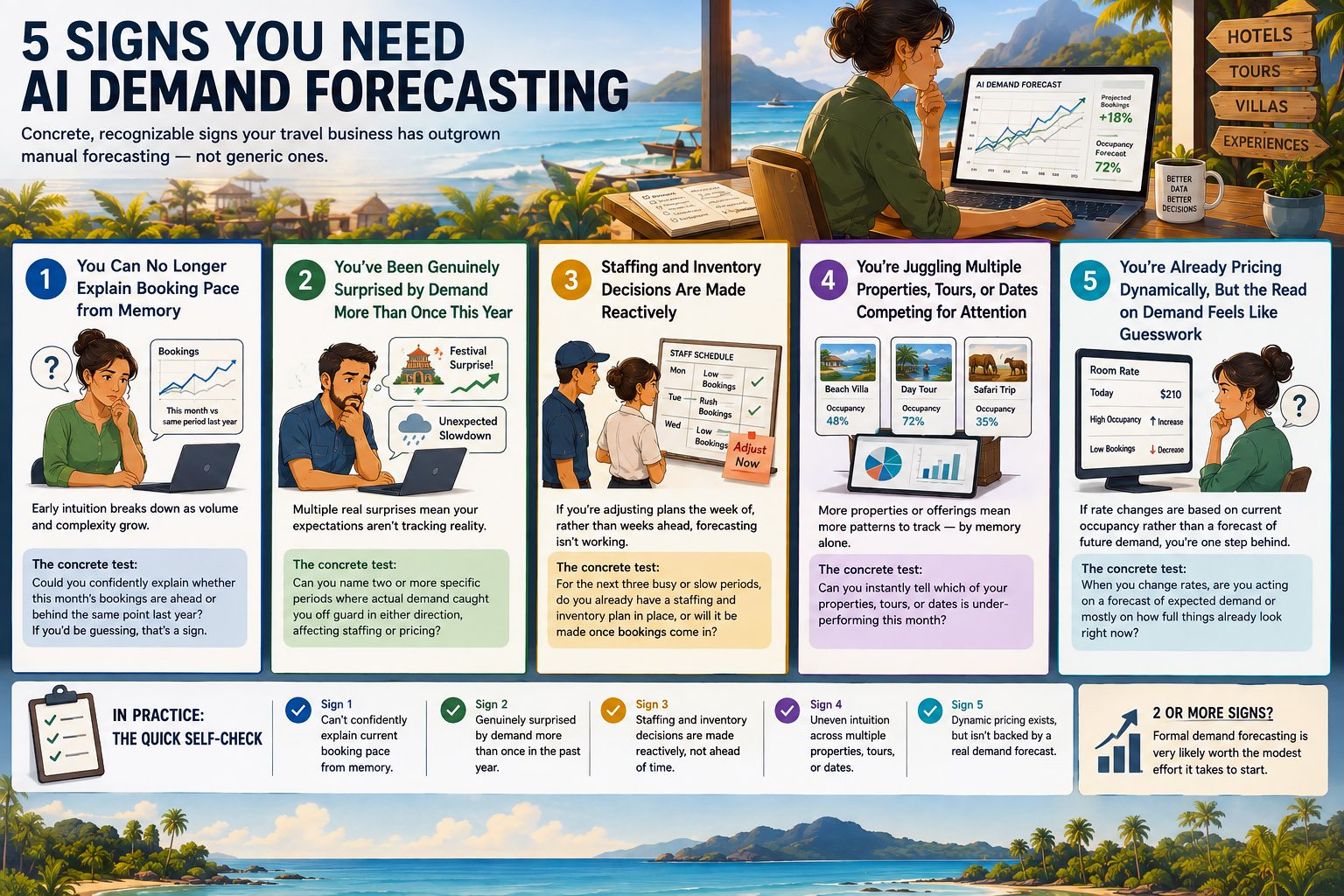
An owner reads about demand forecasting, nods along, and closes the tab with the same unresolved question: does this actually apply to my business, or is it something for operations bigger than mine? That question deserves a direct answer, not a vague “it depends.” Below are five concrete, recognizable signs — not generic ones like “you want to grow” — that a travel or hospitality business has genuinely outgrown informal, memory-based forecasting.
Why This Question Matters
Adopting forecasting too early wastes effort on a system more sophisticated than your actual decisions require. Waiting too long means staffing, inventory, and pricing decisions keep getting made reactively, after the fact, instead of ahead of it — and that gap compounds quietly, season after season, in ways that are easy to blame on “an off year” rather than a forecasting gap.
The cost of getting this timing wrong isn’t dramatic. It’s a slow accumulation of missed staffing calls, mistimed pricing, and inventory decisions made a few weeks too late to matter.
Sign 1: You Can No Longer Explain Booking Pace from Memory
Early on, most owners can explain their booking patterns intuitively — “we always fill up two weeks out,” “weekends book faster than weekdays.” That intuition works until the business has enough volume, enough properties, or enough offerings that the pattern stops being something one person can hold in their head accurately.
The concrete test: if you tried to explain, right now, whether this month’s bookings are running ahead of or behind the same point last year, could you answer with real confidence, or would you be guessing based on a general feeling? If it’s the latter, that’s the first sign — not because guessing is unreasonable at a smaller scale, but because the business has likely grown past the point where a gut feeling is reliably accurate.
Sign 2: You’ve Been Genuinely Surprised by Demand More Than Once This Year
Every business gets the occasional surprise — a slow week that shouldn’t have been slow, a rush nobody predicted. One surprise a year is normal. Multiple genuine surprises, where actual demand diverged meaningfully from what you expected going in, is a different signal.
One surprise is bad luck. Three surprises in a year, all in different directions, means your expectations aren’t actually tracking reality — and no amount of good luck fixes that going forward.
The concrete test: think back over the past twelve months. Can you name two or more specific periods where actual demand caught you off guard, in either direction, badly enough to affect staffing or pricing decisions after the fact? If yes, that’s a real, recurring pattern worth addressing rather than a run of bad luck.
Sign 3: Staffing and Inventory Decisions Are Made Reactively
This is one of the clearest practical signs, because it shows up in daily operations rather than abstract numbers. If staffing gets adjusted the week of, rather than weeks ahead, based on how bookings are actually landing — and if that reactive adjustment happens more often than not — the business is operating without a working forecast, whether or not anyone’s called it that.
The concrete test: for your next three known busy or slow periods, do you already have a staffing and inventory plan in place, or will that plan get made once you see how bookings actually come in? If it’s consistently the latter, the business has reached the point where reactive planning is costing real time and, often, real money in rushed decisions.
Sign 4: You’re Juggling Multiple Properties, Tours, or Dates Competing for Attention
A single property or a single tour offering is manageable by memory and intuition for a long time. The moment a business is running several properties, several tour products, or many simultaneous date-based offerings, the cognitive load of tracking each one’s demand pattern individually exceeds what any person can reasonably hold in their head, even an experienced one.
The concrete test: if asked right now which of your properties, tours, or dates is underperforming its typical pattern this month, could you answer immediately for all of them, or only for the one or two you happen to be thinking about? If coverage is uneven — strong intuition for your flagship offering, genuine uncertainty about the rest — that unevenness itself is the sign.
Sign 5: You’re Already Pricing Dynamically, But the Read on Demand Feels Like Guesswork
Some businesses adopt dynamic pricing before they’ve built real forecasting underneath it — adjusting rates based on current occupancy and a rough sense of the calendar, without a genuine read on where demand is actually heading. This works, to a point, but it’s pricing reactively to what’s already happened rather than pricing ahead of what’s likely to happen.
The concrete test: when you raise or lower a rate, is that decision based on a considered forecast of expected demand, or mostly on how full things already look right now? If it’s consistently the latter, your pricing is one step behind where it could be, and formal forecasting is the missing layer underneath it.
In Practice: The Quick Self-Check
- Sign 1: Can’t confidently explain current booking pace from memory.
- Sign 2: Genuinely surprised by demand more than once in the past year.
- Sign 3: Staffing and inventory decisions are made reactively, not ahead of time.
- Sign 4: Uneven intuition across multiple properties, tours, or dates.
- Sign 5: Dynamic pricing exists, but isn’t backed by a real demand forecast.
If two or more of these are true, formal forecasting is very likely worth the modest effort it takes to start.
How These Signs Show Up Differently by Business Type
A hotel typically notices Sign 1 and Sign 3 first — booking pace across room types becomes hard to track by feel, and staffing gets scheduled reactively around occupancy that’s already materialized rather than anticipated. A tour operator running multiple daily departures tends to notice Sign 4 earliest — attention naturally gravitates to the most popular tour, while less-watched offerings drift without anyone quite noticing until a season underperforms. A DMC juggling multiple simultaneous client itineraries and group quotes often notices Sign 2 first — genuine surprises in how quickly quotes convert to bookings, which affects how confidently the business can commit to arrangements with local partners ahead of time.
Recognizing which sign tends to show up first for your specific business type is often a useful shortcut — it points to where a first, modest forecasting habit would pay off fastest.
What Happens If You Ignore These Signs
Nothing dramatic happens immediately, which is exactly why these signs are easy to ignore for a season or two longer than they should be. What accumulates instead is a slow tax: staffing costs that run slightly higher than necessary because decisions are made a week later than they could be, pricing that’s a step behind actual demand, and a nagging sense that the business is somehow underperforming its potential without a clear diagnosis of why.
The businesses that wait longest to address these signs aren’t in crisis. They’re just quietly leaving a percentage of achievable revenue on the table every single season, without ever seeing it as a single, nameable loss.
What If Only One or Two Signs Apply?
Not every sign needs to be true for forecasting to be worthwhile, and it’s fair to be honest about the reverse too — if only one applies, and mildly, a simple, informal tracking habit may be all that’s needed for now rather than a formal system.
These signs aren’t a pass/fail test. They’re a way to be honest with yourself about whether your business’s actual complexity has outgrown the informal approach that used to work fine.
Sign 3 (reactive staffing) and Sign 5 (pricing without a real forecast underneath it) tend to be the two with the clearest immediate cost, so if either is strongly true on its own, that’s usually enough to justify starting, even if the others are more borderline.
What to Do Once You Recognize the Signs
If two or more of these signs sound familiar, the next reasonable step is understanding what demand forecasting actually involves and what it would realistically look like for a business your size — AI demand forecasting explained covers what it is, what inputs it needs, and why it’s more than just comparing this year to last year’s numbers. If you’d rather talk through your specific situation directly, how AI revenue management consulting works walks through what that conversation and process actually looks like.
Common Mistakes When Responding to These Signs
The most common mistake is waiting for a dramatic, undeniable failure before acting — most businesses that would benefit from forecasting have been showing these signs quietly for a season or two before anyone names them explicitly. A close second is overcorrecting once the signs are recognized, jumping straight to a sophisticated algorithmic system before establishing even the basic habit of tracking bookings, lead time, and known one-off events. The simpler starting point almost always serves a business better than an ambitious system built before the underlying data discipline exists to support it.
In Practice: What to Track So You Catch These Signs Early
- Bookings and lead time by date, so Sign 1 and Sign 5 become answerable rather than felt.
- A running note of any demand surprise, positive or negative, so Sign 2 becomes a countable pattern instead of a vague memory.
- A simple weekly staffing-and-inventory review, so Sign 3 gets caught before it becomes the default mode of operating.
- A shared view across all properties, tours, or dates, so Sign 4 doesn’t hide in whichever offering currently has the most attention.
Frequently Asked Questions
Do I need all five signs to be true before I should act? No — two or more, especially if they include reactive staffing decisions or pricing without a real forecast underneath it, is usually enough signal to justify starting.
What if I only recognize one sign, but it’s a strong one? A single strong, recurring sign — especially reactive staffing or genuine repeated demand surprises — can be reason enough on its own, even without the others being clearly true yet.
Is this only relevant for larger operations? No — a single-property business with growing complexity (more tour offerings, more source markets, more date-based products) can show these signs well before it reaches any particular size threshold.
How do I start if I recognize the signs but have no forecasting system at all? Begin with simple, disciplined record-keeping — bookings, lead time, and known one-off events — before considering any dedicated tool; that habit alone addresses much of what these signs point to.
Could these signs point to a different problem instead of a forecasting gap? Possibly — inconsistent staffing, for instance, could also stem from a scheduling or communication problem rather than a forecasting one. It’s worth ruling out simpler operational fixes before assuming a data or forecasting gap is the root cause.
How quickly should I expect things to improve once I start forecasting? Expect gradual improvement over a few seasons rather than an immediate fix — forecasting accuracy compounds with consistent tracking, and the first attempt is rarely the most accurate one.
Do these signs apply the same way to a brand-new business? Less so at first — a business needs at least a season of real data before most of these signs become meaningful; in the very early days, simply starting to track bookings and lead time matters more than diagnosing these specific signs.
What if different signs point in different directions — some say yes, some say no? That’s common and worth taking seriously rather than averaging out — a strong Sign 3 (reactive staffing) alone is often reason enough to start, even if other signs are more ambiguous.
Final Thoughts
The honest test isn’t whether your business is “big enough” for demand forecasting — it’s whether you can still explain your own booking patterns with real confidence, or whether you’ve quietly been guessing and calling it intuition. If two or more of the signs above sound familiar, that’s not a judgment on how you’ve run things so far — it’s simply a signal that your business has grown into a level of complexity where a bit more structure will pay for itself.
This fits within the broader picture of AI revenue and demand management and AI for the travel industry as a whole.
Last updated: August2026