An owner has read enough to recognize the signs — reactive staffing, pricing a step behind demand, surprises that keep repeating. She’s ready to act, but “revenue management consulting” is vague enough that she’s not sure what she’d actually be buying: software, a person dictating rates, or something else.
Here’s a straight answer: it’s a process, not a product — assessment, prioritization, build, adoption — ending with your own team running a system they trust, not a subscription nobody understands. This piece walks through what each stage actually involves and what outcomes are realistic to expect.
An owner has read enough by now to recognize the signs — reactive staffing, pricing that feels a step behind actual demand, surprises that keep repeating. She’s ready to do something about it, but “revenue management consulting” is a vague enough phrase that she’s not sure what she’d actually be buying: a piece of software, a person who tells her what rates to set, or something else entirely.
That confusion is reasonable, because the term gets used loosely. Here’s a straight answer: it’s a process, not a product — one that ends with your business having both a working pricing and forecasting system and a team that actually trusts and uses it, rather than a subscription nobody fully understands.
The Real Question Behind This
Most owners considering this aren’t really asking “what does a consultant do.” They’re asking whether this is worth the investment compared to continuing to manage pricing and staffing by intuition, or buying a piece of software and figuring it out alone.
A revenue management engagement is worth it when your business has real complexity a spreadsheet can’t keep up with. It’s not worth it if the honest answer is that you just haven’t gotten around to a simple set of pricing rules yet.
If your business is small enough that a disciplined, manually-maintained set of rules would cover most of the value — as covered in the pieces on AI dynamic pricing and demand forecasting — that’s worth trying first. Consulting earns its cost once complexity, data volume, or the stakes of getting pricing wrong have grown past what a business can reasonably self-manage.
What This Actually Is
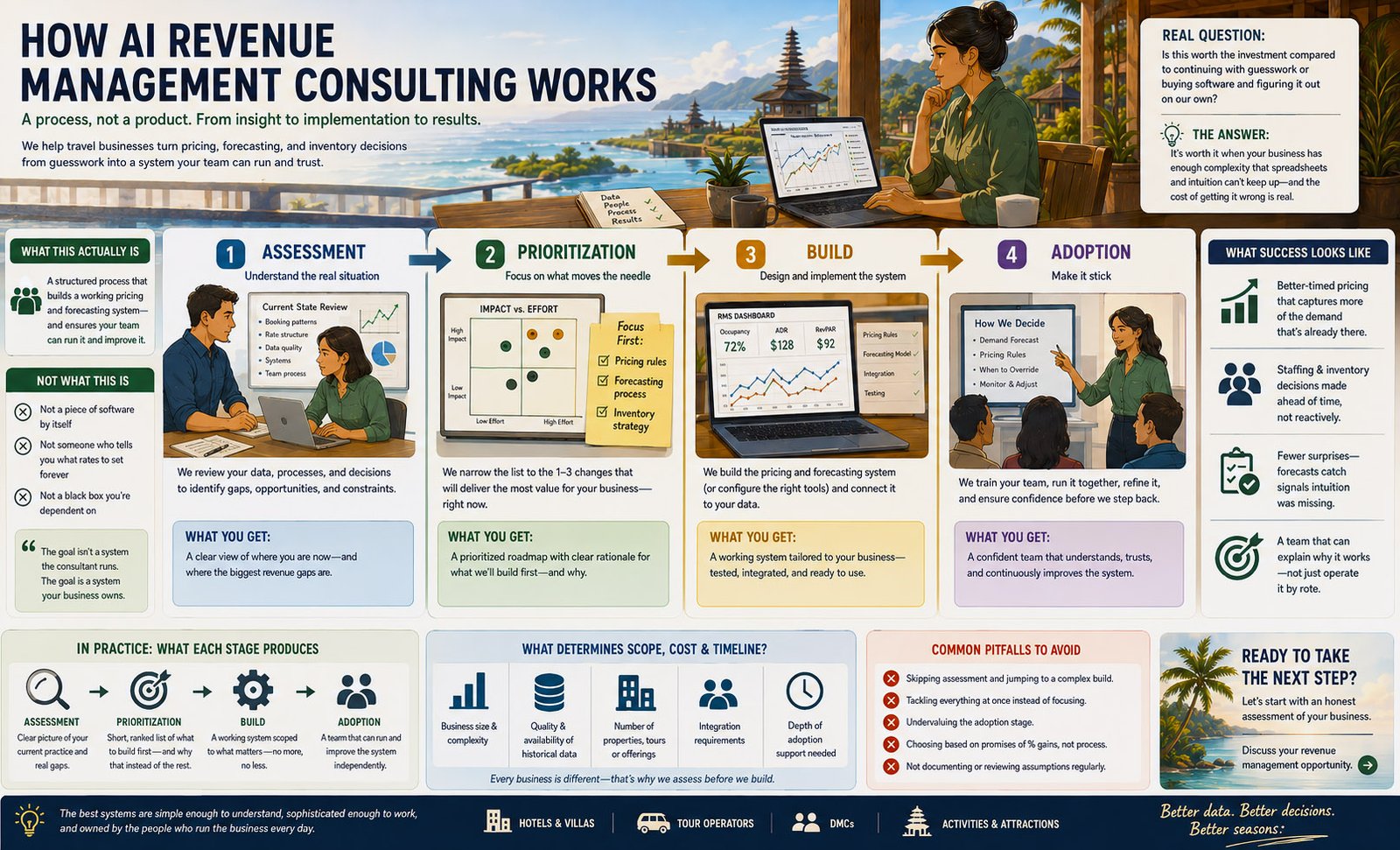
Strip away the vague language, and a revenue management consulting engagement is a structured process that takes a business from wherever its current pricing and forecasting practice sits — whether that’s nothing formal at all, or a partially-working spreadsheet system — to a working setup the business’s own team can run and trust going forward. It’s not a black box a consultant manages forever; the goal is a system and a set of skills that stay with your business.
The Engagement Process, Stage by Stage
Most well-run engagements follow a recognizable shape, even though the specific work varies by business.
Assessment comes first — understanding your actual current pricing and forecasting practice, your data (however informal), your booking patterns, and where the real gaps are. This stage is more conversation and data review than construction, and it’s the stage most often rushed by consultants eager to start building.
Prioritization narrows the work to what actually matters most for your business — not every possible pricing and forecasting improvement, but the two or three that would move the needle most given your specific situation.
Build is where the actual system gets constructed — whether that’s a well-structured set of pricing rules, a forecasting log and process, or a more sophisticated tool, depending on what the assessment and prioritization stages determined was actually warranted.
Adoption is the final and often most consequential stage: making sure your team understands, trusts, and will actually keep using what’s been built, long after the engagement ends.
In Practice: What Each Stage Actually Produces
- Assessment produces a clear picture of your current pricing and forecasting practice and where the real gaps are — not a sales pitch for a specific tool.
- Prioritization produces a short, ranked list of what’s actually worth building first, given your business’s specific complexity and stakes.
- Build produces a working system — rules, a forecasting process, or software — scoped to what prioritization determined, not the most sophisticated option available.
- Adoption produces a team that can run and adjust the system themselves, with a clear plan for what happens once the engagement ends.
What Assessment Actually Involves
This stage typically means reviewing your existing booking and rate history (however organized or disorganized), talking through how staffing and pricing decisions currently get made, and being honest about where intuition is working well versus where it’s been producing surprises. A good assessment doesn’t assume you need a sophisticated system — it’s entirely possible the honest conclusion is that a simpler, self-managed approach would serve you better, and a consultant who skips straight past this possibility isn’t doing the assessment properly.
What Prioritization Actually Involves
Assessment usually surfaces more potential improvements than are worth tackling at once — a business might genuinely benefit from better pricing rules, more disciplined forecasting, and clearer inventory management all at the same time, but trying to build all three simultaneously usually means none of them get the attention needed to actually work. Prioritization is the deliberate narrowing of that list to the one or two changes that matter most given your specific situation.
The businesses that get the most value from this kind of engagement aren’t the ones that tackle everything at once. They’re the ones willing to fix the single biggest gap first and prove it works before adding the next one.
This stage should produce a clear, specific answer to “what are we actually building first, and why this instead of the other options the assessment surfaced” — not a vague commitment to “improve revenue management” broadly.
What Build Actually Involves
The build stage varies more than any other, because it depends entirely on what the first two stages determined. For some businesses, “build” means formalizing a set of pricing rules and a forecasting log your own team can maintain — genuinely lightweight, and appropriately so. For others with more complexity, it means implementing and configuring more sophisticated forecasting or pricing software, connected to existing booking systems. The build stage should never look more sophisticated than what the assessment actually justified.
What Adoption Actually Involves
Most revenue management engagements that fail to deliver lasting value don’t fail at the build stage. They fail here, when the consultant leaves and the system quietly stops being used because no one on the team ever fully trusted or understood it.
Adoption means training your team not just on which buttons to press, but on the reasoning behind the rules or the forecast — why a certain occupancy threshold triggers a rate change, what to do when the forecast and reality diverge, when to override the system and when to trust it. A good engagement builds in a defined handoff period where the team runs the system with support available, before the consultant steps back entirely.
What Outcomes to Reasonably Expect
Exact results depend heavily on your starting point and how much complexity your business genuinely has, but the realistic shape of improvement usually shows up in three places: better-timed pricing that captures more of the demand that was already there, staffing and inventory decisions made ahead of time rather than reactively, and fewer genuine surprises because the forecast is catching signals a gut-feeling approach was missing.
In Practice: What “Success” Actually Looks Like
- A pricing and forecasting process your team runs confidently, without needing to call a consultant for routine decisions.
- Fewer reactive, last-minute staffing and inventory scrambles, because decisions are made ahead of the date rather than in response to it.
- A measurable, if modest, improvement in average rate captured — not a dramatic transformation, but a real, sustained gain.
- A team that can explain why the system works, not just operate it by rote.
Be cautious of any engagement promising dramatic, specific percentage gains upfront — a responsible consultant will describe the kind of improvement to expect in general terms until they’ve actually assessed your specific situation, rather than quoting a number before understanding your business.
What Determines Cost and Timeline in Your Specific Case
The scope of assessment, the complexity of the build, and how much adoption support is needed all vary by business size, how much historical data already exists in usable form, and how many properties, tours, or offerings are involved. A single-property business with a season or two of clean data is a meaningfully smaller engagement than a multi-property operation with fragmented, disorganized historical records. Exact cost and timeline get worked out once these specifics are understood in the assessment stage, rather than quoted blind beforehand.
Common Pitfalls
The most common pitfall is skipping straight to a sophisticated build without a genuine assessment — a consultant (or a business eager to move fast) implementing an impressive-sounding system before establishing whether the business’s actual complexity justifies it. A close second is under-investing in the adoption stage, treating it as a brief handoff meeting rather than the sustained effort it actually requires to build real staff trust and understanding. The quieter pitfall is choosing a consultant based on confident promises of specific percentage gains rather than a clear, honest description of the assessment process — that confidence is often a sign the assessment stage is being skipped rather than respected.
How to Know You’re Ready
In Practice: Signs You’re Ready to Start
- You’ve recognized real complexity or recurring surprises in your own pricing and forecasting, not just a general sense that “we should modernize.”
- You have at least some historical booking data, even if imperfectly organized — the assessment stage can work with this, but not with nothing at all.
- Your team has bandwidth to be genuinely involved in the adoption stage, not just to receive a finished system.
- You’re prepared for an honest assessment, including the possibility that a simpler, self-managed approach is the right conclusion.
Frequently Asked Questions
Do I need to already have dynamic pricing or forecasting in place before starting? No — many engagements start from nothing formal at all. The assessment stage is designed to work with whatever your current practice actually is.
How long does a typical engagement take? It varies with scope, but expect the assessment and prioritization stages to take real time upfront — rushing them is the most common reason a build ends up mismatched to the business’s actual needs.
What happens after the engagement ends? A well-run engagement leaves your team able to run and adjust the system independently, with a clear understanding of when it might be worth revisiting — not an ongoing dependency on the consultant.
Can this work for a business with only one property or tour offering? Yes, though the engagement is typically smaller in scope — a single-property business often needs a lighter assessment and a simpler build than a multi-property operation.
What if the assessment concludes I don’t actually need a sophisticated system? That’s a legitimate and valuable outcome — a good consultant will say so rather than building something more complex than your business warrants just to justify the engagement.
How do I know if a consultant is being realistic about outcomes? Be wary of specific percentage gains promised before an assessment has happened — a responsible consultant describes likely improvement in general terms until they’ve actually reviewed your business’s data and complexity.
Is this different from just buying revenue management software? Yes — software alone doesn’t address whether your team will actually understand, trust, and correctly use it. Consulting is specifically the process of getting from software or rules to a system your business genuinely runs well.
What if the assessment identifies more improvements than we can tackle right now? That’s expected and normal — prioritization exists specifically to narrow a longer list to the one or two changes worth building first, rather than attempting everything at once.
Do we need to commit to the full four-stage process upfront, or can we start smaller? Most engagements can start with just the assessment stage, which gives you a clear picture of your situation before committing further — it’s reasonable to decide after that stage whether to continue.
Final Thoughts
The owner from the opening isn’t buying a piece of software or handing over pricing decisions to an outside party — she’s investing in a process that ends with her own team confidently running a system that fits her business’s actual complexity, no more and no less. That’s the honest shape of what “AI revenue management consulting” should mean.
If the signs described elsewhere on this site sound familiar and you’re ready to talk through what an assessment would actually look like for your business, discuss your revenue management opportunity and we’ll start from an honest look at where things stand today. This fits within the broader picture of AI revenue and demand management and AI for the travel industry as a whole.
Last updated: August2026