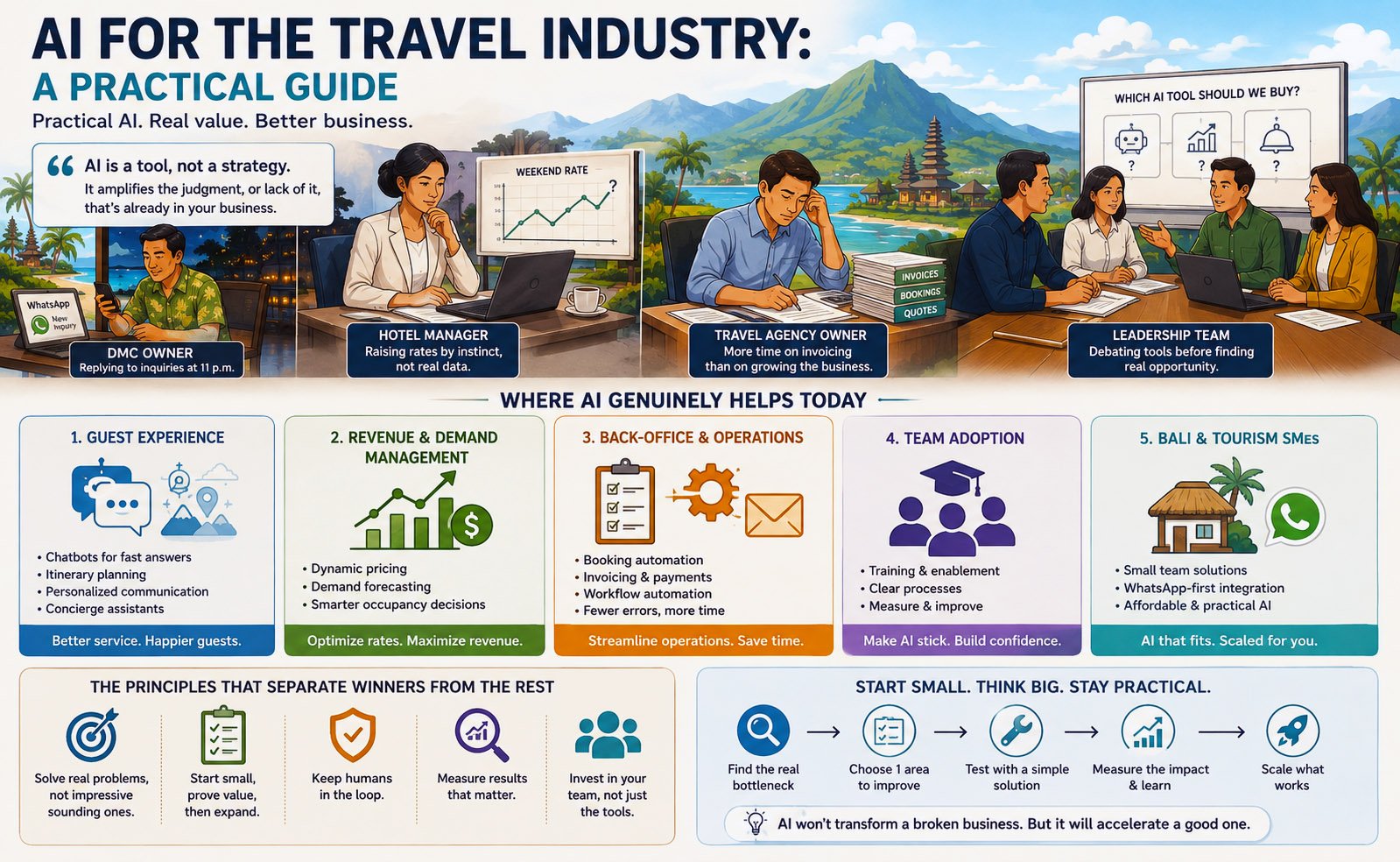
A DMC owner in Sanur is still replying to WhatsApp at 11 p.m. A hotel manager raises her rate by instinct, not data. A travel agency owner spends more evenings on invoicing than sales calls. A leadership team debates which tool to buy before asking where their real opportunity is. Four different problems, one honest fix away from a better answer.
This is a grounded guide to that conversation: where AI actually helps a travel business today, where it’s overhyped, and why “AI is not the strategy — better business is” isn’t a slogan, it’s the whole point.
A DMC owner in Sanur is still replying to WhatsApp inquiries at 11 p.m. A hotel manager raises her weekend rate by instinct, without really knowing if it’s the right call. A travel agency owner spends more evening hours on invoicing than on the sales calls that grow his business. A leadership team debates which AI tool to buy before anyone’s asked where their business’s actual opportunity is. Four different businesses, four different corners of the travel industry — and all four are one honest conversation away from a genuinely better answer than the one they’re currently working with.
This is a practical guide to that conversation. Not a list of impressive-sounding AI capabilities, and not a warning that AI will transform your business overnight. Just a grounded map of where AI actually helps a travel business today, where it’s overhyped, and what separates the businesses that get real value from it from the ones left with an abandoned subscription and a skeptical team.
AI Is Not the Strategy. Better Business Is.
This is worth stating plainly before anything else, because it’s the idea every other section of this guide comes back to: AI is a tool, not a strategy. A business that already runs well — that understands its guests, prices thoughtfully, keeps its admin under control, and has a team that adapts well to change — will get real value from AI applied to specific, well-chosen problems. A business hoping AI will paper over deeper issues — unclear positioning, inconsistent service, a team that’s already stretched too thin — usually finds that AI just makes the underlying problem faster and more visible, not solved.
The businesses that get the most out of AI aren’t the most technologically sophisticated ones. They’re the ones who were already disciplined about understanding their own operations, and simply pointed that discipline at a new set of tools.
Every section below assumes this framing. AI doesn’t replace good judgment about your business — it amplifies whatever judgment, or lack of it, is already there.
Where AI Genuinely Helps Today: An Honest Map
Travel and hospitality businesses today see real, grounded value from AI in four broad areas, plus a fifth consideration specific to smaller, tourism-vertical operations like those common in Bali.
| Area | What it actually addresses |
|---|---|
| Guest experience | Chatbots, itinerary planning, personalized communication, concierge assistants |
| Revenue & demand management | Dynamic pricing and demand forecasting |
| Back-office & operations | Booking, invoicing, admin, and workflow automation |
| Team adoption | The discipline that determines whether any of the above actually sticks |
| Bali & tourism SMEs | The same fundamentals, scaled for small-team, WhatsApp-first operations |
These aren’t ranked by importance — the right starting point depends entirely on your business’s actual bottleneck, not a universal order. What follows is a grounded summary of each, with the honest tradeoffs that most generic “AI for travel” content skips.
Guest Experience: Beyond the Chatbot
Most conversations about AI and travel start and end with chatbots, which undersells what’s actually available and overstates what a chatbot alone can do. Guest experience AI is really four related but distinct layers: chatbots for fast, first-response answers to repetitive questions; itinerary planning tools that handle structural drafting while leaving local judgment and timing to a person; personalized communication that uses what a guest actually told you, transparently, rather than reaching for inferred details that feel invasive; and concierge assistants that coordinate genuinely complex, multi-step requests.
Each layer has its own honest tradeoff. A chatbot that’s over-scoped erodes guest trust the first time it confidently answers wrong. An itinerary tool that skips a human logistics review can send a guest into a poorly-timed trip with your business’s name on it. Personalization that stacks too many inferred details into one message reads as surveillance, not service. And a concierge assistant launched without real testing either buries staff in escalations or mishandles a request that actually mattered. AI for guest experience covers all four layers in depth, including how they connect and where each one’s real risk sits.
Revenue & Demand Management: Pricing and Forecasting Done Right
The second major area is less visible to guests but often has an equally direct effect on the bottom line: dynamic pricing and demand forecasting. Dynamic pricing means adjusting rates based on real demand signals rather than a static rate set once and left alone — and it scales down further than most owners assume, starting with a handful of clear, manually-set rules rather than a sophisticated algorithm. Demand forecasting means predicting future booking patterns based on more than just “what happened last year” — accounting for calendar shifts, booking pace, competitor changes, and one-off events a simple year-over-year comparison would miss entirely.
The honest caveat here matters more than most content acknowledges: both practices improve with more historical data and more disciplined tracking, and a business hoping to skip straight to a sophisticated system without that underlying discipline usually ends up with something that looks impressive and performs poorly. AI revenue and demand management walks through both practices in plain terms, with real guidance on where smaller operators should and shouldn’t invest.
Back-Office & Operations: The Unglamorous High-Value Layer
This is the area that gets the least attention in AI marketing and often delivers the most reliable return. Booking confirmations, invoicing, and payment follow-ups are repetitive, structured, and — critically — lower-risk to automate than anything touching the guest relationship directly, because a mistake here is usually caught and corrected before it ever reaches a client. For agencies and DMCs specifically, the challenge is rarely a lack of things to automate; it’s a lack of a method for choosing which workflow is actually worth automating first, rather than whichever feels most urgent or most impressive to describe.
The honest distinction that runs through this whole area: invoicing mistakes are financial and costlier to unwind than a wrong chatbot answer, which is why a human check stays in the loop longer here than it does for lower-stakes tasks. automating back-office travel operations covers realistic automation of booking and invoicing, a genuine framework for finding which workflow has the most leverage, concrete quick wins for time-poor solo operators, and what a real automation project actually involves from start to finish.
Team Adoption: Why This Determines Everything Else
This is the area most likely to be skipped entirely, and it’s arguably the one that determines whether any of the previous three actually deliver value. A tool bought before understanding the actual problem, rolled out with a single announcement and no ongoing support, chosen because a competitor has something similar — these are the specific, recognizable patterns behind most stalled AI adoption in travel businesses, and none of them are technology failures.
Most AI projects that fail in travel and hospitality don’t fail because the tool didn’t work. They fail because nobody planned for the four things that actually determine adoption: understanding the real opportunity, choosing it deliberately, testing it against real cases, and training a team to actually trust it.
A real adoption roadmap has four stages — opportunity assessment, prioritization, rollout, and team enablement — and skipping or rushing any one of them tends to undermine the others. building an AI adoption roadmap covers what each stage actually involves, the specific, recognizable mistakes that derail adoption, what realistic training looks like, and what actually drives the cost of getting outside help.
A Note on Bali and Tourism SMEs Specifically
Everything above holds broadly across the travel industry, but it plays out differently for a small, WhatsApp-first operation than it does for a hotel chain or an enterprise travel platform. A Bali DMC, villa management company, or tour operator typically runs on a small team wearing multiple roles, with guest communication happening almost entirely through WhatsApp and Instagram rather than email or a booking portal’s internal messaging — and generic global AI-for-tourism advice, built around a call center and a marketing department, usually doesn’t fit that reality well.
The fundamentals don’t change — start narrow, keep a human check on anything financial, build team trust before expanding scope — but the starting point, the budget, and the pace look meaningfully different at this scale. AI for Bali DMCs and tour operators covers the specific realities of running an AI project as a small Bali tourism business — budget, staffing, seasonality — and where each type of business should genuinely start.
In Practice: How These Five Areas Connect
- Team adoption isn’t a fifth, separate project — it’s the discipline that determines whether guest experience, revenue management, and back-office AI actually deliver value once built.
- Back-office automation is often the safest first project, since mistakes are lower-stakes and easier to catch, which builds organizational confidence before tackling guest-facing work.
- Revenue management depends on genuine forecasting discipline, which itself depends on the same honest record-keeping habits that make back-office automation work well.
- The Bali-specific guidance isn’t a separate philosophy — it’s the same fundamentals, deliberately scaled down for a small-team, WhatsApp-first reality.
Where AI Is Overhyped
It’s worth being just as direct about where the marketing outpaces the reality, because a guide that only tells you where AI helps isn’t actually useful for making decisions.
Fully autonomous guest-facing AI — a system that handles every guest interaction without human oversight — is oversold for the vast majority of travel businesses. The businesses getting real value from guest-facing AI keep a human in the loop for anything ambiguous, complex, or emotionally charged, and the marketing promising a fully hands-off system tends to underdeliver badly once it meets a guest request the training data didn’t anticipate. Similarly, “AI-powered revenue optimization” that promises dramatic percentage gains without first understanding your specific business’s data and complexity is a red flag more than a promise — a responsible approach describes likely improvement only after a genuine assessment, not before one.
The most overhyped claim in travel AI isn’t about any specific technology — it’s the implicit promise that adopting AI is itself a strategy. It isn’t. It’s a tool that makes an already-good strategy execute faster, and makes a bad one fail faster too.
Sophisticated, fully-integrated systems in general are oversold to businesses that would get most of the available value from a much simpler starting point — a rules-based pricing system, a templated invoicing workflow, a narrow FAQ chatbot. The gap between “impressive-sounding” and “actually useful for a business your size” is one of the most consistent patterns across every area covered in this guide.
Common Myths Worth Retiring
A few specific claims come up often enough in travel AI marketing that they’re worth addressing directly, since believing them tends to lead straight into the mistakes covered throughout this guide.
“AI will replace the need for local expertise.” It won’t, and the areas where this is most obviously false — itinerary planning, personalized guest recommendations, anything involving genuine local knowledge — are exactly where AI’s role is drafting a starting point, not making the final call.
“Bigger, more sophisticated tools are always better.” They’re not, at least not as a starting point — a narrow, well-tested tool that a team actually trusts consistently outperforms an ambitious system nobody fully understands or uses correctly.
“If a competitor has it, we need it too.” Sometimes true, often not — the better question is whether your own business has the specific problem that tool addresses, confirmed through your own assessment rather than assumed from someone else’s adoption.
“Once it’s built, adoption takes care of itself.” This is the single most consistently wrong assumption across every area of this guide — a technically working tool with no training, no ongoing review, and no clear ownership fails to deliver value just as often as a poorly-built one.
In Practice: A Quick Reality Check Before Any AI Purchase
- Would you still want this if no competitor had it? If not, you may be chasing hype rather than a confirmed need.
- Can you name the specific workflow or problem this addresses, based on your own observation? If not, you haven’t finished the assessment stage yet.
- Is someone specifically responsible for training and ongoing review, or is adoption being left to chance? If the latter, that’s worth fixing before anything is purchased, not after.
- Is the sophistication of this tool actually matched to your team’s readiness to use it, or is it more advanced than your business currently needs?
The Common Thread Across Every Success Story on This Site
Every genuinely successful AI project described across the guest experience, revenue management, back-office, and adoption content on this site shares the same shape, regardless of which specific tool or workflow was involved: start narrow, test against real cases before trusting broadly, keep a human check where the stakes are real, and build team trust deliberately rather than assuming adoption will simply happen once a tool exists.
None of these four principles is exciting to describe. None of them requires sophisticated technology. All four are, in practice, the actual difference between an AI project that delivers real, lasting value and one that quietly gets abandoned within a season — which circles back to the opening framing: AI is not the strategy. The discipline to apply it narrowly, test it honestly, and adopt it deliberately is.
A Composite Year Across a Whole Business
Picture a mid-sized hotel group a year after approaching AI with this whole picture in mind, rather than chasing one impressive-sounding project.
Guest experience started narrow: a chatbot handling five repeat questions, tested and refined for weeks before wider rollout, paired with a modest pre-arrival personalization layer using only what guests had explicitly shared. Revenue management started with simple, disciplined pricing rules and an honest forecasting log — no sophisticated algorithm, just consistent record-keeping and a weekly review. Back-office automation targeted the highest-leverage workflow an honest audit revealed, which turned out to be supplier confirmations rather than anything guest-facing. And every one of these projects moved through the same four-stage adoption process — understanding, prioritizing, building and testing, and genuinely training the team — rather than skipping straight to a purchase.
None of these four projects, on their own, would make for a dramatic case study. Together, a year later, the hotel group had measurably reduced admin hours, pricing that better reflected actual demand, a guest messaging system staff genuinely trusted, and — because the first projects succeeded — real organizational appetite to keep going. That’s the realistic shape of “AI for the travel industry” done well: not a transformation story, just a series of modest, well-tested improvements that compounded.
Common Mistakes When Approaching AI for Travel Broadly
The most common mistake, across every area covered in this guide, is starting with a tool instead of a problem — buying something because it seems impressive or because a competitor has it, rather than because an honest look at your own operations identified a real opportunity. A close second is treating “AI for guest experience,” “AI for revenue management,” and “AI for back-office” as one undifferentiated initiative rather than related but distinct decisions, each with its own risk profile and starting point. The quieter mistake, and the one this whole site returns to repeatedly, is skipping team adoption — building something that works technically and never building the trust and training that determines whether a team actually keeps using it.
Every failure pattern in this guide traces back to the same root: skipping the boring, unglamorous thinking — what’s the real problem, is this actually the right tool, will my team trust this — in favor of the exciting part, which is buying and building something.
How to Know Where to Start
In Practice: Choosing Your Starting Point
- If guests routinely wait too long for simple answers, guest experience is likely your starting point — specifically the chatbot layer, scoped narrow.
- If pricing and staffing decisions are made reactively, by instinct rather than a genuine read on demand, revenue and demand management is worth starting with.
- If admin work is eating hours that should go toward growing the business, back-office automation — starting with the highest-leverage workflow, not the most visible one — is the right place to look.
- If you’ve tried AI before and it stalled, the honest starting point is adoption, not a new tool — understanding what specifically went wrong before trying again.
There’s no universally correct order — the right first project is whichever area maps to your business’s actual, current bottleneck, not whichever sounds most exciting to announce.
How These Areas Typically Unfold Over Time
Businesses that engage seriously with AI over a year or more tend to follow a recognizable arc, even though the specific starting point varies. Early on, the focus is usually narrow and defensive — fixing a specific, visible pain point, often in back-office admin or a single guest-facing workflow, with heavy human oversight and modest ambitions. As that first project proves itself and the team builds genuine comfort with testing and adjusting AI tools, scope typically widens — a second workflow, then a third, each benefiting from lessons the first project taught about testing, training, and review.
The businesses further along this arc aren’t the ones who started with the most ambitious project. They’re the ones who let an early, modest success build the organizational muscle for everything that came after.
Later still, businesses that have built this muscle often start connecting previously separate projects — a forecast informing pricing, a chatbot’s escalation patterns informing what a concierge assistant should eventually handle, admin automation freeing up the attention needed to properly test a more ambitious guest-facing project. This is a multi-season process for most businesses, not a single initiative with a defined end date, and expecting it to move faster than that is one of the more common sources of frustration with AI adoption in travel.
What This Actually Costs
Cost varies enormously depending on scope — a narrow, templated first project in any of these areas is genuinely inexpensive to test, often within weeks; a fully integrated, multi-system build is a considerably larger investment, and rarely where a business should start regardless of size. Rather than a single figure, which would be misleading given how much scope varies, the honest approach is understanding what actually drives cost within whichever area you’re considering — the specific breakdowns for revenue management consulting and general AI consulting cover this in real detail, without inventing a number that wouldn’t mean much without knowing your specific business.
Getting Started
In Practice: A Realistic First Step
- Spend a week honestly observing where your team’s time and money actually go, rather than assuming you already know your biggest bottleneck.
- Pick one narrow opportunity within one of the five areas above, not an ambitious, multi-area initiative.
- Test it against real cases from your own business before trusting it broadly — a real guest inquiry, a real invoice, a real pricing decision, not a hypothetical scenario.
- Plan for team adoption from the start, not as an afterthought once the build is finished — this single habit is the clearest predictor of whether a project actually lasts.
Frequently Asked Questions
Where should a business genuinely new to AI actually start? Wherever your honest, current bottleneck is — not wherever sounds most exciting. Back-office automation is often the lowest-risk starting point precisely because mistakes there are easier to catch before they matter.
Is AI adoption really different for a small business versus a large chain? The fundamentals are the same, but the scale, budget, and pace differ meaningfully — a small business should generally start narrower and simpler than a large chain’s version of the same project, not attempt to match enterprise-scale sophistication from day one.
How do I know if a specific AI vendor’s promises are realistic? Be wary of specific, dramatic outcome claims made before any real understanding of your business — a responsible vendor or consultant asks detailed questions before promising results, not the other way around.
Should guest experience or back-office automation come first? There’s no universal answer, but back-office automation is often the safer, faster-to-prove-out first project, since the stakes of a mistake are lower and more contained than anything guest-facing.
How much of this can a business do without outside help? A meaningful amount — honest self-assessment, simple pricing rules, basic templated automation, and initial team training can often be handled internally, especially for smaller businesses. Outside help tends to be most valuable for keeping an assessment honest and for more complex builds or integrations.
What’s the biggest single predictor of whether an AI project in travel actually succeeds? Whether team adoption was planned for from the start — more than the specific tool, the specific vendor, or even the specific problem chosen, a genuine training and adoption plan is the clearest differentiator between projects that last and ones that quietly fade.
Does this guide apply to airlines and large OTAs, or just smaller operators? The core principles apply broadly, but this guide is written primarily for the scale most travel businesses actually operate at — hotels, villas, DMCs, tour operators, and travel agencies — rather than the enterprise scale of airlines or major OTAs, which face additional complexity beyond this guide’s scope.
How do I avoid chasing hype instead of a genuine need? Ask whether you’d still be pursuing a given AI project if a competitor hadn’t adopted something similar — if the honest answer is no, that’s worth pausing on before committing real time and budget.
Is there a risk in waiting too long to start with AI? Some, particularly around competitive response time and staffing efficiency, but the greater and more common risk is starting too fast, on the wrong problem, without a plan for adoption — a delayed, well-planned first project usually outperforms a rushed, poorly-scoped one.
What if I’ve already tried AI once and it didn’t work? That’s genuinely common, and recoverable — an honest look at what specifically went wrong (the wrong tool, no training, no ongoing review) usually reveals a clear, achievable path to a better second attempt, covered in more depth in the adoption roadmap content.
How long does it realistically take to see the benefits described in this guide? A narrow first project can show measurable results within weeks. The fuller picture — multiple areas working together, real organizational comfort with testing and adopting AI tools — typically develops over a year or more, not a single quarter.
Should a business tackle guest experience, revenue management, and back-office automation all at once, since they’re all covered in this guide? No — this guide covers all five areas for completeness, not as a checklist to work through simultaneously. Choosing one, proving it, and letting that success inform the next is consistently more effective than spreading effort across several at once.
Is there a risk that AI adoption becomes a permanent, never-ending project with no clear finish line? In a sense, yes — the businesses that do this well treat it as an ongoing discipline rather than a project with a defined end date, similar to how good pricing or good guest service is never really “finished.” That’s not a downside; it’s simply what sustained improvement looks like.
Final Thoughts
The DMC owner, the hotel manager, the travel agency owner, and the leadership team from the opening aren’t facing a technology problem. They’re facing the same question every business in this guide is ultimately answering: where does AI genuinely help my specific operation, and am I willing to do the unglamorous work — honest assessment, narrow scope, real testing, genuine team training — that determines whether it actually sticks.
AI is not the strategy. It never was. Better business — understanding your guests, your numbers, your admin, and your team well enough to know exactly where a tool would help — is the strategy, and always has been. AI, applied to that understanding with real discipline, is simply one of the more useful tools available for executing it well.
Last updated: August 2026