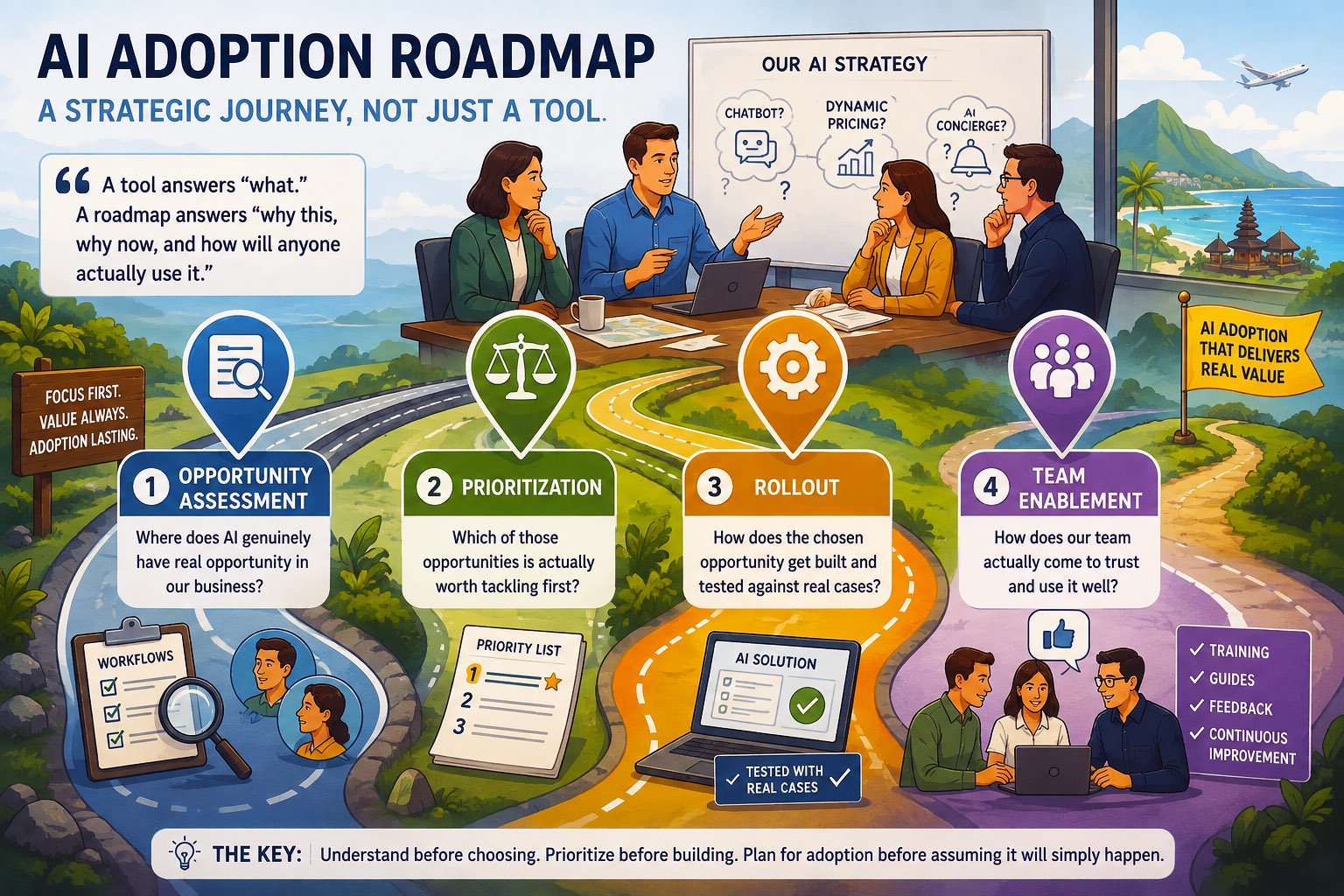
A leadership team sits down to discuss “our AI strategy,” and within minutes the conversation drifts to specific tools — a chatbot, dynamic pricing, a concierge assistant a competitor mentioned. Nobody’s wrong to be excited. But they’ve skipped the actual first question: not which tool, but where AI genuinely fits, in what order, and how the team will actually use it.
Grounded in one idea — the most valuable AI solutions are rarely the most complicated — this piece walks through what a realistic roadmap contains: opportunity assessment, prioritization, rollout, team enablement.
A leadership team sits down to discuss “our AI strategy” and the conversation drifts, within minutes, toward specific tools — should we get a chatbot, is dynamic pricing worth it, what about that concierge assistant a competitor mentioned. Nobody’s wrong to be excited about any of these. But the conversation has skipped the actual first question: not which tool, but where does AI genuinely fit in our business, in what order, and how will our team actually come to use it well.
That’s what an adoption roadmap is for, and it’s worth saying plainly upfront what this whole site is built around: the most valuable AI solutions are rarely the most complicated ones. A roadmap isn’t a plan for building something impressive. It’s a plan for finding the specific, often unglamorous place where AI would genuinely help, and getting your team to a point where they trust and use it — which turns out to be a harder and more valuable problem than choosing a tool ever was.
Why This Is Bigger Than Buying a Tool
Most businesses that struggle with AI adoption didn’t fail because the technology didn’t work. They failed because they skipped the thinking that determines whether a tool addresses a real problem and whether a team will actually use it. A roadmap exists specifically to prevent that — not by adding bureaucracy, but by making sure the sequence is right: understand before choosing, prioritize before building, and plan for adoption before assuming it will simply happen.
A tool answers “what.” A roadmap answers “why this, why now, and how will anyone actually use it.” Most failed AI projects skipped straight to the tool and never answered the other three questions.
The Roadmap in Overview: Four Stages
A realistic AI adoption roadmap has four stages, each answering a distinct question a leadership team needs to get right in order.
| Stage | What it answers |
|---|---|
| Opportunity assessment | Where does AI genuinely have real opportunity in our business? |
| Prioritization | Which of those opportunities is actually worth tackling first? |
| Rollout | How does the chosen opportunity get built and tested against real cases? |
| Team enablement | How does our team actually come to trust and use it well? |
These aren’t independent projects — each stage’s output is the next stage’s input, and skipping or rushing any one of them tends to undermine everything that follows.
Opportunity Assessment
This stage means taking an honest inventory of where your business’s real bottlenecks and repetitive tasks actually are — not a brainstorm of impressive-sounding AI use cases pulled from a generic article, but a grounded look at what your team actually does, where time gets lost, and where mistakes or delays cost the most. This is more observation and conversation than construction: reviewing real workflows across departments, talking to the staff who actually do the work, rather than assuming leadership already knows where the friction is.
The output is a realistic, business-specific list of opportunities — not a plan yet, just an honest picture grounded in your actual operations. For a deeper look at exactly what this stage produces and why skipping it is the most common reason AI projects fail, what an AI adoption roadmap actually is covers this stage, along with prioritization, in more depth.
Prioritization
Opportunity assessment almost always surfaces more possibilities than are worth pursuing at once. Prioritization is the deliberate, sometimes uncomfortable narrowing of that list — weighing each opportunity against how much time or money it could realistically save, how repetitive and well-defined the underlying task is, how risky it would be if the automation got something wrong, and how ready your team actually is to adopt something new in that specific area.
The businesses that get real value from AI aren’t the ones with the longest opportunity list. They’re the ones willing to rank that list honestly and commit to the top one or two, rather than trying to tackle everything at once.
This stage should produce a specific, defensible answer to “what are we actually doing first, and why this instead of the other options” — not a vague commitment to “improving efficiency with AI” that could apply to any business in any industry.
Rollout
This is where the actual system gets built and tested — a template system, a drafting assistant, a more integrated tool, whatever the previous two stages determined was actually warranted. Testing means running it against real cases from your business, not hypothetical scenarios, with a person reviewing results closely before trusting it more broadly. A well-scoped rollout is deliberately narrower than “automate the whole department” — one workflow, proven, before the next.
Rollout should also produce clarity on scope boundaries: exactly which cases the system handles, and which get routed to a person, rather than a vague expectation that it will “handle guest communication” broadly without a clear line drawn anywhere.
Team Enablement
This is the stage most roadmaps that exist only on paper get wrong, because it’s about people, not technology, and it’s the one most often compressed into a single announcement email. Real enablement means training built around your team’s actual scenarios, not generic examples; a clear, known channel for questions and flagged problems; and a scheduled check-in in the weeks after launch specifically to catch quiet reversion before it becomes permanent.
Most roadmaps that stall don’t fail at the build stage. They fail here, when the system works fine technically and quietly stops being used because the team never fully trusted or understood it.
training hospitality teams to use AI covers what genuinely effective enablement looks like in practice — executive briefings, hands-on workshops built around real scenarios, and the ongoing support layer most businesses skip.
In Practice: How the Four Stages Connect
- Assessment feeds directly into prioritization — you can’t rank opportunities you haven’t honestly identified first.
- Prioritization determines rollout scope — the chosen opportunity, not everything on the original list, gets built.
- Rollout and enablement should be planned together, not sequentially — a rollout plan without a training plan attached is only half a plan.
- Enablement’s feedback should inform the next round of prioritization — what you learn from one rollout usually reveals what’s worth tackling next.
Grounded in “The Most Valuable AI Solutions Are Rarely the Most Complicated”
It’s worth dwelling on this idea directly, because it shapes every stage above in a specific way. A sophisticated, fully-integrated AI system sounds more impressive than a simple templated tool — but sophistication isn’t the goal, and chasing it before the simpler version has proven its value is one of the more reliable ways to waste a roadmap’s effort.
The instinct to build the most capable version of a tool from day one is usually the wrong instinct. The most valuable version is the one your team will actually understand, trust, and keep using.
This shows up concretely at every stage: opportunity assessment should surface the boring, high-volume, repetitive workflows alongside the exciting guest-facing ones, and often the boring ones turn out to matter more. Prioritization should resist the pull toward whichever opportunity sounds most impressive to describe at a leadership meeting. Rollout should start narrower than feels satisfying, proving value on a small scope before expanding. And enablement should be built around whatever level of sophistication your team can actually absorb and trust, not the most advanced version a vendor is willing to sell.
Learning From What Goes Wrong
Even a well-designed roadmap can go wrong in predictable, recognizable ways — buying a tool before the assessment stage is genuinely complete, chasing hype instead of a confirmed internal need, skipping enablement because the build felt like the finish line, or rolling out too much at once instead of proving one narrow scope first. common AI adoption mistakes covers these patterns in detail, including how they tend to compound rather than occur in isolation, and what recovering from a failed first attempt actually looks like if your business has already been through this once.
What It Costs to Do This Properly
A roadmap done well isn’t necessarily an expensive undertaking, and the honest cost depends heavily on which stages you’re paying for outside help with and how complex your business’s specific situation is. A strategy and assessment engagement, a workflow build, and team enablement are genuinely different scopes of investment, and comparing quotes without understanding which of these you’re actually being quoted for is one of the most common ways businesses misjudge cost. how much AI consulting costs breaks down the real drivers of cost across each stage, without inventing a number that wouldn’t mean much without knowing your specific business anyway.
A Composite Year
Picture a mid-sized hotel group a year after committing to this four-stage process rather than jumping straight to a tool purchase.
The opportunity assessment, done honestly across departments, surfaced something the leadership team hadn’t expected — a supplier and vendor communication workflow was costing more staff time than the guest-facing gaps everyone had assumed would be the priority. Prioritization confirmed it: high volume, highly repetitive, and costly when delayed. Rollout built a narrow, templated system for that specific workflow, tested against real supplier interactions for several weeks before wider use. Enablement meant a short executive briefing so department heads could explain the change confidently, a hands-on workshop using the team’s actual supplier correspondence, and a named staff member checking in on usage for the first month.
A year in, the hotel group hadn’t built anything that would make for an exciting case study. They had a system their team actually trusted, real hours back, and — because the first project succeeded — genuine appetite to tackle a second one.
That second project, once it started, moved noticeably faster than the first — not because the technology got easier, but because the team already understood what a well-run rollout felt like.
Common Mistakes Across the Whole Process
The most common mistake, across every stage, is treating the roadmap as a formality to move through quickly on the way to choosing a tool, when the roadmap’s thinking is the actual work that determines whether the tool succeeds. A close second is running one or two stages well and then rushing the rest — a solid assessment and prioritization followed by a rushed rollout and no real enablement plan is still, functionally, a failed process, even though half of it was done properly. The quieter mistake is treating the roadmap as a one-time document rather than something revisited — priorities shift as a business changes, and a roadmap frozen in time stops reflecting the business it was built for.
Measuring Whether the Roadmap Is Actually Working
Success isn’t “we completed all four stages” — it’s whether the chosen opportunity is delivering real, measurable value, and whether your team trusts the system enough to keep using it without ongoing pressure to do so.
In Practice: Signals Worth Tracking
- Measurable time or cost savings on the specific workflow the roadmap targeted — not a vague sense of improvement, an actual before-and-after comparison.
- Usage that holds steady or grows after the first month, rather than quietly declining once the initial launch attention fades.
- Staff describing the tool in practical terms — “it saves me time on X” — rather than vague or hesitant answers when asked how it’s going.
- A clear, evidence-based sense of what to prioritize next, since a successful first rollout usually reveals the next-highest-opportunity workflow.
If these signals are present, that’s the moment to revisit prioritization and consider the next opportunity. If they’re not, the honest response is to look back at which of the four stages was rushed or skipped, rather than assuming the whole idea of adoption roadmaps doesn’t work for your business.
Staffing and Ownership
A roadmap’s stages don’t run themselves, and every one of them depends on someone actually being responsible for it — an assessment nobody owns doesn’t get revisited, a rollout nobody’s testing against real cases doesn’t get caught when it drifts, an enablement plan nobody’s checking on quietly becomes an announcement email again.
In Practice: Assigning Real Ownership
- Name a specific owner for the opportunity assessment, even if it’s a shared effort — someone needs to be responsible for making sure it happens and stays honest.
- Name a specific owner for prioritization decisions, so the reasoning behind what got chosen is clear and defensible to the rest of the team.
- Name a specific owner for rollout testing, responsible for reviewing real cases before wider use begins.
- Name a specific owner for ongoing enablement and review, since this is the stage most likely to quietly lose its owner once the initial excitement fades.
How This Fits the Bigger Picture
An adoption roadmap is the process that determines whether any AI project — in guest experience, revenue management, or back-office operations — actually succeeds, rather than a separate category of AI use on its own. See AI for the travel industry overview for the full landscape, including AI for guest experience, AI revenue management, and back-office automation — a roadmap is the discipline that makes any of those three actually work in practice rather than staying a good idea that never gets properly adopted. If your business operates specifically in Bali’s tourism sector, the same fundamentals apply at a different scale, with different starting priorities and constraints — see AI for Bali tour operators for that version of the picture.
How to Know You’re Ready to Start
In Practice: Readiness Signs
- Your leadership team is having “which tool should we buy” conversations before having “where’s our actual opportunity” conversations — recognizing this pattern is itself a sign you’re ready for a more deliberate process.
- You can commit real time to an honest opportunity assessment, involving the staff who actually do the work, not just leadership’s assumptions about it.
- You’re prepared for prioritization to point somewhere other than what feels most exciting — the boring, high-leverage workflow is often the right first choice.
- Someone can own each of the four stages specifically, including the enablement stage that most roadmaps quietly lose track of.
Frequently Asked Questions
How long does a full roadmap process actually take? It varies with business size and complexity, but a focused opportunity assessment and prioritization exercise often takes one to two weeks, with rollout and enablement timelines depending heavily on what gets chosen — considerably faster overall than most leadership teams expect.
Do we need to complete all four stages before seeing any value? No — value typically starts showing up during rollout, once the first narrow build is tested and working, well before the broader roadmap process is “complete” in any formal sense.
Can a small business or solo operator use this same four-stage structure? Yes, though it’s usually much lighter and faster — the same four questions apply at any scale, even if a solo operator’s version takes days rather than weeks.
What if our leadership team disagrees about prioritization? Bring the disagreement back to the actual criteria — volume, repetition, cost of delay or error, team readiness — rather than letting it become a matter of differing intuitions or preferences.
How often should a roadmap be revisited? At least annually, or after any significant change in team size, technology, or business priorities — a roadmap that’s never revisited stops reflecting the business it was built for.
Is it possible to do this without any outside help? Many businesses can run assessment and prioritization internally, especially with a smaller team — outside help is often most valuable for keeping the process honest and for the training and enablement stage specifically.
What’s the single biggest predictor of whether a roadmap actually leads to lasting adoption? Whether team enablement was genuinely planned for from the start, rather than treated as an afterthought once the build was finished — this is the stage most correlated with long-term success or quiet failure.
How do we avoid over-engineering the first project? Keep returning to the idea that the most valuable solution is rarely the most complicated one — if the scope keeps expanding before the narrow version has even launched, that’s worth catching before it undermines the whole rollout.
Should every department go through this process at the same time? Generally no — starting with one department or workflow area and proving the approach tends to build the organizational trust and evidence that makes a second, broader effort go faster and more smoothly.
What’s the relationship between a roadmap and the specific AI applications covered elsewhere on this site, like guest experience or revenue management? The roadmap is the process; guest experience, revenue management, and back-office automation are the possible destinations — the opportunity assessment stage is what determines which of those areas, or which specific workflow within them, is actually worth your business’s first roadmap cycle.
How do we keep a roadmap from becoming just another document that sits unused? Tie it to real, scheduled check-ins and named ownership at every stage, as covered above — a roadmap without assigned accountability tends to suffer the same fate as the tools it was meant to guide.
Is it normal for the opportunity assessment to reveal something leadership didn’t expect? Very common, and usually a good sign — it means the assessment is grounded in real observation rather than confirming assumptions leadership walked in with.
Final Thoughts
The leadership team from the opening didn’t need a faster answer to “which tool should we buy.” They needed the four questions a real roadmap forces: where’s the actual opportunity, what’s genuinely worth doing first, how does it get built and tested properly, and how will the team actually come to trust it. None of that is complicated in the technical sense — it’s disciplined, and it’s the discipline, not the sophistication of any particular tool, that determines whether AI adoption actually sticks.
That’s the honest core of this whole pillar: the most valuable AI solutions really are rarely the most complicated ones, and a roadmap’s entire purpose is helping a leadership team find that simpler, better-fitted answer before spending time and trust on the wrong one.
Last updated: August 2026