An owner has visited five consultants’ websites looking for a straight answer on price, and found the same thing five times: “contact us for a custom quote.” Frustrating, but understandable — and this piece gives the honest version those pages skip.
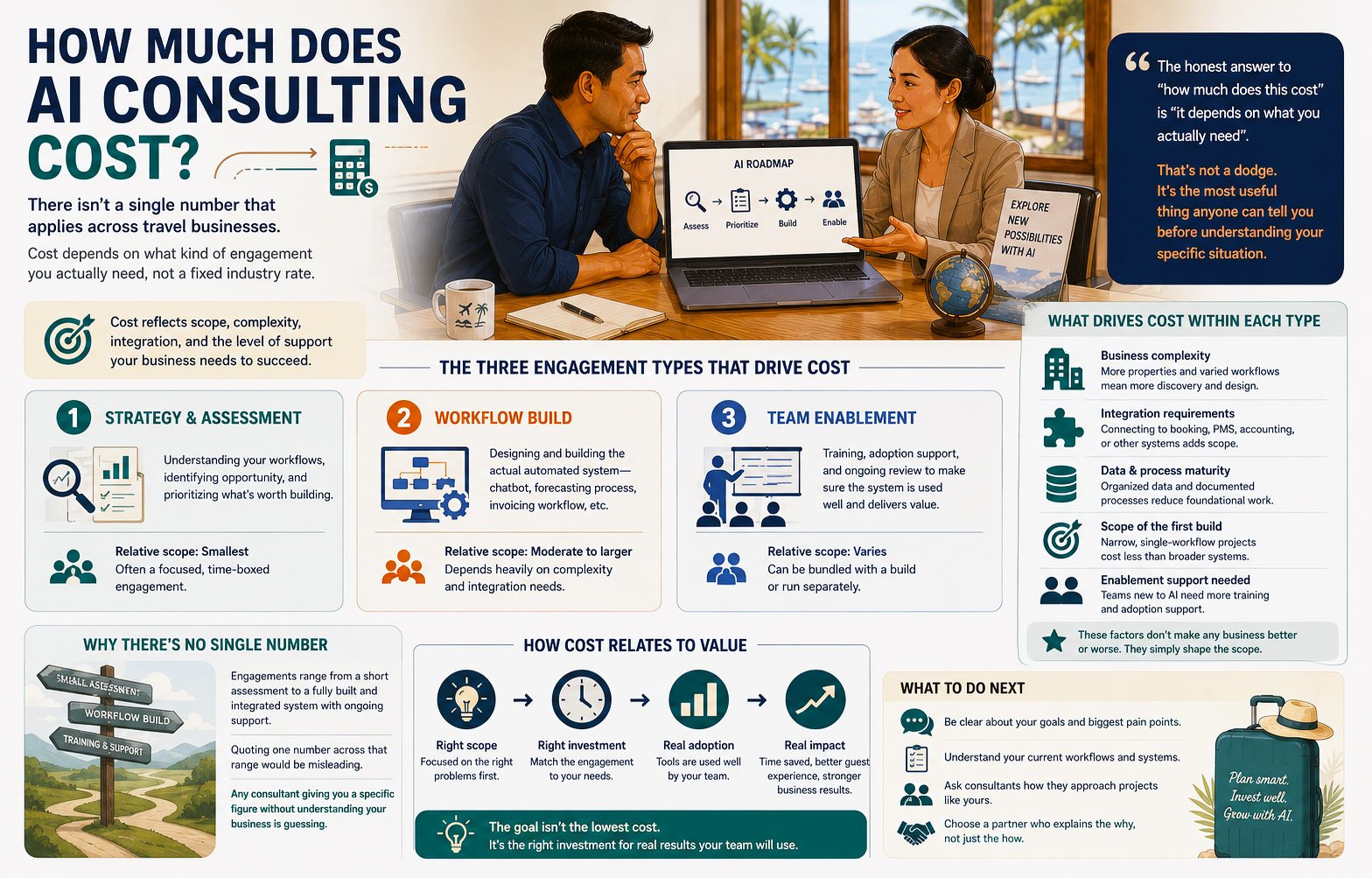
There’s no single number, because it depends on which of three engagement types you actually need: strategy and assessment, a workflow build, or team enablement. This breaks down what genuinely drives cost within each — without inventing a figure, and without pretending a fake “starting from” price is somehow more honest than admitting it depends.
An owner has visited five different consultants’ websites looking for a straight answer on price, and found the same thing five times: “contact us for a custom quote.” Frustrating, but understandable once you know why — and this piece is here to give the honest version of what most of those pages skip, which is what actually determines the number, even without providing the number itself.
Here’s the straight answer upfront: there isn’t a single figure that applies across travel businesses, because the cost of AI consulting depends heavily on what kind of engagement you actually need, not on some fixed industry rate. What follows is a transparent breakdown of what drives cost, so you can reason about your own likely range before ever getting on a call — and exact numbers should come directly from a conversation about your specific business, not a generic pricing page.
The Real Question Behind This
Most owners asking “how much does this cost” are really asking a more specific question: is this going to be a manageable investment for a business my size, or something that only makes sense for a much larger operation? That’s a fair question, and it deserves a real answer rather than either a made-up number or an evasive non-answer.
The honest answer to “how much does this cost” is “it depends on what you actually need” — and that’s not a dodge, it’s the most useful thing anyone can tell you before understanding your specific situation.
Why There’s No Single Number
AI consulting spans a wide range of possible engagements, from a short assessment conversation to a fully built and integrated system with ongoing support. Quoting one number across that entire range would be misleading regardless of which number was chosen — too low for a complex, multi-property build, too high for a single-property business that just needs a lightweight starting point. Any consultant giving you a specific figure before understanding your business is either guessing or padding the number to cover a range they haven’t actually assessed.
The Three Engagement Types That Drive Cost
Cost varies most fundamentally by which type of engagement you actually need, and these map to genuinely different scopes of work.
| Engagement type | What it involves | Relative scope |
|---|---|---|
| Strategy and assessment | Understanding your workflows, identifying opportunity, prioritizing what’s worth building | Smallest — often a focused, time-boxed engagement |
| Workflow build | Designing and building the actual automated system — a chatbot, a forecasting process, an invoicing workflow | Moderate to larger — depends heavily on complexity and integration needs |
| Team enablement | Training, adoption support, and ongoing review to make sure a built system actually gets used well | Varies — can be bundled with a build or run separately |
A business might reasonably start with just the first type — a strategy and assessment engagement — to get clarity before committing to anything larger, or move through all three in sequence for a more complete project.
What Drives Cost Within Each Type
Beyond which engagement type you need, several specific factors shape the actual scope and therefore the cost within that type.
Business complexity — a single-property business with straightforward operations is a smaller engagement than a multi-property operation with varied workflows across each location.
Integration requirements — a project that only needs to draft messages for a human to send is simpler than one that needs to connect directly to an existing booking, accounting, or property management system.
Current data and process maturity — a business with organized historical data and documented processes needs less foundational work than one starting from scratch.
Scope of the first build — a narrow, single-workflow project (one chatbot use case, one invoicing template) costs less than a broader system handling multiple workflows at once.
How much enablement support is needed — a team that’s used similar tools before typically needs less training investment than one adopting AI for the first time.
None of these factors is inherently better or worse to have. They just mean two businesses asking “how much does this cost” can reasonably get quite different answers, both honestly.
In Practice: Questions That Help Determine Your Likely Cost
- How many properties, tours, or offerings does this need to cover — one, or several with different workflows each?
- Does this need to integrate with existing systems, or can it start as a standalone tool a human reviews before acting on?
- How organized is your current data and documentation — ready to work with, or needing to be built up first?
- Is this your team’s first AI tool, or do they already have some comfort with similar systems?
Why This Site Doesn’t List Specific Numbers
It would be easy to publish a price range here to seem more transparent, but doing so before understanding a specific business’s actual scope would mean either making up a number or anchoring expectations to a figure that may have little to do with your actual situation. That’s not the kind of transparency this site aims for — the honest version of transparency is explaining clearly what drives cost, which is what this article does, and reserving an actual figure for a conversation grounded in your real business.
The Difference Between Transparency and a Fake Number
There’s a meaningful difference between a consultant being transparent about pricing and a consultant publishing a specific-looking number that isn’t actually grounded in anything. A range like “starting from [amount]” without any explanation of what that starting scope includes is often less honest than no number at all, since it anchors an expectation the actual engagement may have little relationship to.
A specific number without context isn’t transparency. It’s a marketing device that happens to look like transparency.
Genuine transparency looks like what this article is trying to do instead: explaining the actual variables that determine cost, clearly enough that you can reason about your own likely situation, even without a number attached. If a consultant’s website gives you a specific figure with no explanation of what drives it up or down, that’s worth treating with some skepticism rather than taking at face value.
How to Get an Actual Number
The only reliable way to get a real cost estimate is a conversation that starts with understanding your specific situation — roughly the same assessment-style conversation that begins any well-run engagement in the first place. This isn’t a sales tactic to avoid answering the question; it’s the same honesty this whole site tries to practice about AI adoption generally: a good answer requires understanding the actual problem before proposing a solution, cost included.
In Practice: What to Bring to That Conversation
- A rough sense of your business’s size and complexity — number of properties, tours, or offerings, and how varied your workflows are across them.
- Whatever you already know about your biggest bottleneck, even if it’s just a general sense rather than a precise diagnosis.
- Any existing tools or systems that a new project might need to work alongside or integrate with.
- A realistic sense of your team’s capacity to be involved in testing and adoption, since this affects how much enablement support is worth building in.
Common Pitfalls When Evaluating Cost
The most common pitfall is comparing quotes from different consultants without confirming they’re actually scoped to the same engagement type — a strategy-only quote and a full build-and-enable quote will look very different, and comparing them directly is comparing two different things. A close second is choosing based on the lowest number without checking what’s actually included — a cheaper quote that excludes adoption support often costs more in the long run if the resulting tool never gets properly adopted, echoing exactly the mistakes covered in common AI adoption mistakes. The quieter pitfall is treating cost as the primary decision factor over fit — a consultant who takes the time to understand your specific business before quoting anything is a better signal than one who gives you a fast, generic number.
The consultant who asks you the most questions before mentioning a number is usually the one giving you the most honest one.
How to Know You’re Ready for This Conversation
In Practice: Signs You’re Ready
- You can describe, even roughly, what problem you’re trying to solve — not just a general interest in “doing something with AI.”
- You’ve thought about which of the three engagement types you likely need — just an assessment, a full build, or enablement for something already built.
- You’re prepared for the real answer to depend on specifics you haven’t fully worked out yet — that’s normal, and it’s exactly what an initial conversation is for.
- You’re evaluating based on fit and transparency, not just chasing the lowest quoted number.
Frequently Asked Questions
Can you at least give a rough range, even if not an exact number? Any range given without understanding your specific business would risk either misleading you or being so wide it’s not actually useful — an honest initial conversation is a better use of your time than an anchored, uninformative range.
Why do some consultants quote fast, specific numbers without much discussion? That can be a red flag rather than a sign of confidence — a number given before any real understanding of your business is either a rough guess or a padded figure meant to cover a range of possible scopes.
Is a strategy-only engagement worth doing separately, or should I go straight to a full build? For many businesses, a focused strategy and assessment engagement first is worth it specifically because it clarifies scope before committing to a larger build — this often makes the overall cost more predictable, not less.
Does team enablement always need to be a separate cost from the build? Not necessarily — some engagements bundle build and enablement together, while others separate them, particularly if a business wants to build first and handle training with existing internal resources.
How does business size affect cost most directly? Primarily through complexity and integration needs — a larger business isn’t automatically more expensive if it has one simple, well-defined problem, and a small business isn’t automatically cheap if it needs a system integrated across several booking and payment platforms.
What if I only have budget for the smallest possible engagement right now? Say so directly in the initial conversation — a good consultant can often scope a smaller starting engagement that still delivers real, honest value, rather than only offering an all-or-nothing option.
Should I expect ongoing costs after the initial engagement, or is it a one-time expense? This depends on the engagement type — a strategy-only project is typically one-time, while a built system often benefits from some ongoing review, which may or may not involve continued consultant involvement depending on how the enablement stage was handled.
Is it reasonable to ask for a rough estimate before committing to a full conversation? Yes — asking clarifying questions like the ones in this article, and sharing enough about your situation to get a genuinely useful rough sense, is reasonable; what’s less useful is a number given with no context at all.
How do I compare two quotes that seem to cover different things? Ask each consultant to break down specifically what’s included — assessment, build, integration, enablement — so you’re comparing like for like rather than assuming two very different scopes are the same because the final numbers happen to be close.
Final Thoughts
The honest answer to “how much does AI consulting cost” was never going to be a single number on this page, and any site that gives you one without knowing your business is guessing on your behalf. What actually matters is understanding the real drivers — engagement type, complexity, integration, and enablement needs — so you can walk into a real conversation with realistic expectations rather than an anchored number that may have nothing to do with your actual situation.
If you’re ready to get a real answer for your specific business, book an initial conversation and we’ll start with the same honest assessment that shapes every engagement here. This fits within the broader picture of AI adoption roadmaps for travel businesses and AI for the travel industry as a whole.
Last updated: August 2026