A boutique hotel owner watches a nearby chain change its rate three times in one week — up before a festival, down on a slow Tuesday, up again for a conference weekend. Her own rates haven’t moved in months. She wonders if “AI dynamic pricing” is only for operators with a revenue management department.
It isn’t — but it does look different at her scale. This piece breaks down how dynamic pricing actually works, what data it needs, and what’s realistic for a small hotel or tour operator versus a large chain.
A boutique hotel owner notices a nearby chain property changing its room rate three times in a single week — up before a local festival, down on a slow Tuesday, up again for a weekend with a conference in town. Her own rates haven’t changed in months. She wonders if she’s leaving money on the table, and whether “AI dynamic pricing” is something only a chain with a revenue management department can actually use.
That question — is this for me, or only for the big players — is the right one to start with, and the honest answer is more nuanced than either “you need this now” or “it’s not for you.” Dynamic pricing scales down further than most people expect, but not infinitely, and knowing where the realistic line sits matters more than the pricing technology itself.
Why This Decision Matters
Static pricing leaves money on the table in both directions — underpricing when demand is genuinely high, and overpricing when demand is soft and a lower rate would have filled rooms or seats that otherwise sat empty. Getting dynamic pricing right captures both sides of that gap. Getting it wrong — either through a poorly-tuned automated system or through hesitation that keeps a business stuck with static rates indefinitely — costs real revenue either way.
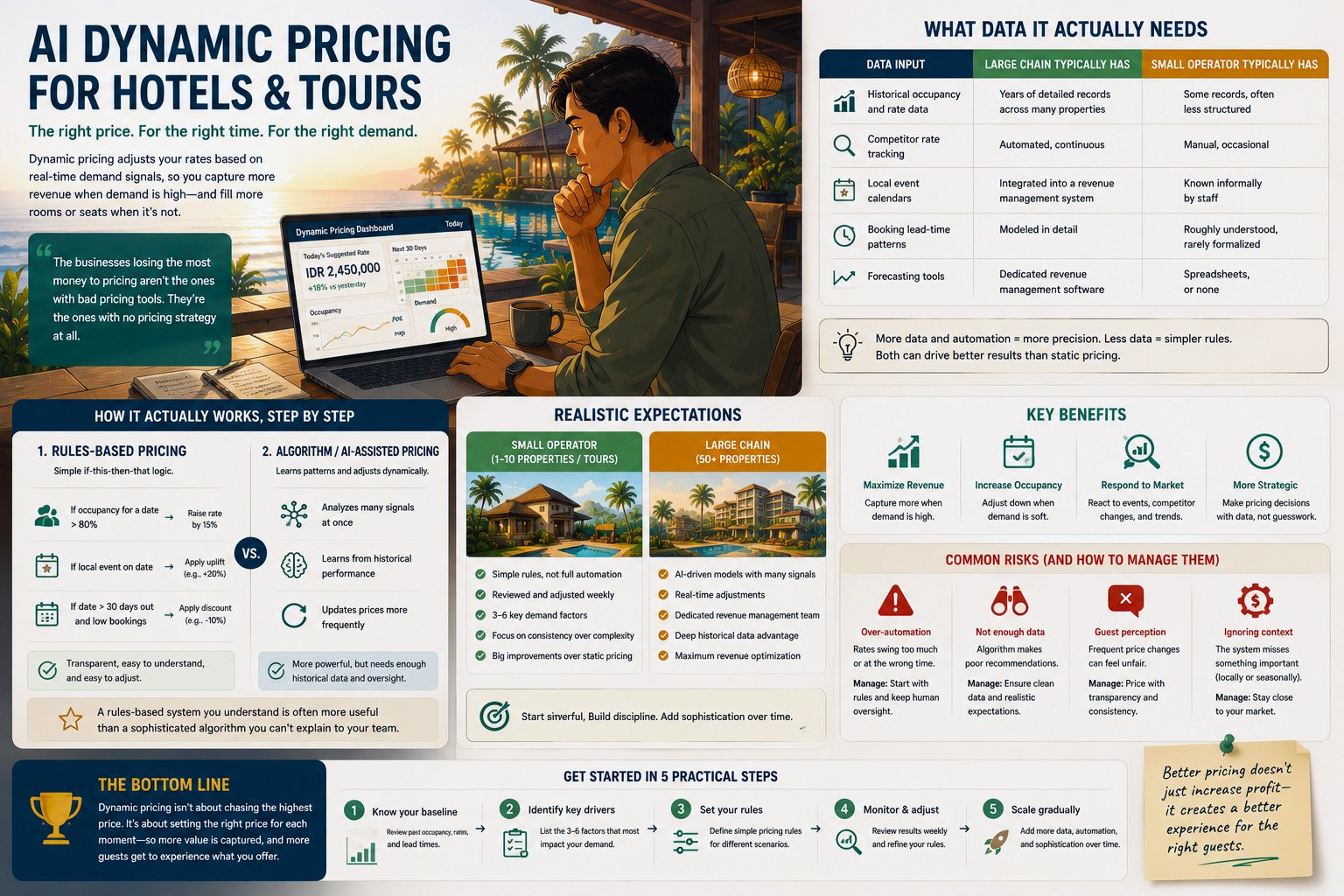
The businesses losing the most money to pricing aren’t the ones with bad pricing tools. They’re the ones with no pricing strategy at all, changing rates by gut feeling a few times a year.
That’s worth sitting with, because it reframes the real comparison: not “static pricing versus AI pricing,” but “an ad hoc, occasional pricing decision versus a disciplined, regularly-updated one” — and AI tools are one way, not the only way, to make that discipline easier to maintain.
What Dynamic Pricing Actually Is
Stripped of the mystique, dynamic pricing is the practice of adjusting a room or tour rate based on real-time or near-real-time demand signals, rather than setting one rate and leaving it for months. Those signals typically include how far in advance a booking is being made (lead time), how full the property or tour already is for that date (occupancy), what comparable properties are charging, whether there’s a local event driving demand, and the day of week or season.
None of this is inherently mysterious or manipulative — it’s the same logic an experienced hotelier has always used when quietly raising rates before a known busy weekend. What’s changed is that a system can track more signals, more consistently, and adjust faster than a person checking rates manually once a week.
What Data It Actually Needs
This is where the gap between a small operator and a large chain becomes concrete, and it’s worth being honest about it upfront.
| Data input | What a large chain typically has | What a small operator typically has |
|---|---|---|
| Historical occupancy and rate data | Years of detailed records across many properties | Some records, often less structured |
| Competitor rate tracking | Automated, continuous | Manual, occasional |
| Local event calendars | Integrated into a revenue management system | Known informally by staff |
| Booking lead-time patterns | Modeled in detail | Roughly understood, rarely formalized |
| Forecasting tools | Dedicated revenue management software | Spreadsheets, or none |
A large chain’s dynamic pricing runs on more data, more automation, and a dedicated team watching it. A small operator can still do real, effective dynamic pricing — it just looks like a simpler set of rules, applied consistently, rather than a fully automated system reacting in real time across hundreds of properties.
How It Actually Works, Step by Step
Dynamic pricing tools generally fall into two tiers, and knowing which one you’re actually being sold matters.
The first tier is rules-based pricing — a set of if-this-then-that logic: if occupancy for a given date crosses a threshold, raise the rate by a set amount; if a known local event falls on a date, apply a set uplift; if a date is more than a set number of days out with low bookings, apply a modest discount to encourage early bookings. This is transparent, easy to understand, and easy to adjust manually when something the rules didn’t anticipate comes up.
The second tier is algorithmic or AI-assisted pricing — a system that learns patterns from historical data and adjusts rates more dynamically, factoring in more signals at once than a person could reasonably track with simple rules. This is more powerful, but also more opaque, and it needs enough historical data to learn from before it can be trusted to run with less oversight.
A rules-based system you fully understand and can adjust by hand is often more useful for a small operator than a sophisticated algorithm you can’t explain to your own team.
Most small-to-mid hotels and tour operators are better served starting with the first tier, and only moving to the second once they have enough data and enough trust in the basic discipline of dynamic pricing to want something more sophisticated.
Realistic Expectations: Small Operator vs. Large Chain
A large hotel chain runs dynamic pricing across hundreds of properties, informed by years of granular data, with a dedicated revenue management team adjusting the model’s assumptions regularly. That scale of operation justifies a correspondingly sophisticated system — the data and the stakes are both large enough to support it.
A small hotel or tour operator, realistically, should expect something more modest: a handful of clear rules, applied consistently, checked and adjusted weekly rather than continuously, informed by a rough but honest read of their own occupancy patterns and known local events. This isn’t a lesser version of dynamic pricing — for a small operation, it’s often the appropriately-scaled version, and it captures the majority of the available value without the cost or complexity of enterprise-grade revenue management software.
In Practice: What a Small Operator Can Realistically Do
- Set three or four clear pricing rules based on occupancy thresholds and known busy periods — not a fully automated, constantly-adjusting system.
- Check and adjust rates weekly, not continuously — this is enough cadence to capture most of the value without requiring daily attention.
- Track competitor rates manually for a handful of comparable properties, rather than expecting real-time automated tracking.
- Build in known local events by hand — festivals, conferences, school holidays — since this local knowledge often beats generic algorithmic pattern-matching anyway.
Common Mistakes
The most damaging mistake is turning on a fully automated pricing system without guardrails — a floor rate below which the system won’t go, and a ceiling above which it won’t push, regardless of what the demand signals suggest. Without those guardrails, a system can occasionally produce a rate that’s technically demand-justified but reputationally damaging, or one so low it undercuts profitability during what looked like a quiet period but wasn’t. A close second is ignoring relationship and brand pricing entirely — a loyal repeat guest or a long-standing tour agent relationship sometimes deserves a rate that a purely demand-driven system wouldn’t produce, and a rigid system with no manual override erodes exactly the relationships that drive repeat business. The quieter mistake is setting up rules once and never revisiting them — a rule that made sense a year ago may not reflect how demand patterns have shifted since.
The pricing mistakes that actually hurt a business aren’t about the algorithm being wrong. They’re about no one setting a floor, a ceiling, or a review date.
Choosing a Tool: Spreadsheet Rules vs. Dedicated Software
For most small-to-mid hotels and tour operators, a well-maintained spreadsheet encoding a handful of clear rules is a perfectly legitimate starting point, and often the right one — it’s free, transparent, and easy for any staff member to understand and adjust. Dedicated revenue management software becomes worth its cost once a business has enough properties, rooms, or tour capacity that manually checking and adjusting rates weekly becomes genuinely time-consuming, or once there’s enough historical data to make an algorithmic approach meaningfully more accurate than simple rules.
Most small operators over-invest in pricing software before they’ve even proven a simple, disciplined rules-based approach — the software isn’t wrong, it’s just early.
The honest signal to upgrade isn’t a specific size threshold — it’s the point where the manual weekly review starts taking longer than it’s worth, or where the rules-based approach is clearly missing patterns a more sophisticated tool would catch.
Measuring Whether It’s Working
The real measure of success isn’t whether rates changed more often — it’s whether average revenue per available room or per tour seat actually improved, and whether occupancy during previously-quiet periods increased.
In Practice: What to Track Over the First Season
- Average rate captured across all bookings, compared to the same period under static pricing.
- Occupancy during previously slow periods, to see whether lower rates during quiet times actually filled more capacity.
- How often guests or agents push back on a rate — a rising trend here is a signal your ceiling or communication needs adjusting.
- How much manual override was needed, which tells you whether your rules are well-tuned or need revisiting.
If average captured rate rises and pushback stays low, the rules are well-calibrated. If pushback rises or occupancy during quiet periods doesn’t improve, that’s a signal to revisit the rules rather than assume dynamic pricing itself isn’t working.
What This Looks Like in Practice
A small tour operator running daily activity tours started with a simple rules-based system: a modest early-booking discount for bookings made more than two weeks out, a standard rate for the two-week window, and a moderate premium for last-minute bookings inside 48 hours, when the operator’s costs to run a tour were fixed regardless of how full it was. The rules were reviewed every Friday, with manual adjustments made ahead of any known local event.
Within the first season, the average rate captured across all bookings rose modestly, driven mostly by better-timed premiums around already-known high-demand periods rather than anything algorithmically sophisticated. Nothing about the system was cutting-edge — it was simply more disciplined and more consistently applied than the previous approach of “the owner adjusts the price when it occurs to her.”
Setting Guardrails
In Practice: Setting Guardrails Before You Start
- Decide your absolute floor rate — the lowest you’ll go regardless of how quiet a period looks, so a discount never undercuts your actual costs.
- Decide your ceiling — the highest premium you’re comfortable charging even during peak demand, to protect guest trust and repeat business.
- Keep a manual override list for loyal guests, agents, or relationships that deserve a rate outside the standard rules.
- Set a recurring review date — monthly at minimum — to check whether the rules still reflect actual demand patterns.
How to Know You’re Ready
In Practice: Signs You’re Ready to Start
- You have at least a season or two of occupancy data, even if it’s informal — enough to spot rough patterns in demand.
- Someone can commit to a weekly review of rates and bookings, at least in the early months.
- You’re prepared to start with simple rules, not a fully automated system, and expand sophistication only as trust and data grow.
- You already know your actual costs well enough to set a defensible floor rate.
Frequently Asked Questions
Do I need special software to do dynamic pricing? Not necessarily at first — a well-maintained spreadsheet with a handful of clear rules can capture most of the value before a dedicated tool becomes worth the cost.
How often should rates actually change? For a small operator, weekly review and adjustment is usually sufficient — daily or real-time adjustment is more common at large-chain scale and rarely necessary for a smaller operation.
Will guests notice and resent price changes? Guests are generally used to prices varying by date and demand, especially in travel — the resentment usually comes from a rate that feels arbitrary or unexplained, not from the fact that it changed.
What if I don’t have much historical data yet? Start with rough, honest rules based on what you do know — known busy periods, general demand patterns — and refine as you accumulate more seasons of data.
Should I match competitor rates directly? Not necessarily — competitor rates are one useful signal, but your own costs, brand positioning, and guest relationships should weigh at least as heavily as what a nearby property charges.
Is dynamic pricing only about raising rates during busy periods? No — it’s equally about lowering rates during genuinely quiet periods to fill capacity that would otherwise go unused, which is often the more overlooked half of the opportunity.
How does this connect to demand forecasting? Closely — dynamic pricing works best when informed by a genuine read on expected demand rather than just current occupancy. AI demand forecasting covers that side of the picture in more depth.
Can I run dynamic pricing across multiple sales channels consistently? Yes, but it takes deliberate effort — make sure your direct booking channel and any third-party platforms reflect the same rules, or guests will notice the inconsistency and it undermines trust.
What’s a reasonable first step if I’ve never done any form of dynamic pricing? Start by simply reviewing your last year of bookings for obvious patterns — busy weekends, known quiet months — and set two or three rules based on what you already know, before adding any new tool at all.
Final Thoughts
The boutique hotel owner from the opening doesn’t need her competitor’s revenue management department to benefit from dynamic pricing. She needs three or four clear rules, a floor and a ceiling she’s comfortable with, and a weekly habit of checking whether they still make sense — which captures most of the real value without any of the complexity a chain’s system carries.
If you’re unsure whether your business shows the kind of demand patterns that would benefit from this, signs you need demand forecasting AI is a useful next read, and if you’re ready to talk through what a realistic setup would look like for your specific property, how AI revenue management consulting works walks through that process. This fits within the broader picture of AI revenue and demand management and AI for the travel industry as a whole.
Last updated: August 2026