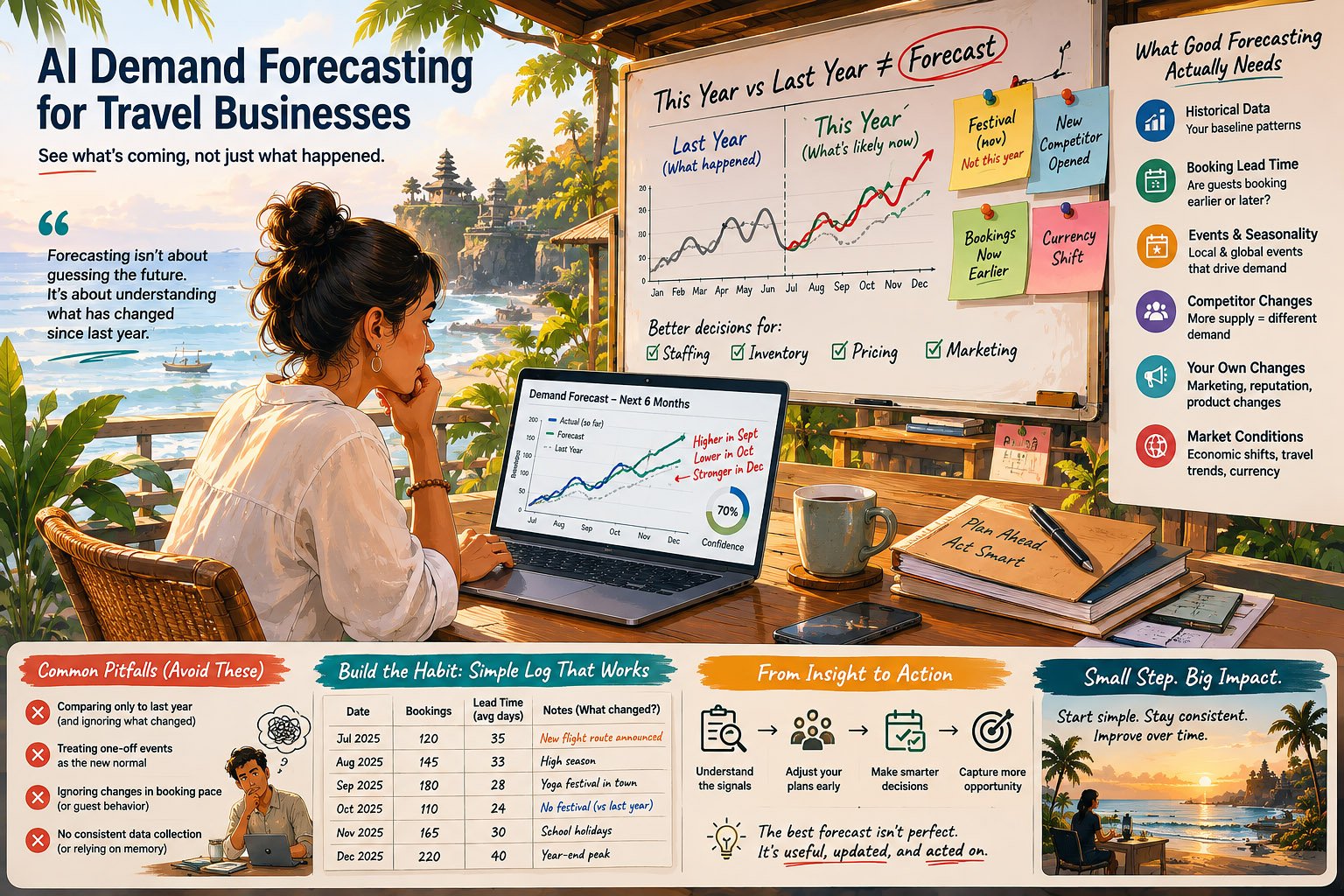
A tour operator plans next October the way she always has: pull up last October’s numbers, staff to match. What she doesn’t account for is that last October’s strength came from a one-off festival that isn’t happening again, a new competitor two blocks away, and a booking-pace shift that’s been building for two years. She overstaffs, underfills, and calls it “an off year” — without ever knowing why.
This piece covers what demand forecasting actually is, what inputs it needs, and why comparing to last year isn’t the same thing as forecasting.
A tour operator plans next October’s staffing the same way she has for years: pull up last October’s booking numbers, staff to match, and adjust slightly for gut feeling. Last October was strong, so she staffs up accordingly. What she doesn’t account for is that last October’s strength was driven by a one-off festival that isn’t happening this year, a competitor that has since opened two blocks away, and a shift in her market’s typical booking lead time that’s been building for two years but never shows up if you only ever compare one October to the previous one.
She overstaffs, underfills, and chalks it up to “an off year” — without ever identifying why, because the comparison she used couldn’t have told her.
Why This Decision Matters
Getting demand forecasting right means staffing correctly, buying inventory correctly, and pricing correctly, all ahead of time rather than reactively. Getting it wrong compounds across every one of those decisions — overstaffing when demand doesn’t materialize, understaffing when it exceeds expectations, and pricing based on a stale read of what “normal” looks like. The cost of a bad forecast rarely shows up as a single obvious mistake; it shows up as a season that quietly underperforms in ways that are hard to trace back to their actual cause.
Comparing this year to last year answers “what happened before.” Forecasting is supposed to answer “what’s likely to happen now” — and those are only the same question if nothing else has changed, which is rarely true.
What Demand Forecasting Actually Is
Demand forecasting is the practice of predicting future booking volume, occupancy, or demand based on a combination of historical patterns and current signals — not just historical patterns alone. It answers a more specific question than “what did last year look like”: it asks what’s likely to happen this specific period, given everything currently known, including things that have changed since last year.
This distinction matters because travel demand is shaped by more than seasonality. Booking pace (how far ahead people are booking compared to previous periods), local and global events, shifts in a business’s own marketing or reputation, and broader economic conditions all move the true forecast away from a simple historical comparison, sometimes significantly.
How This Is Different From “Just Looking at Last Year”
This is worth making concrete, because the difference isn’t abstract — it shows up in specific, common failure patterns.
Calendar shifts get missed. A holiday or festival that fell on a weekend last year might fall midweek this year, shifting demand patterns in ways a same-date comparison won’t catch.
One-off events get treated as the new normal. A single unusually strong or weak period — a festival, a local disruption, a viral social media moment — gets baked into “what to expect” if the comparison is only ever year-over-year, rather than being recognized as an anomaly.
Booking pace changes go unnoticed. If guests are booking two weeks earlier or later than they used to, on average, a same-date comparison won’t reveal that shift, but it changes exactly when a business should expect to see its bookings materialize.
External changes aren’t factored in at all. A new competitor, a currency shift affecting a key source market, a change in flight routes to your region — none of these show up in a comparison of two calendars, but all of them shift real demand.
“Last year we did X, so this year we’ll probably also do X” is a reasonable starting guess. It stops being a forecast the moment something material has changed, and something material almost always has.
What Inputs Demand Forecasting Actually Needs
| Input | What it tells you |
|---|---|
| Historical bookings by date | The baseline seasonal pattern to start from |
| Booking pace (lead time trends) | Whether bookings are running ahead of or behind typical timing |
| Known local and global events | Demand spikes or dips a pure historical comparison would miss |
| Competitor capacity changes | Whether new supply is likely to affect your own demand |
| Marketing and reputation changes | Whether your own visibility has shifted independent of the market |
| Broader economic or travel-market conditions | Macro shifts affecting your source markets’ willingness or ability to travel |
Not every business needs to track all six inputs with equal rigor — a small operator can realistically maintain the first three well and keep a rough, informal eye on the rest, while a larger operation with dedicated staff can formalize tracking across all of them.
Building the Habit of Good Data Collection
Most of the value in demand forecasting comes from consistent, honest record-keeping more than from any particular tool or model. A business that has diligently logged bookings, lead time, and known one-off events for two seasons has better raw material for forecasting than one with five years of booking numbers but no record of what actually drove the unusual periods within them.
In Practice: Setting Up Your Forecasting Log
- Record bookings by date, alongside lead time, not just final occupancy — the pace matters as much as the total.
- Note any known one-off factor for each period — a festival, a closure, a marketing campaign, a competitor opening — while the reason is still fresh and known.
- Keep the log simple enough that someone will actually maintain it — a detailed system nobody updates is worse than a basic one that’s kept current.
- Review the log at least monthly, not just at forecasting time, so patterns and anomalies get caught while they’re still recent and explicable.
The Three Layers of Forecasting
Simple trend-adjusted comparison — taking last year’s numbers and manually adjusting for known changes (a competitor opening, a shifted holiday date). This is better than a raw year-over-year comparison and achievable for almost any business with basic record-keeping.
Statistical forecasting — using historical data to identify patterns (seasonality, trend, booking pace) more rigorously than a manual adjustment, producing a forecast with a reasonable confidence range rather than a single guess.
AI-assisted forecasting — incorporating a wider range of signals (search trends, competitor pricing, external event data) automatically, and updating the forecast continuously as new booking data comes in. This is the most powerful tier and the one that needs the most historical data and the most trust before a business should rely on it heavily.
In Practice: Choosing Your Starting Tier
- Start with trend-adjusted comparison if you don’t yet have more than a season or two of organized historical data.
- Move to statistical forecasting once you have several seasons of clean data and want more rigor than manual adjustment provides.
- Consider AI-assisted forecasting only once the simpler tiers are well-established and you have enough booking volume that the additional signals meaningfully improve accuracy.
- Whatever tier you use, keep a written log of known one-off events each season, so future comparisons can account for them explicitly rather than relying on memory.
What This Looks Like in Practice
A small hotel began keeping a simple, structured log alongside its booking data — noting any local event, unusual weather, marketing push, or competitor change for each month, rather than relying on staff memory to explain unusual patterns after the fact. Within two seasons, this log let them adjust their October forecast for the coming year specifically because they could see the previous October’s strength was tied to a one-off event, rather than assuming it as the new baseline.
The forecasting itself remained fairly simple — a trend-adjusted comparison, not an algorithmic model — but it was informed by a genuinely careful read of what had actually driven past demand, rather than a flat assumption that history repeats itself unchanged.
The forecasting tool mattered less than the discipline of recording what actually caused past demand to look the way it did.
Common Mistakes
The most common mistake is treating last year’s numbers as this year’s baseline without adjusting for anything that’s changed — new competitors, shifted holidays, a different marketing approach. A close second is ignoring booking pace as a leading signal — if bookings for an upcoming period are running notably ahead of or behind the same point last year, that’s often the earliest and most useful signal available, and it’s frequently overlooked in favor of waiting for final numbers. The quieter mistake is treating a forecast as a one-time exercise rather than something to be updated regularly as new data comes in — a forecast made three months out should be refined as the actual date approaches and real booking data accumulates.
Measuring Whether Your Forecast Is Actually Good
A forecast is only useful if it’s checked against what actually happened, and most businesses skip this step entirely — producing a forecast, acting on it, and never circling back to see how close it was.
A forecast nobody checks against reality isn’t really a forecast. It’s a guess with a formula attached.
In Practice: Checking Forecast Accuracy After the Fact
- Compare the forecast to actual results every period, not just when something goes noticeably wrong.
- Note which specific inputs were off — was it a missed event, a booking-pace shift that reversed unexpectedly, a competitor change you didn’t know about?
- Adjust the log and the method based on what you learn, rather than treating each forecast as a fresh start disconnected from the last one’s accuracy.
- Expect early forecasts to be rougher than accuracy improves with more seasons of disciplined tracking — this is a skill that compounds rather than one that’s perfected on the first attempt.
How Forecasting Connects to Pricing
Demand forecasting and dynamic pricing work together, and separating them fully misses much of the value of either. A forecast that correctly identifies an unusually high-demand period is only useful if pricing responds to it — which is where AI dynamic pricing comes in. Forecasting without pricing action is just information; pricing without a genuine forecast underneath it is just reacting to current occupancy rather than anticipating it.
Choosing an Approach for Your Business
For most small-to-mid travel and hospitality businesses, a well-maintained log of bookings, a rough trend-adjusted comparison, and a written record of known one-off events captures the large majority of the available value. Statistical or AI-assisted forecasting becomes worth the additional cost and complexity once a business has enough historical data and enough at stake in getting the forecast right — larger properties, higher booking volumes, or businesses where staffing and inventory decisions carry significant cost if mistimed.
How to Know You’re Ready
In Practice: Signs You’re Ready to Start
- You have at least a season or two of organized booking data, even if it’s just a spreadsheet.
- You can name specific one-off events that affected past demand, rather than treating every unusual period as unexplained.
- Someone can commit to reviewing and updating the forecast periodically, not just building it once and leaving it.
- You’re making real staffing, inventory, or pricing decisions based on the forecast, not just producing a number for its own sake.
If you’re not sure whether your business has reached the point where formal forecasting is worth the effort, signs you need demand forecasting AI walks through the specific indicators worth checking for.
Frequently Asked Questions
Do I need specialized software to do demand forecasting? Not necessarily at first — a well-organized spreadsheet tracking bookings, lead time, and known one-off events can support a genuinely useful trend-adjusted forecast before any dedicated tool is needed.
How far in advance should I forecast? It depends on your business’s typical booking lead time and planning needs — a forecast useful for staffing decisions usually needs a longer horizon than one used mainly for last-minute pricing adjustments.
What if my business hasn’t been open long enough to have historical data? Start by tracking booking pace and known local events carefully from now on — even a single well-documented season is more useful than no forecasting effort at all, and the discipline compounds over time.
How is this different from just watching my calendar fill up? Watching current occupancy tells you what’s already booked. Forecasting tries to anticipate what’s likely to book between now and the date in question, which is what actually lets you act ahead of time rather than after the fact.
Should I trust an algorithmic forecast over my own local knowledge? Treat them as complementary rather than one replacing the other — an algorithm can process more historical patterns than a person can hold in their head, but local knowledge about specific upcoming events is often more current and more accurate than what any model has learned from the past.
How often should I update my forecast? At minimum, revisit it monthly, and more frequently as a specific date approaches and real booking data starts to confirm or contradict the earlier prediction.
Can small operators really benefit from this, or is it mainly useful at scale? Small operators benefit meaningfully from even a simple, disciplined version — the value comes from the habit of tracking causes and booking pace, not from the sophistication of the underlying model.
What’s the fastest way to improve a rough forecast I already have? Go back through your existing data and note the one-off events you can still remember for each unusual period — this single step often improves a rough forecast more than switching to a more sophisticated tool would.
How do I forecast for a brand-new offering with no history at all? Use a comparable existing offering’s pattern as a rough starting proxy, and treat the first season’s actual results as the real baseline going forward, updating quickly once real data starts coming in.
Final Thoughts
The tour operator from the opening didn’t need a sophisticated algorithm to avoid her overstaffing mistake next time — she needed a written record of what actually drove last October’s numbers, and the discipline to check that record before assuming the pattern would simply repeat. That’s most of what good demand forecasting actually is: not a more powerful crystal ball, just a more honest and more current read on what’s actually likely to happen, rather than what happened once before.
This fits within the broader picture of AI revenue and demand management and AI for the travel industry as a whole.
Last updated: August 2026