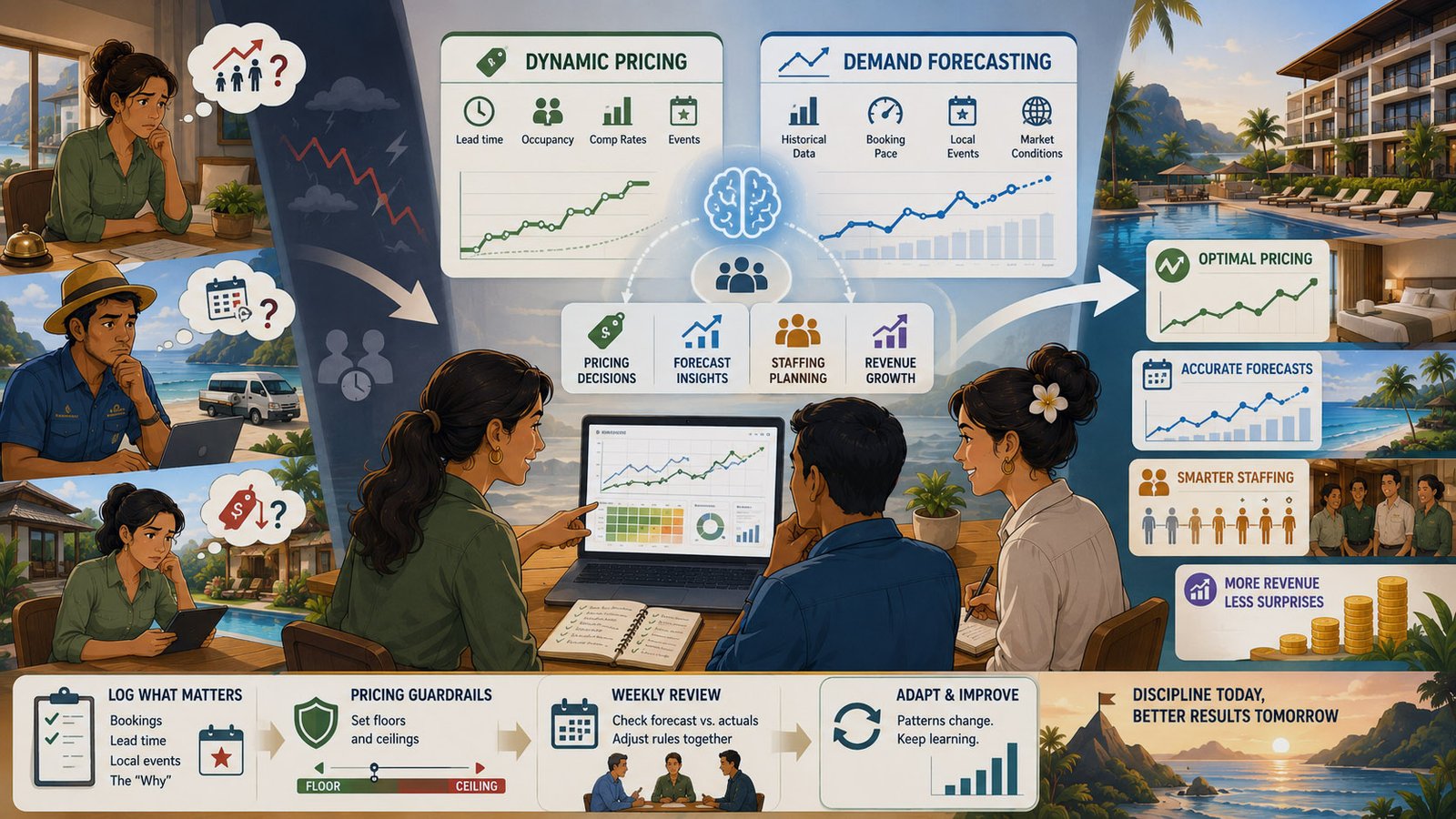
A hotel owner raises her weekend rate by instinct whenever bookings come in fast. A tour operator staffs up for October because October was strong last year. A villa manager discounts a quiet week because it feels right, without knowing if it’ll actually fill rooms. All three are practicing a rough version of revenue management — one honest conversation away from doing it with real discipline instead of gut feeling.
This piece explains dynamic pricing and demand forecasting in plain terms, with real caveats about data, and exactly where smaller operators should and shouldn’t invest.
A hotel owner raises her weekend rate by instinct whenever she notices bookings coming in fast. A tour operator staffs up for October because October was strong last year. A villa manager discounts a quiet week because it feels like the right thing to do, without really knowing if it’ll fill the rooms or just leave money on the table. All three are practicing a rough, informal version of revenue management — and all three are one honest conversation away from doing it with real discipline instead of gut feeling.
“AI revenue management” sounds like it belongs to hotel chains with dedicated teams and enterprise software. Most of what actually matters here, though, scales down much further than that — not because the technology is simple, but because the underlying discipline (price and staff based on an honest read of demand, not just intuition) is available to a business of any size willing to build the habit.
Why This Is Bigger Than “Raise Prices When Busy”
Most owners’ informal revenue management amounts to “raise the rate when it’s obviously busy, drop it when it’s obviously quiet.” That’s not wrong, exactly — but it’s reactive, working off signals that are already visible rather than signals that predict what’s coming. The real opportunity in revenue management is capturing demand you can see coming before it fully materializes, and avoiding both the underpricing that leaves money on the table during genuine high demand and the overpricing that leaves rooms or seats empty during genuine lows.
The gap between “raise the price when it’s busy” and real revenue management isn’t the technology. It’s the difference between reacting to demand and anticipating it.
The Two Core Ideas, and How They Relate
Revenue management for a travel business rests on two related but distinct practices: pricing and forecasting.
| Practice | What it answers | What it needs to work well |
|---|---|---|
| Dynamic pricing | What should I charge, right now, for this date? | Clear rules, guardrails, and a genuine read on demand |
| Demand forecasting | What’s demand likely to look like for a future date? | Historical data, booking pace, and knowledge of what’s changed |
Pricing without forecasting underneath it is just reacting to current occupancy. Forecasting without pricing action on top of it is just information nobody’s using. The two work best together, and most of the value in “AI revenue management” comes from getting both right, not either alone.
Dynamic Pricing in Plain Terms
Dynamic pricing is the practice of adjusting rates based on demand signals — lead time, current occupancy, comparable rates, known events — rather than setting one rate and leaving it static for months. It doesn’t require a sophisticated algorithm to start: a rules-based system (if occupancy crosses a threshold, raise the rate by a set amount; if a known event falls on a date, apply an uplift) captures much of the value, and is transparent enough that any owner can understand and adjust it by hand.
The honest tradeoff is that automation without guardrails can produce a technically demand-justified rate that damages guest trust or undercuts profitability. AI dynamic pricing for hotels and tours covers the mechanics, the data requirements, and what’s realistic at different scales in more depth.
Demand Forecasting in Plain Terms
Demand forecasting predicts future booking volume based on a combination of historical patterns and current signals — not just a comparison to what happened at the same time last year. That distinction matters because travel demand shifts for reasons a same-date comparison can’t catch: calendar shifts, one-off events, changes in booking pace, new competitors, or broader market conditions.
The honest tradeoff here is more subtle than with pricing — the risk isn’t an obviously wrong number, it’s a confidently plausible one built on a comparison that quietly stopped being valid. AI demand forecasting covers what real forecasting requires and how it differs from a simple year-over-year look.
How Pricing and Forecasting Work Together
In Practice: How Pricing and Forecasting Connect
- A forecast identifies a likely high-demand period before it’s visible in current bookings — pricing then acts on that anticipation rather than waiting for occupancy to confirm it.
- A forecast identifies a likely quiet period early enough that a modest, well-timed discount can still fill capacity that would otherwise go unused.
- Pricing guardrails (floor and ceiling) should be informed by forecasting confidence — wider guardrails when the forecast is less certain, tighter ones when it’s well-established.
- Neither should run on autopilot without review — a forecast that’s drifting from reality should trigger a review of the pricing rules built on top of it, not just a shrug.
Real Caveats About Data Requirements
This is worth being honest about, because most content on this topic understates it. Both dynamic pricing and demand forecasting improve with more historical data, cleaner records, and more consistent tracking — and a business with a season or two of informal, scattered records will get real but modest value, while one with several seasons of clean, structured data can support more sophisticated approaches.
| Data maturity | What’s realistic |
|---|---|
| Little to no organized history | Start recording now; use simple, manually-set pricing rules based on known patterns |
| A season or two of informal records | Trend-adjusted forecasting and rules-based pricing, reviewed weekly |
| Several seasons of clean, structured data | Statistical forecasting and more responsive pricing rules |
| Extensive, well-organized multi-year data | AI-assisted forecasting and more automated pricing, still with human guardrails |
The single biggest data caveat isn’t volume — it’s whether anyone recorded why an unusual period happened. Ten years of raw numbers with no record of causes is less useful than two years with an honest note next to every anomaly.
There’s no way around this: businesses hoping to skip straight to a sophisticated system without first building the underlying data discipline usually end up with a system that looks impressive and performs poorly, because it was never fed the quality of input it needed.
A Composite Season
Picture the same three businesses from the opening, a year after each started with simple, disciplined habits rather than sophisticated tools.
The hotel owner still raises her weekend rate when bookings run fast — but now it happens automatically, through a rule she set and understands, and it’s paired with a modest early-booking discount on dates her forecast flags as likely to be quiet, filling rooms that would previously have sat empty. The tour operator no longer staffs October by memory of last year — a simple log, kept for two seasons, told her that last October’s strength came from a one-off festival that isn’t recurring, so this year’s staffing plan reflects the actual expected pattern instead of an outlier treated as normal. The villa manager’s quiet-week discounts are no longer a guess — a rough forecast, built from nothing more than a spreadsheet and a habit of noting local events, tells her which quiet weeks are worth discounting and which are just normal seasonal lulls not worth touching.
None of these three businesses bought sophisticated software. They built a habit of writing down what actually happened and why, and let a handful of simple rules follow from that.
That’s the realistic shape of revenue management done well at small-to-mid scale: not a dramatic technological leap, just the discipline of anticipating demand instead of reacting to it, applied consistently enough to compound over several seasons.
Staffing and Team Trust Across Pricing and Forecasting
Both practices ultimately depend on someone actually maintaining them — reviewing the log, checking the forecast against reality, adjusting the pricing rules as patterns shift. A system that only one person understands is fragile; if that person is out for a season, or leaves the business, the discipline often collapses with them.
In Practice: Building This Into How Your Team Works
- Write the pricing rules and forecasting log down somewhere shared, not just in one person’s head or inbox.
- Involve at least one other team member in the weekly review, even if only briefly, so the habit survives a single person’s absence.
- Revisit the reasoning behind each rule periodically, not just the numbers — a rule everyone can explain is a rule that survives staff turnover.
- Treat a quiet month as a chance to catch up on review, not a reason to skip it — discipline built during slow periods is what pays off during busy ones.
This connects closely to AI adoption roadmaps more broadly — revenue management is one of the clearest examples of a system whose value depends entirely on whether a team actually keeps using it, not just on whether it was built correctly.
Where Smaller Operators Should (and Shouldn’t) Invest
A small hotel, villa, or tour operator should invest, without much hesitation, in the disciplined habits underneath both practices: a simple, written log of bookings and one-off events, a handful of clear pricing rules with real guardrails, and a weekly habit of checking both against reality. These cost little beyond time and consistency, and they capture a meaningful share of the available value.
Where smaller operators should generally hold off is on sophisticated, fully-automated systems — algorithmic pricing engines or AI-assisted forecasting tools that need more historical data and more ongoing oversight than a small team can realistically provide. These aren’t wrong tools; they’re tools scaled for a different kind of operation, and adopting them before the underlying data and habits are in place usually means paying for sophistication the business can’t yet use well.
In Practice: What’s Worth Doing at Small Scale
- Do: keep a simple, honest log of bookings, lead time, and known one-off events.
- Do: set three or four clear pricing rules with a real floor and ceiling.
- Do: review both weekly, and adjust the rules as patterns become clearer.
- Hold off on: fully automated, algorithmic pricing without a season or two of your own clean data behind it.
- Hold off on: dedicated revenue management software until the manual version has been genuinely tested and has clearly outgrown a spreadsheet.
How to Know If You’ve Outgrown the Informal Approach
Not every business needs to move past simple rules and manual tracking, and knowing when you have is its own honest question — reactive staffing decisions, repeated demand surprises, or juggling multiple properties or offerings without a clear read on each one’s performance are the clearest indicators. signs you need demand forecasting AI walks through five concrete, recognizable tests to check your own situation against, rather than a vague sense that “we should be more sophisticated.”
Getting Help When You’re Ready
If those signs sound familiar and you’re ready to move past self-managed rules and spreadsheets, the next reasonable step is understanding what a structured engagement actually involves — assessment, prioritization, build, and adoption, in that order, ending with your own team running a system they trust rather than depending on an outside consultant indefinitely. how AI revenue management consulting works walks through that process end to end, including what outcomes are realistic to expect and what determines cost and timeline for a business your size.
Common Mistakes Across Pricing and Forecasting
The most common mistake is skipping straight to a sophisticated system — algorithmic pricing, AI-assisted forecasting — before the underlying habits of clean data collection and disciplined weekly review are in place. A close second is treating pricing and forecasting as unrelated projects, building one without the other, which leaves either a forecast nobody’s acting on or pricing decisions with no real anticipation behind them. The quieter mistake, and perhaps the most damaging over time, is setting up simple rules or a basic forecast once and never revisiting them — demand patterns shift, competitors change, and a system left unreviewed for a year drifts further from reality with each season that passes.
Every revenue management disappointment covered across this site traces back to the same root: a system trusted with less oversight than it had actually earned.
How This Fits the Bigger Picture
Revenue and demand management is one piece of a larger picture — see AI for the travel industry overview for the full landscape, including AI for guest experience, back-office automation, and AI adoption roadmaps, which shapes how well any pricing or forecasting system actually gets adopted and trusted by a real team rather than sitting unused after launch. If your business operates specifically in Bali’s tourism sector, the same fundamentals apply at a different scale, with different starting priorities — see AI for Bali tour operators for that version of the picture.
How to Know You’re Ready to Start
In Practice: Readiness Signs
- You can name a specific gap — reactive staffing, a pricing decision made mostly by instinct, a repeated demand surprise — rather than a vague sense that “we should modernize.”
- You’re willing to start with simple rules and honest record-keeping, not a sophisticated system, and let data and trust build before expanding.
- Someone can commit to a weekly review of both pricing and forecasting, at least in the early months.
- You’re prepared to record the “why” behind unusual periods, not just the raw numbers — this single habit does more for long-term accuracy than almost any tool.
Frequently Asked Questions
Do I need both pricing and forecasting, or can I start with just one? Starting with one is reasonable — forecasting is often the more foundational of the two, since good pricing decisions depend on a genuine read of demand, but a business already comfortable with basic pricing rules might reasonably start there instead.
How much historical data do I actually need to get started? Even a single season of honest record-keeping is enough to begin — the value compounds with more seasons, but waiting for “enough” data before starting anything means losing the seasons you could have been learning from.
Is this only relevant for larger properties or multi-location businesses? No — a single hotel, villa, or tour operator benefits meaningfully from disciplined, simple pricing rules and forecasting habits, well before reaching any particular size threshold.
What’s the biggest single mistake to avoid? Adopting a sophisticated system before the underlying data discipline and simple habits are in place — this is the pattern behind most disappointing revenue management projects, at any scale.
How do dynamic pricing and demand forecasting relate to my day-to-day staffing decisions? Directly — a good forecast tells you when to staff up or down ahead of time, rather than reacting once bookings have already materialized, which is one of the clearest practical benefits of getting this right.
Should I hire a consultant right away, or try to do this myself first? Trying simple, self-managed rules and record-keeping first is usually the right starting point — consulting earns its cost once your business has real complexity or has clearly outgrown what a spreadsheet and weekly review can handle.
How often should I revisit my pricing rules and forecast? At minimum, monthly, with a lighter weekly check-in — demand patterns and competitive conditions shift more than most owners expect, and a system left unreviewed for a year quietly drifts out of date.
What happens if the person who set up our pricing rules leaves the business? This is exactly why the rules and reasoning should be written down and shared rather than kept in one person’s head — a system only one staff member understands is a real business risk, independent of how good the system itself is.
Can dynamic pricing and forecasting work for seasonal businesses that close part of the year? Yes — the same habits apply, just compressed into the operating season, with extra attention paid to how the off-season affects booking pace and lead time once the business reopens.
Is there a risk of over-relying on historical patterns if travel trends are shifting generally? Yes, which is exactly why the “why” behind each unusual period matters more than the raw numbers — a business tracking causes can distinguish a genuine trend shift from a one-off anomaly, while one tracking only totals can’t.
Final Thoughts
The hotel owner, the tour operator, and the villa manager from the opening are all already practicing a version of revenue management — the honest question isn’t whether to start, it’s whether to keep doing it by instinct or build the modest discipline that turns instinct into something more reliable. For most travel businesses, that discipline starts small: a written log, a few clear rules, a weekly habit of checking both against what actually happened — not a sophisticated system, at least not yet.
Getting this right doesn’t feel like “AI” to the business running it. It feels like fewer surprises, staffing decisions made ahead of time instead of in a scramble, and rates that finally reflect what demand is actually doing.
Last updated: August2026