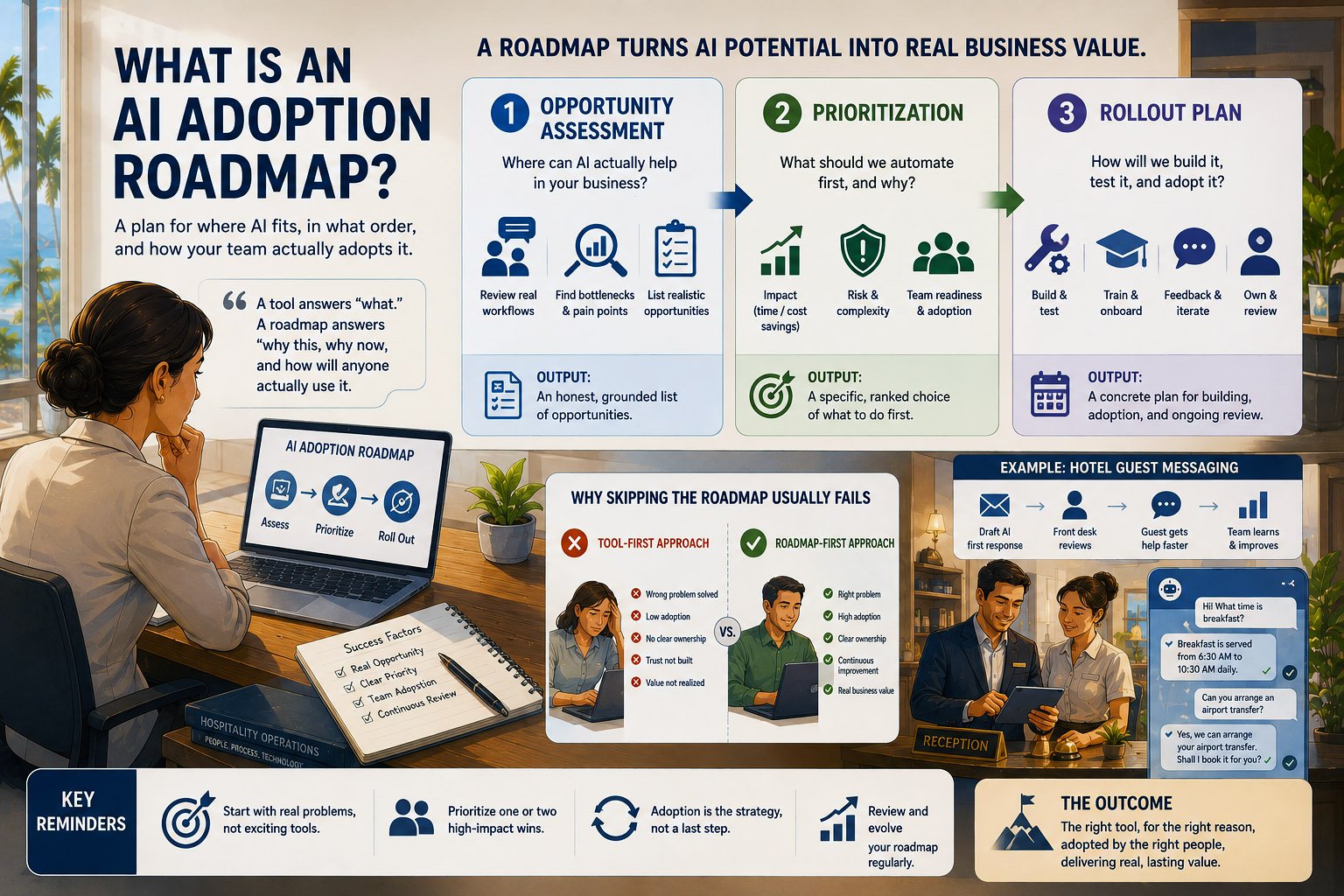
A hotel manager signs up for a chatbot after a good demo, rolls it out with a brief email, and moves on. Three months later, adoption has quietly stalled — half the team still answers manually because they don’t trust it, and nobody’s reviewed what it’s getting wrong. Someone mentions she needed “an adoption roadmap” first. She’s not sure what that means, only that she skipped a step.
A roadmap isn’t a tool or a tech spec — it’s a plan. This piece breaks down what it actually contains, and why buying the tool first usually backfires.
A hotel general manager signs up for a chatbot subscription after a good demo, rolls it out to the front desk team with a brief email explaining how to use it, and moves on to the next priority. Three months later, adoption has quietly stalled — half the team still answers guest messages manually because they don’t trust the tool, nobody’s reviewed what it’s actually getting wrong, and the subscription renews automatically next month regardless. Someone mentions she needed “an adoption roadmap” before buying the tool. She’s not entirely sure what that means, only that she apparently skipped a step.
That’s a common story, and the missing step is worth explaining plainly: an AI adoption roadmap isn’t a tool, a piece of software, or a technical document. It’s a plan — for where AI actually fits in your business, in what order, and how your team gets from “we bought something” to “we’re actually using this well.”
Why This Matters
Buying a tool without a roadmap is like hiring a new employee without deciding what job they’re actually meant to do. The tool might be perfectly capable, but without a clear sense of which problem it’s solving, how it fits into existing work, and how the team will actually adopt it, even a good tool tends to underdeliver — not because the technology failed, but because nobody planned for anything beyond the purchase.
A tool answers “what.” A roadmap answers “why this, why now, and how will anyone actually use it.” Skipping straight to the tool means skipping the three questions that determine whether it ever gets used.
What an AI Adoption Roadmap Actually Is
Stripped of jargon, an AI adoption roadmap is a structured plan that answers three questions in order: where does AI actually have real opportunity in your business, which of those opportunities is worth tackling first, and how will your team actually start using whatever gets built. It’s not a technical specification, and it’s not something a vendor hands you after a sales call — it’s a business planning document, grounded in your actual operations, that happens to be about AI.
What It Actually Contains
A real roadmap has three core components, and each answers a distinct question.
Opportunity assessment identifies where AI could genuinely help across your business — not a wishlist of everything AI can theoretically do, but a grounded look at your actual workflows, bottlenecks, and pain points.
Prioritization narrows that list down to what’s actually worth tackling first, weighing factors like how much time or money a given opportunity could realistically save against how difficult or risky it would be to implement.
Rollout plan lays out how the chosen opportunity actually gets built, tested, and adopted by your team — not just a launch date, but a genuine plan for training, feedback, and adjustment.
Component One: Opportunity Assessment
This stage means taking an honest inventory of where your business’s real bottlenecks and repetitive tasks actually are — not a brainstorm of impressive-sounding AI use cases, but a grounded look at what your team actually does all day, where time gets lost, and where mistakes or delays cost the most. For a hotel, this might surface guest communication delays, inconsistent personalization, or slow back-office processes. For a tour operator, it might surface admin overload or a specific gap in guest-facing responsiveness.
The output of this stage is a realistic list of opportunities — not a plan yet, just an honest picture of where AI could plausibly help, grounded in your actual operations rather than a generic industry list.
Component Two: Prioritization
Opportunity assessment usually surfaces more possibilities than are worth pursuing at once. Prioritization is the deliberate narrowing of that list, weighing each opportunity against a few practical questions: how much time or money would this realistically save, how repetitive and well-defined is the underlying task, how risky is it if the automation gets something wrong, and how ready is your team to actually adopt something new here.
The businesses that get real value from AI aren’t the ones with the longest opportunity list. They’re the ones willing to rank that list honestly and commit to the top one or two, rather than trying to tackle everything at once.
The output of this stage is a clear, specific answer to “what are we actually doing first, and why this instead of the other options” — not a vague commitment to “improving efficiency with AI” broadly.
Component Three: Rollout Plan
This is where most roadmaps that exist only on paper fall apart in practice, because rollout is about people, not technology. A real rollout plan covers how the chosen opportunity gets built and tested against real cases, who on the team gets trained and how, what the feedback and correction process looks like once it’s live, and who’s responsible for maintaining and reviewing it going forward.
The output of this stage is a plan your team can actually follow — specific enough that everyone involved knows what happens in the first week, the first month, and beyond, rather than a vague expectation that adoption will simply happen once the tool is turned on.
In Practice: What Each Component Actually Produces
- Opportunity assessment produces an honest, grounded list of where AI could plausibly help — not a wishlist copied from a generic article.
- Prioritization produces a specific, ranked answer to what’s worth building first, with clear reasoning your team can understand and buy into.
- Rollout plan produces a concrete plan for building, testing, training, and reviewing — the part most skipped roadmaps leave out entirely.
Why Skipping Straight to a Tool Usually Fails
The hotel manager from the opening isn’t unusual — buying a tool first and figuring out the plan later is the default pattern for a lot of businesses, because it feels like faster progress. It usually isn’t, for a specific reason: without an opportunity assessment, there’s no way to know if the tool addresses your actual highest-value problem versus just a plausible-sounding one. Without prioritization, there’s no clear reasoning the team can understand for why this particular change is happening now. And without a rollout plan, adoption is left to chance — some staff will figure it out, others won’t, and nobody’s specifically responsible for noticing when it quietly stops being used.
A tool bought before a roadmap is a solution in search of a problem it hasn’t actually confirmed it solves. A tool bought after a roadmap is a specific answer to a specific, already-understood need.
This is why “we bought a chatbot and it didn’t really work out” is such a common story — not because chatbots don’t work, but because the purchase happened before anyone did the planning work that determines whether a chatbot was even the right answer, and before anyone planned for how the team would actually come to trust and use it.
How a Roadmap Differs from a Generic “AI Strategy”
These terms get used interchangeably, but there’s a useful distinction worth drawing. A generic AI strategy document often stays abstract — broad statements about “leveraging AI for competitive advantage” that sound reasonable but don’t specify which workflow, which tool, or which team member does what differently on Monday morning. A roadmap, done properly, is concrete by design: it names the specific opportunity, the specific reasoning for prioritizing it, and the specific people responsible for rollout.
If a document could apply to almost any business in almost any industry, it’s a strategy statement, not a roadmap. A real roadmap is specific enough that it would look wrong pasted into a different company’s plan.
In Practice: Roadmap vs. Generic Strategy Statement
- A strategy statement says: “We will use AI to improve guest experience.”
- A roadmap says: “We will automate first-response drafting for our five most common guest questions, starting next month, with the front desk team reviewing flagged conversations daily for the first four weeks.”
- A strategy statement is aspirational. A roadmap is actionable by a specific person on a specific date.
- If your roadmap could be copy-pasted into a competitor’s plan unchanged, it’s not specific enough yet.
What a Roadmap Is Not
It’s worth clearing up a few common misconceptions directly. A roadmap isn’t a technical specification or a piece of software — it’s a business plan that happens to involve AI, and it can be written and understood by someone with no technical background at all. It’s not a one-time document either — a roadmap that gets written once and never revisited goes stale as the business changes, and the best ones are revisited at least annually. And it’s not something only large companies need — a solo operator benefits from the same three-question structure (where’s the opportunity, what’s worth doing first, how will I actually use it), even if the answers come from a much shorter, faster process than a large hotel chain’s would.
A Worked Example
A boutique hotel’s general manager, after the chatbot experience described in the opening, went back and ran a proper opportunity assessment before trying again. It surfaced several possibilities — guest messaging delays, inconsistent personalization, slow back-office invoicing — and prioritization pointed toward guest messaging as the clearest first opportunity, given its high volume and the team’s existing frustration with it.
This time, the rollout plan specified exactly which five repeat questions the new system would handle, who on the front desk team would review flagged conversations daily for the first month, and a specific four-week check-in to assess whether it was actually working before expanding scope. The tool itself was similar to what had failed before — the difference was everything around it.
Common Mistakes
The most common mistake is treating the roadmap as a formality to complete quickly before getting to the “real” work of choosing and buying a tool, when the roadmap’s thinking is actually the work that determines whether the tool succeeds. A close second is writing an opportunity assessment that’s really just a wishlist of impressive AI use cases pulled from generic articles, rather than a grounded look at the business’s own actual bottlenecks. The quieter mistake is treating the rollout plan as an afterthought — a single training email, with no defined ownership for ongoing review — which is exactly the gap that let the chatbot in the opening story quietly fail.
Where This Fits Relative to Other Priorities
A roadmap’s rollout stage depends heavily on how well your team actually adopts and trusts whatever gets built — training hospitality teams to use AI covers what genuinely effective training and adoption support looks like, beyond a single onboarding email. And since even a well-planned roadmap can go wrong in predictable ways, common AI adoption mistakes covers the specific, recurring failure patterns worth knowing about before you start.
How to Know You’re Ready to Build One
In Practice: Signs You’re Ready
- You’ve tried, or are tempted to try, buying a tool without a clear plan behind it — recognizing this pattern is itself a sign you’re ready for the more deliberate approach.
- You can commit real time to an honest opportunity assessment, not just a quick brainstorm.
- You’re prepared for prioritization to point somewhere other than what you originally assumed was the obvious first move.
- Someone can own the rollout plan specifically, including ongoing review, not just the initial launch.
Getting Started
In Practice: A Realistic First Step
- Spend a week honestly logging where your team’s time and attention actually go, rather than assuming you already know.
- List every plausible AI opportunity that surfaces, without judging or prioritizing yet.
- Rank that list against real criteria — time saved, risk, team readiness — rather than picking whichever sounds most exciting.
- Write down who owns rollout and review before building anything, so adoption isn’t left to chance once the tool exists.
Frequently Asked Questions
Do I need a roadmap even for a small business with just one or two possible AI projects? Yes, though it can be much shorter and faster than a larger organization’s version — the same three questions (where’s the opportunity, what’s worth doing first, how will we actually adopt it) still apply, just at a smaller scale.
How long does it take to build a roadmap? It varies, but a focused opportunity assessment and prioritization exercise often takes one to two weeks for a small-to-mid business — considerably faster than most owners expect, especially compared to the time lost to a failed, unplanned tool purchase.
Can I write a roadmap myself, or do I need outside help? Many businesses can run the opportunity assessment and prioritization stages internally — outside help is often most valuable for keeping the process honest and for building the rollout plan’s training and adoption components.
What if I’ve already bought a tool without a roadmap? It’s not too late — you can still run an opportunity assessment and prioritization exercise retroactively, which often reveals whether the tool you bought was actually the right first choice or should be paused in favor of a better-targeted one.
How often should a roadmap be updated? At least annually, or after any significant change in team size, technology, or business priorities — a roadmap written once and never revisited stops reflecting the business it was built for.
Does a roadmap need to cover every department at once? No — most effective roadmaps start narrow, covering one department or workflow area, and expand once the first rollout has proven the approach works.
What’s the single biggest sign a business skipped this process? A tool that was purchased and rolled out, but nobody can clearly explain why this particular tool, why now, or who’s responsible for making sure it’s actually being used well.
How specific does a roadmap actually need to be to count as one? Specific enough that it wouldn’t make sense pasted into a different business’s plan unchanged — if it’s still describing generic aspirations rather than a named workflow, a named priority reason, and a named owner for rollout, it’s not there yet.
Can a roadmap change after it’s written, or is it meant to be fixed? It should change — a roadmap is a living plan, not a locked commitment, and revisiting it as the rollout reveals new information or as priorities shift is a sign it’s being used correctly, not a sign it failed.
Final Thoughts
The hotel manager from the opening didn’t need a more sophisticated chatbot the second time around. She needed the thinking she’d skipped the first time — an honest look at where the opportunity actually was, a clear reason for choosing guest messaging over the other possibilities, and a specific plan for how her team would actually come to trust and use it. That’s the real function of an AI adoption roadmap: not a technical document, just the planning work that determines whether a tool succeeds or quietly fails.
This fits within the broader picture of AI adoption roadmaps for travel businesses and AI for the travel industry as a whole.
Last updated: August 2026