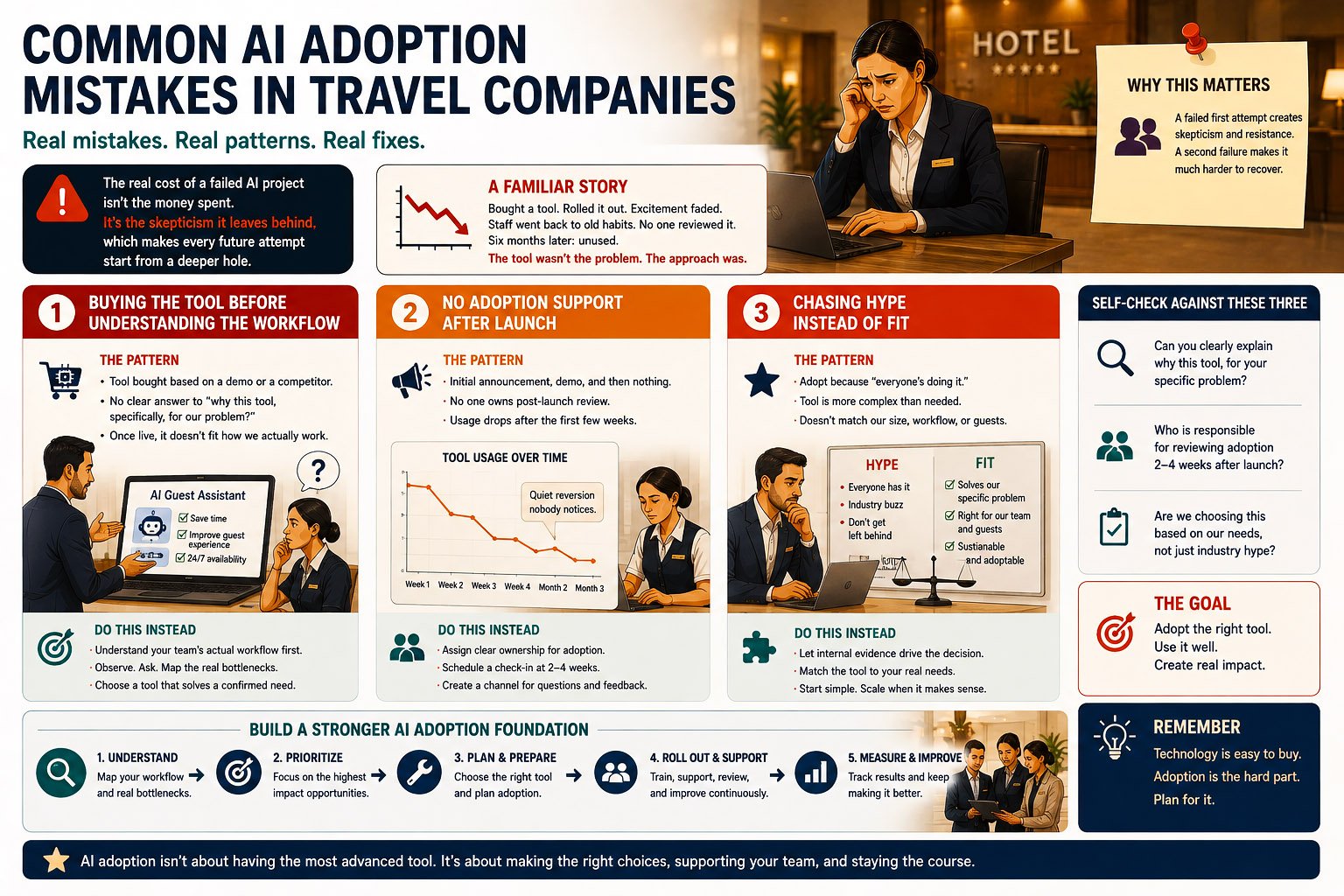
A hotel manager tried AI once already. She bought a well-reviewed guest-messaging tool, rolled it out, and six months later it’s quietly unused — staff drifted back to manual replies, nobody’s sure who’s supposed to review it. She’s not against AI. She’s against repeating whatever went wrong, and she’s not entirely sure what that was.
This piece skips the generic “communicate clearly, get buy-in” advice and names the specific, recognizable patterns behind most stalled AI adoption — plus what an honest second attempt actually looks like.
A hotel general manager tried AI once already. She bought a well-reviewed guest-messaging tool, rolled it out, and six months later it’s quietly unused — staff drifted back to manual replies, nobody’s sure who’s supposed to be reviewing it, and she’s not eager to bring up “the AI project” in her next leadership meeting. She’s not against AI. She’s against repeating whatever went wrong the first time, and she’s not entirely sure what that was.
This is a common position, and it deserves a specific, honest answer rather than a generic list of “communicate clearly” and “get buy-in” that could apply to literally any change management effort. The failures below are the real, recognizable patterns behind most stalled AI adoption in travel and hospitality — not because the technology didn’t work, but because of specific, avoidable decisions made around it.
Why This Matters More the Second Time
A failed first attempt costs more than the subscription fee wasted. It costs organizational trust — staff who watched one AI initiative fizzle are more skeptical of the next one, and leadership that got burned once is understandably cautious about investing real time in a second attempt. Getting the diagnosis right matters more here than it would for a first try, because a second failure is harder to recover from than a first.
The real cost of a failed AI project isn’t the money spent. It’s the skepticism it leaves behind, which makes every future attempt start from a deeper hole.
Mistake One: Buying the Tool Before Understanding the Workflow
This is the most common mistake by a wide margin, and it looks exactly like the opening story: a leader sees a demo, likes what it promises, and buys it — without first doing the unglamorous work of understanding what the actual workflow looks like today, where the real bottleneck is, and whether this specific tool addresses it.
The recognizable pattern: the tool gets purchased based on a vendor’s pitch or a competitor’s example, not based on your own team’s actual pain points. Nobody can clearly answer “why this tool, specifically, for our specific problem” — the honest answer is closer to “it seemed like the kind of thing we should be doing.” Once it’s live, staff quickly discover it doesn’t quite fit how they actually work, because nobody checked that before buying it.
What to do instead: spend real time — even just a week of honest observation — understanding your team’s actual workflow before evaluating any tool. A tool chosen after this step answers a specific, already-confirmed need. A tool chosen before it is a guess wearing the appearance of a decision.
Mistake Two: No Adoption Support After Launch
This is the mistake most responsible for a technically-working tool quietly falling out of use, exactly as it did for the hotel manager in the opening. The tool launches, there’s an initial announcement or demo, and then nothing — no one is specifically responsible for checking whether it’s actually being used well, no clear channel exists for staff to flag problems, and no scheduled check-in ever happens to catch quiet reversion before it becomes permanent.
The recognizable pattern: usage looks fine in the first week or two, driven by novelty and the memory of the launch announcement, then gradually declines as staff hit edge cases the tool wasn’t shown to handle and default back to old habits under pressure. Nobody notices because nobody’s specifically watching for it — the absence of complaints gets mistaken for the absence of problems.
What to do instead: assign clear, specific ownership for post-launch review, build in a scheduled check-in at two to four weeks, and make sure staff know exactly who to go to with a problem rather than being expected to figure it out or stay silent.
Mistake Three: Chasing Hype Instead of Fit
This mistake often looks like decisiveness from the outside — a business moving fast to “not get left behind” — but it’s usually the opposite of a considered decision. The tool gets chosen because a competitor has it, because it’s the subject of industry buzz, or because a conference speaker made a compelling case for a category of tool without ever addressing whether it fits your specific business’s size, workflow, or guest base.
The recognizable pattern: the stated reason for adoption is external (“everyone’s doing this now”) rather than internal (“this addresses our specific bottleneck”). The tool chosen is often more sophisticated than the business actually needs — a fully custom concierge assistant when a narrow chatbot would have addressed the actual problem, or an AI-assisted forecasting system when a simple spreadsheet and a season of honest record-keeping would have gotten most of the value. Complexity purchased to keep up with a trend rarely gets the careful, patient rollout a genuinely necessary tool would.
What to do instead: let internal evidence, not external comparison, drive the decision. If a competitor’s tool genuinely addresses a problem you also have, that’s useful information — but the decision should still run through your own opportunity assessment and prioritization, not skip straight to matching what someone else is doing.
In Practice: Self-Check Against These Three
- Can you name the specific workflow this tool addresses, based on your own observation, not a vendor’s pitch? If not, that’s Mistake One.
- Is someone specifically responsible for reviewing usage after launch, with a scheduled check-in already on the calendar? If not, that’s Mistake Two.
- If a competitor hadn’t adopted something similar, would you still be pursuing this based on your own actual need? If the honest answer is no, that’s Mistake Three.
Mistake Four: Automating the Most Visible Workflow, Not the Most Costly One
This mistake is subtler than the first three, because it doesn’t look like a mistake at all — it looks like reasonable prioritization. A business automates its guest-facing chatbot first, because that’s the visible, easy-to-describe project, while a genuinely more costly internal bottleneck — a manual supplier-confirmation process, an invoicing workflow eating hours weekly — goes untouched because it never made anyone’s shortlist.
The recognizable pattern: the chosen project is the one that would be easiest to describe at a networking event or industry conference, not the one that scores highest on actual time saved or risk reduced. This isn’t dishonesty — it’s a natural human bias toward the interesting, visible option over the boring, high-leverage one.
What to do instead: run an honest leverage assessment — volume, repetition, cost of delay or error — across your real workflows before choosing a target, rather than defaulting to whichever feels most exciting to build.
Mistake Five: Treating Training as a Single Event
This mistake shows up after a tool has already been chosen reasonably well, which makes it especially frustrating — the right tool, aimed at the right problem, still fails to get adopted because staff were shown it once and left to figure out the rest.
The recognizable pattern: a single announcement, demo, or onboarding email, followed by an expectation that staff will simply absorb it and start using the tool fluently. Under real time pressure — a guest waiting, a phone ringing — staff default to whatever they already know how to do without thinking, and a single training session never gets a new tool to that same level of automatic comfort.
What to do instead: treat training as a process with multiple touchpoints — an initial hands-on session using real scenarios from your own business, followed by ongoing support and at least one scheduled check-in, not a single event assumed to be sufficient.
Mistake Six: No Clear Owner for Ongoing Review
A tool with no owner isn’t neutral. It’s slowly drifting toward being wrong, and nobody will notice until a mistake is visible enough to force attention.
This mistake compounds quietly over time rather than causing an obvious, immediate failure. A tool gets launched, works reasonably well at first, and then nobody is specifically tasked with periodically checking whether its outputs are still accurate — pricing rules that no longer reflect current demand, a chatbot’s FAQ answers that have gone stale as policies changed, a forecasting model built on assumptions that quietly stopped being true.
The recognizable pattern: if you asked “who checks whether this is still working correctly,” there’s no clear individual answer — it’s everyone’s job in theory and no one’s job in practice, which in most organizations means it’s nobody’s job at all.
What to do instead: name a specific person, even if their review is brief and monthly, responsible for checking the tool’s outputs against reality and flagging when something needs adjustment.
Mistake Seven: Rolling Out Everything at Once
This mistake usually comes from good intentions — a leader excited about AI’s potential decides to tackle several workflows simultaneously rather than proving the approach on one narrow target first. The result is that attention, testing rigor, and staff training all get spread thin across multiple projects, and none of them gets the careful rollout that would have made a single, focused project succeed.
The recognizable pattern: multiple tools or workflows launch in the same month, staff are asked to absorb several new processes at once, and when problems inevitably surface, it’s unclear which specific change is causing which specific issue, making troubleshooting far harder than it needed to be.
What to do instead: choose one workflow, run it through the full cycle — understanding, prioritization, build and test, adoption — and let it succeed (or fail, and be adjusted) before starting a second. A focused first project also builds the organizational trust and evidence that makes every subsequent project faster and more confident.
In Practice: Recognizable Warning Signs Before It’s Too Late
- Usage quietly declining after the first few weeks, with nobody watching closely enough to notice the trend.
- Staff describing the tool as “the thing IT set up” rather than something that’s actually theirs to use and adjust.
- No one can name who’s responsible for reviewing whether the tool is still working correctly.
- Multiple new tools launched in close succession, making it hard to tell which one is causing which problem when something goes wrong.
Why These Mistakes Compound
These seven mistakes rarely occur in isolation — they tend to reinforce each other, which is part of why a single failed attempt often feels harder to diagnose than any one mistake alone would suggest. Buying a tool before understanding the workflow (Mistake One) makes it more likely the tool doesn’t fit well, which makes adoption harder, which makes the absence of ongoing support (Mistake Two) more damaging than it would be for a well-fitted tool. Chasing hype (Mistake Three) often leads directly to choosing something more sophisticated than needed, which makes training (Mistake Five) more difficult and increases the odds that no one fully understands the tool well enough to own its ongoing review (Mistake Six).
Most failed AI projects aren’t undone by one dramatic mistake. They’re undone by three or four small ones, each making the next one more likely, until the whole thing quietly falls apart.
This is worth understanding because it changes how you should think about a second attempt: fixing just one of these seven mistakes in isolation, while leaving the others in place, often isn’t enough to produce a genuinely different outcome.
Why Generic Change-Management Advice Falls Short Here
Most advice on “why change initiatives fail” is written broadly enough to apply to any organizational change — a new POS system, a new scheduling process, a new AI tool, all treated identically. That generality is exactly why it’s often unhelpful for AI specifically: AI adoption carries a few failure modes that don’t show up the same way in other kinds of organizational change.
“Communicate clearly and get buy-in” is true of almost any change effort and specific to none of them. The mistakes that actually sink AI adoption in travel businesses have sharper edges than that.
AI tools, unlike most operational changes, tend to be trusted or distrusted based on whether they get something visibly wrong in front of a person — a single bad guest interaction or an obviously wrong invoice does more damage to adoption than an equivalent number of minor annoyances with a new scheduling system ever would. AI tools also degrade quietly if unmaintained, in a way a new physical process generally doesn’t — a forecasting model or a chatbot’s answers can drift out of date without anyone noticing, while a manual process either gets followed or it doesn’t. These are specific dynamics, and they’re why the seven mistakes above are named as concretely as they are, rather than folded into generic change-management language.
What Recovery Actually Looks Like After a Failed Attempt
If you recognize your own situation in several of the mistakes above, the honest news is that recovery is very achievable — a failed first attempt is diagnostic information, not a verdict on whether AI can work for your business.
Recovery starts with an honest post-mortem: which of these seven patterns actually applied to your situation, specifically, rather than a vague sense that “it just didn’t work.” This diagnosis matters because the fix is different depending on which mistakes were actually made — a tool that was well-chosen but poorly trained needs a different response than a tool that was never the right fit to begin with.
From there, recovery usually means restarting with a narrower, more deliberate scope than the first attempt — one workflow, chosen through genuine assessment rather than hype or visibility, with clear ownership and a real training plan built in from the start rather than added as an afterthought. It also means being honest with staff about what’s different this time, since a team that watched one attempt fail will reasonably want to know why this attempt deserves their trust.
In Practice: Running an Honest Post-Mortem
- List which of the seven mistakes actually applied, specifically, rather than accepting a vague “it just didn’t work” explanation.
- Ask the staff who used the tool what actually happened, not just what leadership assumed happened — their account often differs meaningfully from the official story.
- Identify which mistake, if fixed alone, would have made the biggest difference — this usually points to where a second attempt should focus first.
- Write down what will be genuinely different this time, specific enough to explain to a skeptical staff member in one or two sentences.
A Worked Example
The hotel manager from the opening ran an honest post-mortem and identified three of the seven mistakes clearly: the tool had been chosen after a single demo without understanding the actual guest-messaging workflow, there had been no ongoing review after launch, and training had been a single announcement rather than a real process. She hadn’t chased hype particularly — the tool itself wasn’t a bad fit in theory, just poorly implemented.
Her second attempt, several months later, started with two weeks of honestly observing the front desk’s actual message volume and content before deciding anything. The same category of tool ended up being the right choice, but the rollout looked different: a hands-on workshop using the hotel’s actual most common guest questions, a named staff member responsible for daily review during the first month, and a scheduled four-week check-in built in from day one. Usage held steady where it had previously declined, and staff described the second attempt as feeling genuinely different — not because the technology changed, but because everything around it did.
Frequently Asked Questions
How do I know which of these mistakes actually happened in my failed attempt? An honest, specific post-mortem — reviewing what was chosen, why, how it was rolled out, and what happened afterward — usually reveals two or three of the seven clearly, once you’re looking for them specifically rather than accepting a vague “it just didn’t work.”
Is it possible to fix a stalled AI tool without starting over completely? Sometimes, if the underlying tool was reasonably well-chosen and the failure was mainly in training or ongoing support — adding those missing pieces can revive an existing tool rather than requiring a full restart.
How do I rebuild staff trust after a failed first attempt? Be direct about what’s different this time and why, rather than simply relaunching and hoping for a better outcome — staff who understand the specific changes are far more likely to give a second attempt genuine effort.
Should I involve the same staff who were skeptical of the first attempt? Yes, and deliberately — their skepticism often contains real, specific feedback about what went wrong, and involving them in diagnosing the failure tends to build more genuine buy-in than working around them.
How long should I wait before trying again after a failed attempt? There’s no fixed waiting period, but rushing straight into a second attempt without a genuine post-mortem usually just repeats whatever went wrong the first time, whatever the calendar gap.
Is chasing hype always a mistake, even if the tool turns out to be genuinely useful? The concern isn’t whether the tool is good — it’s whether the decision process actually confirmed fit for your business, or skipped that step because of external pressure. A hype-driven choice can occasionally still work out, but it’s a worse process even when the outcome happens to be fine.
What’s the single most important thing to fix before trying again? If you can only address one thing, ownership for ongoing review tends to have outsized impact — a tool with a clear, accountable owner catches problems early enough that many of the other mistakes become easier to correct before they compound.
How much should a recovery attempt cost compared to the first one? Often less, since the understanding and leverage work from the failed attempt (even if imperfect) usually isn’t entirely wasted — a genuine second attempt is frequently narrower in scope and better-targeted than the first, which can make it faster and cheaper, not more expensive.
Is it worth getting outside help for a second attempt, even if we didn’t the first time? Often yes, specifically because an outside perspective can keep the post-mortem honest — it’s easy to unconsciously protect the original decision-makers’ reasoning when diagnosing internally. If you’re weighing this, how much AI consulting costs covers what that investment typically looks like.
Can these same seven mistakes happen even in a business that’s generally good at adopting new technology? Yes — being comfortable with technology in general doesn’t protect against AI-specific failure modes like chasing hype or skipping ongoing review, since those are about process discipline more than technical comfort.
What if leadership disagrees about which mistakes actually happened? Bring the disagreement back to specific, checkable facts — was there a documented workflow understanding step, was there a named owner for review, was training a single event or a process — rather than letting it stay a matter of differing impressions.
Final Thoughts
The hotel manager from the opening didn’t need a different tool the second time — she needed a different process around the same category of tool: real understanding before buying, real training instead of an announcement, and someone actually responsible for noticing if it started drifting off track. That’s true for most failed AI attempts in travel and hospitality: the technology was rarely the actual problem.
If you’re looking at a stalled or failed AI initiative right now, the honest first step isn’t a new tool — it’s an honest, specific diagnosis of which of these patterns actually happened, so a second attempt fixes the real problem instead of just trying harder at the same mistake. This fits within the broader picture of what an AI adoption roadmap is, AI adoption roadmaps for travel businesses, and AI for the travel industry as a whole.
Last updated: August 2026
Other Reads
- AI for the Travel Industry: A Practical Guide
- AI Adoption Roadmaps for Travel Businesses
- What Is an AI Adoption Roadmap?
- How to Train Hospitality Teams to Use AI
- Common AI Adoption Mistakes in Travel Companies
- How Much Does AI Consulting Cost?