An owner has read enough — the quick wins, the leverage framework, the honest tradeoffs — and is ready to actually do this. But “let’s automate our workflows” is still vague enough to ask directly: what actually happens once you say yes? A months-long IT project, or something manageable?
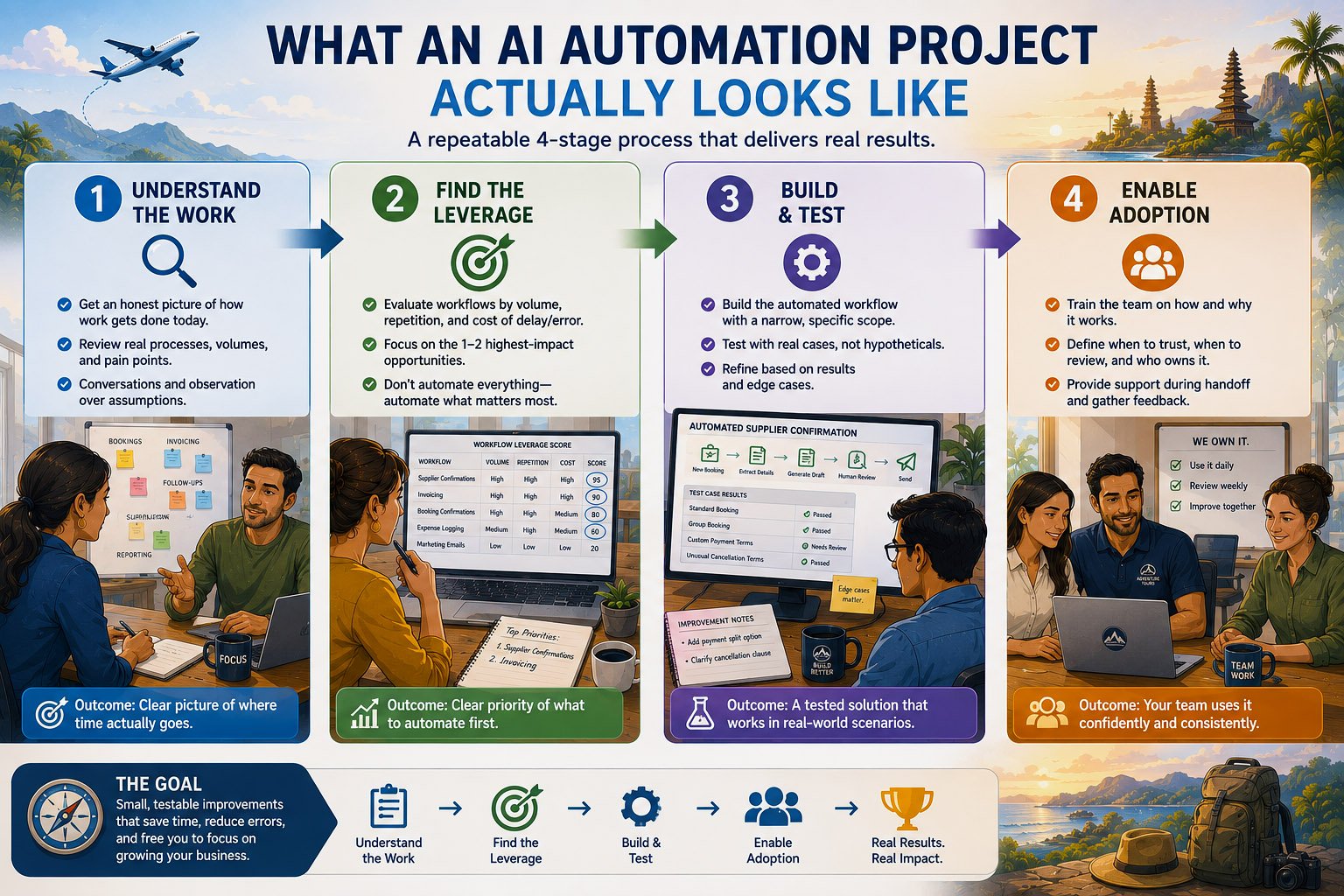
Here’s the straight answer: a repeatable four-stage process — understand the work, find the leverage, build and test, enable adoption — and for most travel businesses, far less disruptive than the phrase “automation project” makes it sound.
An owner has read enough by now — the quick wins, the leverage framework, the honest tradeoffs — and is ready to actually do this. But “let’s automate our workflows” is still a vague enough phrase that it’s worth asking directly: what actually happens once you say yes? Is this a months-long IT project with a dozen meetings, or something more manageable?
Here’s the straight answer: it’s a repeatable four-stage process — understand the work, find the leverage, build and test, enable adoption — and for most travel businesses, it’s considerably more manageable than the phrase “automation project” makes it sound, provided each stage gets the attention it actually needs rather than being rushed through.
The Real Question Behind This
Most owners asking about this aren’t really asking “what are the technical steps.” They’re asking whether this is going to disrupt how their business runs for weeks, whether it requires expertise they don’t have, and whether the investment of time and attention is actually going to pay off or just add another half-finished project to the pile.
A well-run automation project shouldn’t feel like a disruption to your business. It should feel like a series of small, testable improvements that never ask you to bet everything on one big change.
That’s the design principle behind the four-stage process below — each stage is deliberately smaller and more contained than “build an AI system for our business” sounds like it should be.
Stage One: Understand the Work
This stage comes first because skipping it is the single most common reason automation projects solve the wrong problem. It means getting an honest, current picture of what your team actually spends time on — not what anyone assumes, but what a real look at a typical week or two shows. This is more conversation and observation than construction: reviewing actual workflows, actual volumes, actual pain points, rather than starting from a list of things AI can theoretically do.
For a solo operator, this might be a few days of honestly logging admin time. For a larger agency, it might mean brief conversations with several staff members about what actually eats their day. Either way, the output is the same: a clear, evidence-based picture of where time is actually going, replacing the guesswork most businesses start with.
Stage Two: Find the Leverage
Once the work is understood, the next stage narrows that picture down to what’s actually worth automating first — not everything that could theoretically be automated, but the specific workflow or two where automation would make the biggest real difference. This means weighing volume, repetition, and the cost of delay or error against each other, and being willing to set aside workflows that feel important but don’t actually score well against those criteria.
This stage is where a lot of businesses want to skip ahead, either building whatever feels most urgent or whatever a vendor happens to be pitching. AI workflow automation for travel agencies covers this stage in real depth — the specific framework for evaluating which workflow deserves the effort first, and the common trap of automating the most visible task instead of the most costly one.
Stage Three: Build and Test
This is the stage most people picture when they hear “automation project,” but it should be the most contained one if the first two stages were done properly — by this point, the scope is already narrow and specific, not open-ended.
The build itself is rarely the slow part of a well-run project. Understanding the work and finding the real leverage is what takes the care most owners don’t expect to need to spend.
Building means constructing the actual automated workflow — a template system, a drafting assistant, an integrated tool, whatever the previous stages determined was actually warranted. Testing means running it against real cases from your business, not hypothetical or demo scenarios, with a person reviewing the results closely before trusting it more broadly. This stage typically surfaces edge cases the first two stages didn’t anticipate, and a good process expects that rather than treating it as a failure.
Stage Four: Enable Adoption
Most automation projects that fail to deliver lasting value don’t fail at the build stage. They fail here — the system gets built, works fine technically, and then quietly stops being used because the team never fully trusted or understood it.
Adoption means training your team not just on how to use whatever’s been built, but on why it works the way it does — what to do when something doesn’t look right, when to trust the automated output and when to override it, and who’s responsible for reviewing and maintaining it going forward. A good process builds in a defined handoff period, where the system runs with support available, before anyone is expected to run it entirely independently.
In Practice: What Each Stage Actually Produces
- Understanding the work produces a clear, evidence-based picture of where time actually goes — not assumptions, actual observation.
- Finding the leverage produces a specific, ranked answer to what’s worth automating first, and an honest list of what’s not worth automating yet.
- Building and testing produces a working system, tested against real cases from your business, scoped to exactly what the previous stages justified.
- Enabling adoption produces a team that understands and trusts the system enough to keep using it well after the project officially ends.
A Worked Example
A five-person travel agency went through all four stages over about six weeks. The first two — understanding the work and finding the leverage — took roughly half that time, longer than the owner initially expected, but they surfaced a target (supplier confirmation workflow) nobody had considered going in. Building and testing the templated system took under two weeks, since the scope was narrow and specific by that point. Adoption took the remaining time — training two staff members who handled the workflow most, running it alongside the old manual process for a week before fully switching over, and setting a simple monthly check-in to catch anything drifting.
Six weeks sounds long for what turned out to be a fairly modest, templated system — but most of that time went into getting the target right, not building the solution. A rushed process might have built something in a week, aimed at the wrong workflow, and delivered far less value despite moving faster.
What Determines Cost and Timeline
The scope of each stage, and therefore the overall cost and timeline, depends on your business’s size, how organized your current data and processes already are, and how much complexity the chosen workflow actually has. A solo operator automating a single, simple workflow is a much smaller project than a multi-property business automating something that touches several systems. Exact cost and timeline get worked out once the first stage — understanding the work — is actually complete, rather than quoted before anyone knows what the real target and scope will be.
Common Pitfalls
The most common pitfall is compressing or skipping the first two stages entirely, jumping straight to building something because it feels like progress — this consistently produces systems that are technically fine but aimed at the wrong problem. A close second is under-investing in the adoption stage, treating it as a quick handoff meeting rather than the sustained effort it actually takes to build genuine staff trust and understanding. The quieter pitfall is choosing a scope that’s too ambitious for a first project — trying to automate an entire department’s workflows at once, rather than proving the process on one narrow, well-chosen target first.
Why the First Project Matters More Than It Seems
The first automation project a business runs through this process does double duty: it delivers value on its own specific workflow, and it builds the organizational muscle — trust in the process, evidence of what “done well” looks like, staff comfort with testing and adjusting a new system — that makes every subsequent project faster and less fraught.
A business’s second automation project almost always goes more smoothly than the first, not because the workflow is simpler, but because the team already knows what a well-run process feels like.
This is part of why rushing or shortcutting the first project costs more than it seems to in the moment — a rocky first experience makes the whole team more skeptical of the next one, even if the underlying idea was sound.
What Outcomes to Reasonably Expect
Exact results depend on your specific starting point and the workflow chosen, but the realistic shape of a well-run project usually includes measurable time savings on the specific workflow automated, fewer errors in that workflow (not just faster completion), and a team that can explain how and why the system works rather than just operating it by rote.
In Practice: What “Success” Actually Looks Like
- A specific, measurable time savings on the workflow that was actually targeted — not a vague sense of “things feel more efficient.”
- A team that runs the system confidently, without needing outside help for routine use.
- Fewer errors in the automated workflow, not just faster completion of it.
- A clear, evidence-based sense of what to tackle next, since finishing one leverage exercise usually reveals the next-highest-leverage target.
Be cautious of any process that promises dramatic transformation from a single project — a well-run first automation effort delivers real, measurable value on one specific workflow, and that’s the honest, sustainable shape of progress rather than a company-wide overnight change.
How to Know You’re Ready
In Practice: Signs You’re Ready to Start
- You can commit real time to the first two stages, not just the building part — this is where most of the value actually gets determined.
- You’re prepared for the leverage exercise to point somewhere unexpected, rather than confirming whatever you already assumed needed automating.
- Someone on your team can be involved in testing and adoption, not just receive a finished system at the end.
- You’re starting with one workflow, not several at once — a focused first project builds the trust and evidence needed for a second one to go faster.
Frequently Asked Questions
How long does a typical project actually take? It varies with scope, but expect the first two stages — understanding the work and finding the leverage — to take real time, often more than the building stage itself; rushing them is the most common cause of a mismatched project.
Do I need technical expertise to go through this process? Not necessarily — the first two stages are almost entirely non-technical, and the building stage can be handled by a consultant or partner while your team focuses on providing real information and testing feedback.
What if the leverage exercise points to a workflow I didn’t expect? That’s actually a good sign — it usually means the exercise is working as intended, surfacing a genuine bottleneck rather than confirming an assumption made without real evidence.
Can this process work for a solo operator, not just a team? Yes, though it’s typically lighter — a solo operator moves through understanding the work and finding the leverage more quickly, since there’s only one person’s time to audit.
What happens if we build something and it doesn’t actually help? This is exactly why testing against real cases happens before full adoption — if a build isn’t delivering value, that’s caught and adjusted before the team is asked to depend on it.
Should we tackle multiple workflows in our first project? Generally no — one focused project builds real evidence and organizational trust, which makes a second project faster and more confident than trying to do several at once from the start.
How involved does the business owner need to be throughout the process? Most involved during the first two stages, since real business knowledge is essential there; less involved during building, though testing and adoption benefit from ongoing engagement.
What’s the single biggest difference between a project that works and one that doesn’t? Whether the first two stages were given real time and honesty, or rushed through to get to the more exciting-feeling building stage.
Do we need to hire an outside consultant for this, or can we run the process ourselves? Smaller, simpler projects are sometimes manageable internally, especially the first two stages — but many businesses find an outside perspective helpful for keeping the leverage exercise honest, since it’s easy to unconsciously favor the workflow you already wanted to automate.
How do we avoid losing momentum between stages, especially if understanding the work takes longer than expected? Set a specific end date for the first stage in advance, and treat it as a firm checkpoint — open-ended “understanding” phases are where projects most often stall out before ever reaching the build stage.
Final Thoughts
The five-person agency from the worked example didn’t set out to build something impressive — they set out to understand where their time actually went, found the real leverage, built something narrow and well-tested, and made sure their team actually trusted it before calling the project done. That’s the honest shape of what an AI automation project actually looks like: less dramatic than the phrase suggests, and more reliable because of it.
If you’re ready to go through this process for your own business, discuss automating your operations and we’ll start with the first stage — an honest look at where your team’s time is actually going. This fits within the broader picture of back-office and operations automation and AI for the travel industry as a whole.
Last updated: July 2026
Other Reads
- AI for the Travel Industry: A Practical Guide
- AI for Back-Office & Operations in Travel
- Automating Booking & Invoicing with AI
- AI Workflow Automation for Travel Agencies
- Reducing Admin Work in Tour Operations with AI
- What an AI Automation Project Actually Looks Like