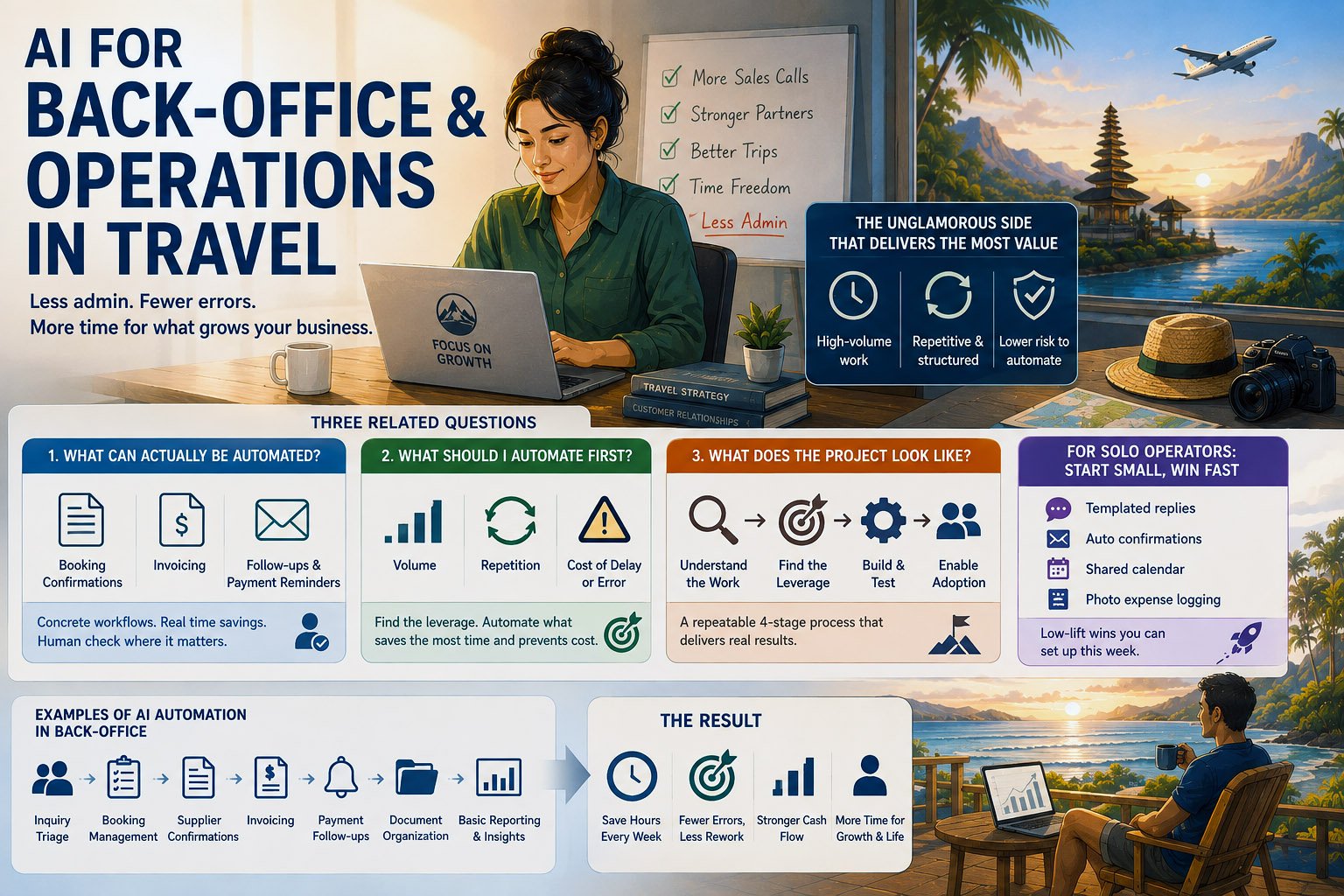
A travel agency owner spends more evening hours on invoicing than on the sales calls that actually grow her business. Another agency owner has read a dozen “AI for travel” articles and still doesn’t know which workflow to automate first. A solo tour operator gets home from guiding and starts the second job nobody sees.
None of these involve a chatbot or a clever itinerary tool. All three are back-office problems — and they’re where AI delivers some of the most reliable, least glamorous value in a travel business. This piece ties together where to start, what to automate first, and what a real project actually involves.
A travel agency owner spends more evening hours on invoicing than she does on the sales calls that actually bring in business. A five-person agency’s owner has read a dozen “AI for travel” articles and still doesn’t know which of his workflows is actually worth automating first. A solo tour operator gets home from guiding, opens his inbox, and starts the second job nobody sees. None of these three problems involves a guest-facing chatbot, a clever itinerary generator, or anything that would make for an exciting conference talk. All three are back-office problems, and all three are exactly where AI delivers some of the most reliable, least-discussed value in a travel business.
Back-office automation doesn’t get the attention guest-facing AI does, because formatting an invoice or drafting a supplier confirmation isn’t a compelling demo. But it’s frequently the highest-return place to start, precisely because these tasks are repetitive, structured, and low-risk to automate compared to anything touching the guest relationship directly.
Why the Unglamorous Layer Is Often the Highest-Value One
Guest-facing AI gets the marketing budget and the conference stage time. Back-office automation gets ignored, not because it matters less, but because nobody wants to describe “I automated my invoicing” as their big AI story. That’s a shame, because the actual math usually favors the boring option: back-office tasks tend to be higher-volume, more repetitive, and lower-stakes to get slightly wrong than guest-facing conversations, which makes them a genuinely safer and often faster place to see real time savings.
The most impressive-sounding AI project and the highest-ROI one are rarely the same project. For most travel businesses, the highest-ROI one is quietly fixing the invoicing process nobody wants to talk about.
The Three Related Questions This Covers
Back-office automation for a travel business really breaks down into three related questions, each covered in more depth elsewhere on this site.
| Question | What it covers |
|---|---|
| What can actually be automated? | Booking confirmations, invoicing, follow-ups — the concrete starting point |
| What should I automate first? | A leverage framework for choosing between competing priorities |
| What does the actual project look like? | The real stages of an automation engagement, end to end |
There’s a fourth angle specifically for solo and very small operators, since the right starting point looks different when there’s no team to spread the work across — concrete, low-lift wins rather than a full framework.
Booking & Invoicing: The Most Concrete Starting Point
For most travel agencies and DMCs, booking confirmations, invoicing, and payment follow-ups are the most concrete, fastest-to-automate layer of back-office work — repetitive, structured, and largely low-risk once a human check is built into the process. The honest caveat here matters: invoicing mistakes are financial, not just informational, and carry more real cost than a wrong chatbot answer, which means a human check-in stays part of the process longer than it might for other automated tasks. automating booking and invoicing covers exactly where the automation ceiling sits for each of these three workflows, and what genuinely still needs a human’s judgment.
Finding the Leverage: Choosing What to Automate First
Most businesses don’t have a shortage of things that could theoretically be automated — they have a shortage of a method for choosing between them. The right first target isn’t whatever feels most urgent or whatever a vendor happens to be pitching; it’s the workflow that scores highest on volume, repetition, and cost of delay or error, evaluated together rather than any single one in isolation.
The workflow that’s most tempting to automate first and the workflow that would actually save the most time are frequently two different things.
AI workflow automation for travel agencies covers this leverage framework in full, including the common trap of automating the most visible workflow instead of the most costly one, and how the highest-leverage target tends to shift as an agency grows.
For Time-Poor Solo Operators: Start Smaller
The leverage framework assumes some capacity to run a two-week audit and think through tradeoffs — a reasonable assumption for an agency with a team, but not always for a solo operator drowning in admin with zero spare hours. For that situation, the right advice inverts: skip the framework for now, and start with a handful of concrete, low-effort wins — templated replies, auto-generated confirmations, a single shared calendar, photo-based expense logging — that can be set up in twenty minutes each, one at a time. reducing admin work with AI covers these specific quick wins for operators who genuinely don’t have the bandwidth for a bigger project right now.
What a Real Engagement Involves
For businesses ready to move past quick wins into something more structured, an automation project follows a repeatable shape: understand the work, find the leverage, build and test, enable adoption. Each stage is deliberately smaller and more contained than “build an AI system for our business” makes it sound, and the biggest determinant of whether a project actually delivers value is whether the first two stages get real time and honesty, rather than being rushed through to reach the more exciting-feeling building stage. what an AI automation project looks like walks through all four stages in detail, including a worked example and what outcomes are realistic to expect.
How These Four Pieces Fit Together
In Practice: How These Four Pieces Connect
- If you have zero spare time, start with the quick wins — they’re designed to work without any framework or process at all.
- Once quick wins are running smoothly, the leverage exercise helps identify what’s actually worth a bigger, more structured effort next.
- Booking and invoicing is usually where the leverage exercise points, for agencies and DMCs specifically, since it tends to score high on volume, repetition, and cost of error.
- The four-stage project process is how you actually build and adopt whatever the leverage exercise identifies — it’s the “how,” not a separate decision about “what.”
None of these four pieces is a complete answer on its own — together, they cover the realistic path from “buried in admin” to “running a system that actually works,” at whatever pace and scale fits your specific business.
Why This Layer Delivers More Reliable Value Than It Gets Credit For
Guest-facing AI carries real reputational risk if it goes wrong in front of a guest, in real time, with no chance to quietly fix it first. Back-office automation carries a different, generally lower risk profile — a formatting error in an internal draft gets caught before anything reaches a client; even a mistake that does reach a client, in a standard confirmation or invoice, is usually correctable without lasting damage if caught quickly. This lower risk ceiling is exactly why back-office automation tends to deliver more consistent, less dramatic-but-more-reliable value than flashier guest-facing projects, especially as a first AI initiative for a business still building trust in the whole idea of automation.
Back-office automation rarely makes for an exciting case study. It’s also rarely the project that goes visibly, publicly wrong — which makes it the safer place to build organizational confidence before tackling anything guest-facing.
The Honest Tradeoffs
It’s worth being direct about what back-office automation costs a business if it goes wrong, since the caution here differs by workflow. Booking confirmation errors are usually a minor embarrassment, correctable with an apology and a fix. Invoicing errors are financial and take real time to untangle — a wrong currency conversion or missed line item doesn’t just look sloppy, it creates an actual discrepancy someone has to track down and resolve, and it can genuinely dent trust with a client or supplier. Workflow automation chosen poorly — targeting the wrong leverage point — doesn’t fail loudly, it just quietly underdelivers, leaving a team unconvinced that automation is worth the effort at all, which can delay a genuinely valuable second attempt.
None of this argues against back-office automation — it argues for the pattern that runs through every piece of this pillar: start narrow, keep a human check in the loop where the stakes are financial, and prove value on one workflow before expanding.
Measuring Whether Back-Office Automation Is Actually Working
Across all four pieces of this pillar, the real measure of success is the same, even though the specific numbers differ by workflow: is your team spending measurably less time on repetitive formatting and admin, and is that time visibly going toward higher-value work rather than just being absorbed into general busyness?
In Practice: What to Track Across Any Back-Office Project
- Hours spent on the specific workflow automated, before and after — the clearest, most direct signal available.
- Error rates on financial documents specifically, which should hold steady or improve, never quietly worsen in exchange for speed.
- Whether the time saved actually shows up somewhere else — more sales calls made, more attention on client relationships, an earlier end to the workday — rather than simply vanishing into other busywork.
- Staff confidence in the system, since a tool nobody trusts enough to rely on isn’t delivering its promised value even if it’s technically functioning.
If hours saved are real, errors stay low, and staff genuinely trust the system, that’s the signal to consider what’s next — whether that’s expanding scope, tackling the next-highest-leverage workflow, or finally turning attention to guest-facing AI with the organizational confidence a successful back-office project builds.
A Composite Year
Picture the same three businesses from the opening, a year after each started with the approach suited to their situation.
The agency owner who used to spend her evenings on invoicing now has a templated system pulling confirmed booking details straight into formatted invoices, with a two-minute human check before anything goes out — her evening hours went from mostly invoicing to mostly the sales and relationship work that actually grows her business. The agency owner unsure where to start ran the leverage exercise and found, to his own surprise, that supplier confirmations — not guest-facing chat — were his highest-leverage target; that project, done narrow and well-tested, gave his team enough confidence to tackle a second, more ambitious project a few months later. The solo tour operator started with four small wins over three weeks, recovered a meaningful chunk of his evenings almost immediately, and — deliberately — didn’t touch anything more sophisticated for two months, letting the improvement settle before considering what was next.
None of these three ended up with a dramatically transformed business. All three ended up with real, specific hours back, spent on the parts of the work that actually needed them.
Common Mistakes Across Back-Office Automation
The most common mistake, across every workflow covered in this pillar, is skipping straight to building something without first understanding where time actually goes or which workflow has real leverage — this produces technically fine systems aimed at the wrong problem. A close second is treating financial workflows like invoicing with the same light-touch automation appropriate for lower-stakes tasks like drafting a supplier inquiry — the cost of an error is different, and the human oversight should reflect that difference for longer than it needs to elsewhere. The quieter mistake, most relevant for solo operators specifically, is attempting too much at once out of frustration with accumulated admin — a rushed, ambitious first attempt is far more likely to be abandoned than a modest one that actually gets finished and used.
Staffing and Adoption
Every piece of back-office automation covered here ultimately depends on someone actually using it consistently — a templated invoicing system nobody checks drifts toward errors; a leverage exercise nobody revisits goes stale as the business changes; quick wins nobody maintains quietly stop being wins.
In Practice: Building This Into How Your Team Works
- Assign clear ownership for reviewing and maintaining whatever gets automated, even if it’s just one person checking in monthly.
- Revisit the leverage exercise periodically, since the highest-leverage workflow shifts as a business grows or changes.
- Treat a slow period as a chance to catch up on review, not a reason to skip it — the habits built during quiet times are what carry through busy ones.
- Involve the staff who’ll actually use each piece during testing, not just at rollout, since their early friction usually points at real gaps worth fixing.
This connects closely to AI adoption roadmaps more broadly — back-office automation is one of the clearest examples of a project whose value depends entirely on whether a team keeps using it well after the initial setup, not just on whether it was built correctly.
How This Fits the Bigger Picture
Back-office automation is one piece of a larger picture — see AI for the travel industry overview for the full landscape, including AI for guest experience and AI revenue management, which shape the guest-facing and pricing sides of a travel business respectively. If your business operates specifically in Bali’s tourism sector, the same fundamentals of starting narrow, checking financial workflows carefully, and building team trust apply at a different scale — see AI for Bali tour operators for that version of the picture.
How to Know You’re Ready to Start
In Practice: Readiness Signs
- You can name a specific back-office pain point — invoicing hours, an unclear sense of what to automate first, or simply too little time to think strategically about any of it — rather than a vague sense that “we should modernize.”
- You’re honest about your own capacity — a solo operator with zero spare hours should start with quick wins, not a full leverage exercise, and that’s a legitimate starting point, not a lesser one.
- You’re prepared to keep a human check on anything financial, at least until the system has earned trust over real time.
- Someone can commit to maintaining whatever gets built, even modestly, since unmaintained automation degrades faster than no automation at all.
Frequently Asked Questions
Where should I actually start if I’m not sure which of these four pieces applies to me? If you have almost no spare time, start with the quick wins. If you have some capacity and multiple workflows competing for attention, start with the leverage exercise. If your leverage exercise points to booking or invoicing specifically, that piece covers it in depth. And once you’re ready for something more structured, the project-process piece covers what to expect.
Is back-office automation really higher-value than guest-facing AI? Not universally — it depends on your specific bottleneck — but it’s frequently lower-risk and faster to prove value on, which makes it a strong candidate for a first automation project even when guest-facing AI is also worth pursuing eventually.
How much time should I expect to invest before seeing results? Quick wins can show results within days. A properly-run leverage exercise and first structured project typically takes several weeks, with most of that time going into understanding the work and finding the right leverage rather than building.
Do I need different tools for booking automation versus invoicing versus admin quick wins? Not necessarily — many businesses use overlapping or connected tools across these areas, though the right starting tier (simple template versus more integrated system) differs by workflow and by how much volume and complexity is involved.
What’s the biggest risk specific to this category of automation, compared to guest-facing AI? Financial errors in invoicing carry more real cost than a wrong chatbot answer, which is why a human check stays in the loop longer here than it might for lower-stakes, guest-facing tasks.
Can a solo operator eventually use the full four-stage project process, or is that only for larger businesses? A solo operator can absolutely use it, typically in a lighter, faster form — but starting with quick wins first, before attempting a full structured project, tends to be the more sustainable path for someone with very little spare capacity.
How do I know if my agency has outgrown quick wins and needs the fuller leverage exercise? If you have a team, meaningful volume, and several competing workflows that all feel worth automating, that complexity itself is the signal — quick wins work best for a single person or a very small, simple operation.
What’s the most common reason a back-office automation effort fails to deliver value? Skipping the understanding and leverage stages and building something based on assumption or a vendor’s pitch rather than actual evidence about where time and money are really being lost.
Should back-office automation come before or after guest-facing AI projects? There’s no universal rule, but back-office work is often the safer, faster-to-prove first project precisely because the stakes of a mistake are lower and more contained — many businesses build organizational confidence here before tackling guest-facing automation.
How do I keep momentum going once the first back-office project is done? Revisit the leverage exercise for what’s next, rather than assuming the work is finished — most businesses have more than one workflow worth automating, and the second project usually moves faster with the first one’s lessons in hand.
Is it worth documenting what we learn from a back-office automation project? Yes — a short written record of what worked, what didn’t, and why saves real time on future projects and helps new team members understand the reasoning behind systems they didn’t build themselves.
Final Thoughts
The travel agency owner buried in invoices, the agency owner unsure what to automate first, and the solo tour operator losing his evenings to admin are all solving a version of the same problem, at different scales and with different starting points available to them. None of their solutions made for an exciting story. All three got real, specific time back — which was always the actual point.
Back-office automation done well doesn’t look like a transformation. It looks like an evening that ends earlier, an invoice that goes out correct the first time, and a team that trusts the systems it’s using enough to keep using them.
Last updated: July 2026