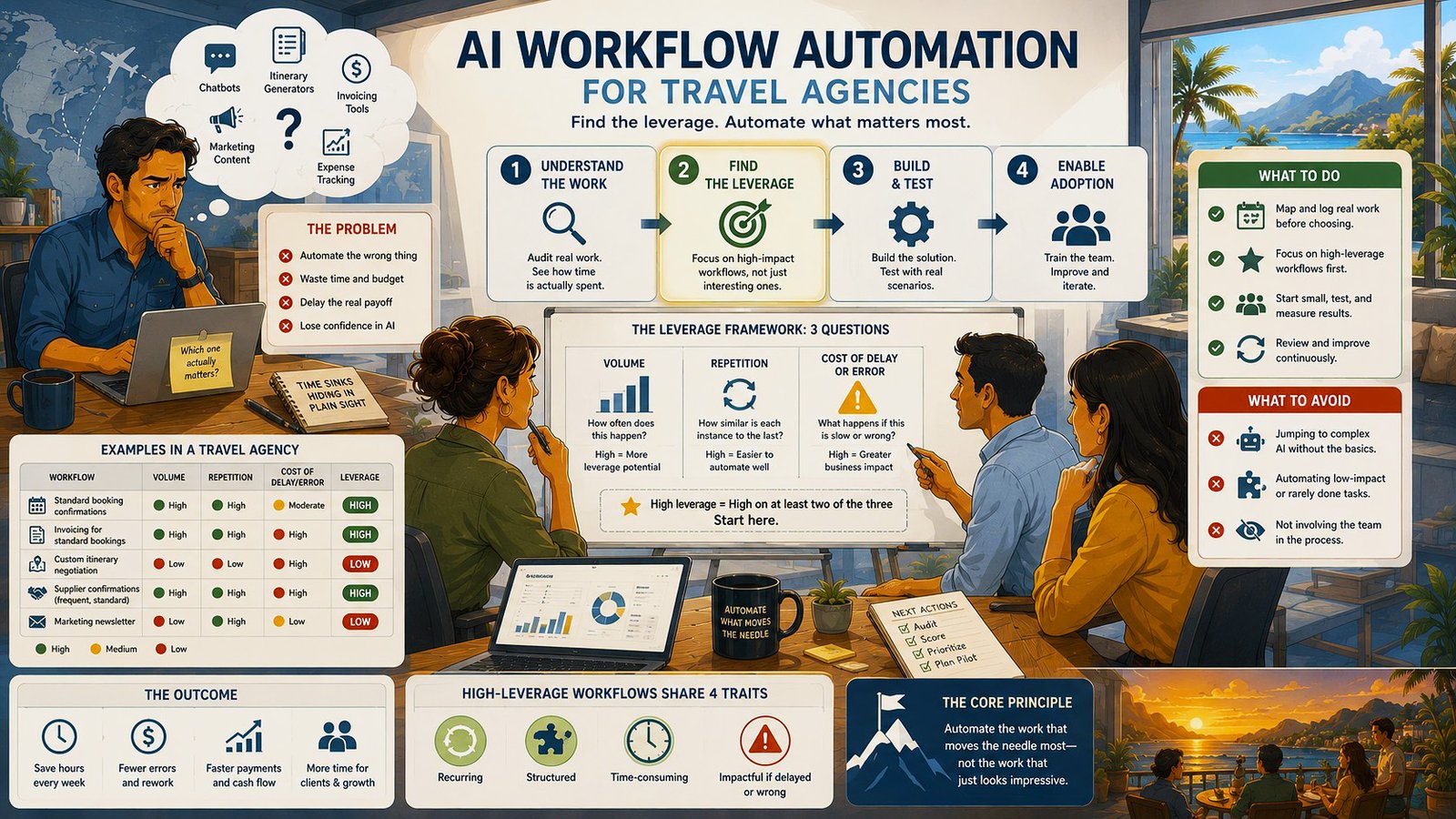
A travel agency owner reads “10 ways AI can transform your travel business” and comes away more confused than when he started. He picks the flashiest one — an itinerary tool — spends a month setting it up, and saves maybe twenty minutes a week. Meanwhile the real time sink, a manual supplier-confirmation process eating two hours daily, goes untouched because it never made anyone’s top-ten list.
This piece isn’t another list of possibilities. It’s a method — three questions that tell you which workflow is actually worth automating first, and why the answer is rarely the one you’d expect.
A travel agency owner reads a list of “10 ways AI can transform your travel business” and comes away more confused than when he started. Chatbots, itinerary generators, invoicing tools, marketing content, expense tracking — all plausible, none prioritized, and no way to tell which one would actually make the biggest difference to his specific agency versus which one just sounded most impressive on a vendor’s homepage. He picks one — a flashy itinerary tool — spends a month setting it up, and finds it saves him maybe twenty minutes a week. Meanwhile, the real time sink, a manual supplier-confirmation process that eats two hours daily, goes untouched because it never made anyone’s top-ten list.
That’s the actual problem with most AI-for-travel-agency advice: it’s a menu of possibilities, not a method for choosing between them. This piece is about the method — specifically, how to find the leverage: the handful of workflows where automation would genuinely move the needle for your business, as opposed to the ones that just sound good in a pitch deck.
Why This Decision Matters
Automating the wrong workflow first doesn’t just waste the time spent building it — it also delays the payoff from the workflow that actually mattered, and it can sour an owner or a team on automation entirely if the first attempt doesn’t deliver visible value. Given limited time and attention, the sequence in which workflows get tackled matters almost as much as whether they get automated at all.
Most agencies don’t fail at automation because the technology didn’t work. They fail because they automated the workflow that was easiest to picture, not the one that was actually costing them the most.
The Four-Step Approach, and Where “Finding the Leverage” Fits
Any AI project worth doing follows roughly the same shape: understand the work, find the leverage, build and test, enable adoption. This piece is squarely about the second step, because it’s the one most commonly skipped — owners tend to move straight from “we should use AI” to “let’s build something,” without the deliberate middle step of figuring out which specific workflow deserves the effort.
Understanding the work comes first, and briefly: this means having an honest, current picture of what your team actually spends time on day to day — not what you assume they spend time on, but what a real audit of a typical week would show. Without this, “finding the leverage” is just guessing with more confidence.
The Leverage Framework: Three Questions for Every Workflow
Once you have a real picture of what your team does, evaluate each recurring workflow against three questions.
Volume — how often does this happen? A task done fifty times a week has more raw leverage potential than one done twice a month, all else being equal.
Repetition — how similar is each instance to the last? A workflow that’s genuinely the same shape every time (a standard booking confirmation) automates cleanly. One that varies significantly case to case (a complex custom itinerary negotiation) resists automation, or only partially benefits from it.
Cost of delay or error — what actually happens if this task is slow or gets something wrong? A delayed marketing newsletter costs little. A delayed supplier confirmation on a time-sensitive booking can cost a sale. An invoicing error costs real money and trust to unwind.
High leverage sits where all three point the same direction: frequent, repetitive, and costly if mishandled or delayed. Low leverage is where a workflow is infrequent, highly variable, or low-stakes even when it goes wrong — these are rarely worth automating first, regardless of how technically interesting the automation would be.
In Practice: Scoring Your Workflows
- List every recurring workflow your team handles for two weeks, without judging which seems automatable yet.
- Rate each on volume, repetition, and cost of delay or error, on a simple high/medium/low scale rather than an elaborate scoring system.
- Look for workflows that score high on at least two of the three — these are your leverage candidates.
- Set aside anything that’s low on all three — it may be worth automating eventually, but it’s not where to start.
High-Leverage vs. Low-Leverage: Concrete Examples for a Travel Agency
Applying this to a typical agency’s actual workflows makes the framework concrete rather than abstract.
| Workflow | Volume | Repetition | Cost of delay/error | Leverage |
|---|---|---|---|---|
| Standard booking confirmations | High | High | Moderate | High |
| Invoicing for standard bookings | High | High | High | High |
| Custom itinerary negotiation | Moderate | Low | High | Low (for automation) |
| Supplier availability checks | High | High | High | High |
| Marketing newsletter drafting | Low | Moderate | Low | Low |
| Payment reminder follow-ups | High | High | Moderate | High |
| Expense and commission tracking | Moderate | High | Moderate | Moderate |
| Client onboarding for a first-time booker | Low | Moderate | Moderate | Low to moderate |
The highest-leverage workflows are almost never the ones that make for an exciting pitch. They’re the boring, high-volume, repetitive ones nobody wants to talk about at a conference.
Notice that “custom itinerary negotiation” — probably the workflow that feels most central to what makes a travel agency valuable — scores low for automation specifically, not because it’s unimportant, but because its low repetition means automation has little to work with. That’s not a flaw in the framework; it’s the framework correctly identifying that some of your most valuable work is exactly the work that should stay human.
Questions That Reveal Hidden Leverage
Some of the highest-leverage workflows aren’t obvious because they don’t feel like “a workflow” — they feel like background noise, the stuff that just happens.
In Practice: Questions That Reveal Hidden Leverage
- What do you find yourself doing at the same time, in the same way, almost every single day — even if it only takes a few minutes each time?
- What task do you dread most on a Monday morning, not because it’s hard, but because it’s tedious and repetitive?
- What’s the first thing that falls behind when you’re busy or short-staffed — that backlog is usually revealing a workflow with real, uncaptured volume?
- What do new hires take the longest to learn, not because it’s conceptually difficult, but because it involves a lot of small, repetitive judgment calls that could be templated?
These questions often surface workflows that never would have made a list generated from memory alone, because they’re too routine to feel notable — which is exactly why they tend to have real leverage once actually measured.
The Trap of Automating the Most Visible Workflow
There’s a specific, common trap worth naming directly: automating the workflow that’s most visible to clients or most impressive to describe, rather than the one that’s actually costing the most time internally. A guest-facing chatbot is visible and easy to talk about at a networking event. A backend supplier-confirmation process that eats two hours a day is invisible to everyone except the person doing it — and is very often the higher-leverage target.
The workflow you’d be proudest to describe to another agency owner and the workflow that’s actually costing you the most time are frequently two different things. Choose based on the leverage framework, not the story you’d want to tell.
This trap is worth being honest with yourself about, because the pull toward the visible, exciting option is real — automating something guest-facing feels like “doing AI” in a way that fixing an internal supplier workflow doesn’t, even when the internal fix would save far more time.
How Leverage Changes as Your Agency Grows
The specific workflows with the highest leverage shift as an agency’s size and structure change, and it’s worth revisiting the exercise periodically rather than treating it as a one-time analysis.
A small agency — an owner and one or two staff — often finds the highest leverage in the most personally time-consuming tasks: whatever the owner spends the most evening and weekend hours on, since that time is the scarcest resource in the business. A growing agency, adding staff and volume, often finds leverage shifting toward consistency workflows — making sure every staff member handles a standard booking or invoice the same correct way, since inconsistency starts to cost more as more people are involved. A larger, more established agency often finds the highest remaining leverage in workflows that connect systems — passing information between booking, invoicing, and supplier communication without manual re-entry at each handoff.
A Worked Example
A five-person agency ran the two-week workflow audit and was surprised by the result. The owner had assumed the highest-leverage target would be guest-facing communication, since that’s what felt most urgent day to day. The audit told a different story: supplier availability checks — calling or emailing suppliers to confirm space before finalizing a booking — happened dozens of times a week, followed an almost identical pattern every time, and directly affected how fast a booking could be confirmed, which affected whether the client stuck around or booked elsewhere.
That became the first automation target, well before anything guest-facing. A templated supplier-inquiry system, drafting the standard availability request and tracking responses, cut the average confirmation turnaround meaningfully within the first month. Guest-facing chatbot work came later, once this backend workflow was running smoothly — and by then, the team had a much clearer, evidence-based sense of what “worth automating” actually looked like for their business, rather than guessing from a generic list.
Common Mistakes
The most common mistake, by a wide margin, is skipping the leverage exercise entirely and automating whatever workflow comes to mind first or whatever a vendor happens to be selling. A close second is running the exercise once and never revisiting it, even as the agency’s size, staffing, and workflows change — leverage shifts, and a target that made sense a year ago may not be the highest-leverage one anymore. The quieter mistake is treating “high volume” alone as sufficient justification without checking repetition and cost of delay — a high-volume but highly variable task (like custom itinerary building) doesn’t automate cleanly just because it happens often.
What Happens When You Get the Leverage Assessment Wrong
It’s worth being honest that this framework doesn’t guarantee a perfect first choice — sometimes a workflow that looked high-leverage on paper turns out, once actually automated, to save less time than expected, or to need more human oversight than anticipated to stay accurate. This isn’t a failure of the method; it’s a normal part of testing an assessment against reality.
A leverage assessment is a well-informed hypothesis, not a guarantee. The point isn’t to get it perfectly right on the first try — it’s to make a far better first guess than picking based on what sounds impressive.
When this happens, the right response is to treat it as information rather than a reason to abandon the framework — either the workflow needs a narrower scope than first attempted, or the initial scoring missed something about how variable the task actually was in practice. Either way, the next-highest-scoring candidate from the original audit is usually a better next step than starting the whole exercise over from scratch.
From Finding Leverage to Building
Once you’ve identified your highest-leverage workflow, the next steps are building and testing it against real cases, then working on team adoption — the stages that come after this one. If your highest-leverage workflow turns out to be booking confirmations, invoicing, or payment follow-ups, automating booking and invoicing covers what realistic automation of that specific area looks like, including honest notes on what still needs a human. More broadly, this exercise sits within the wider question of reducing admin work with AI across a travel business.
Common Objections to This Framework
“Everything feels urgent” is the most common pushback, and it’s worth taking seriously rather than dismissing — but urgency and leverage aren’t the same thing. A client complaint feels urgent in the moment; a slow supplier-confirmation process is a quieter, compounding cost that rarely feels urgent on any single day but adds up to far more lost time over a month. The leverage framework is specifically designed to surface the second kind of problem, which busy owners consistently underweight in favor of whatever feels most pressing today.
A second objection: “our workflows are too varied to score this way.” In practice, most agencies find that even highly personalized service has a repeatable structural core — the specific recommendations vary, but the process of confirming availability, sending a confirmation, and issuing an invoice usually doesn’t. The framework asks you to separate the variable, judgment-heavy part of a workflow from its repeatable structural shell, rather than assuming the whole thing is too unique to touch.
Choosing What Not to Automate
The leverage framework is as useful for what it rules out as for what it recommends. Workflows that are low-volume, highly variable, or low-stakes when they go wrong are usually not worth the effort of automating, even if a tool exists that technically could — the time spent building and maintaining that automation would outweigh the modest time it saves. It’s worth being deliberate about naming these explicitly, rather than leaving them as an unspoken assumption, so the team understands why certain tasks are staying manual on purpose rather than by oversight.
In Practice: Workflows Usually Worth Leaving Manual
- Custom itinerary negotiation — high value, but low repetition means little automation leverage.
- Sensitive client relationship conversations — complaints, disputes, anything emotionally charged.
- Low-frequency, high-variability admin tasks — the odd one-off request that doesn’t recur often enough to justify building for it.
- Anything where the “automated” version would need more oversight time than the manual version currently takes.
How to Know You’re Ready to Run This Exercise
In Practice: Signs You’re Ready
- You (or your team) can commit to two weeks of honestly logging what you actually spend time on, not what you assume you spend time on.
- You’re prepared for the leverage exercise to point somewhere unglamorous — the highest-leverage workflow is rarely the most exciting one to describe.
- You’re willing to leave some valuable work manual on purpose, once it’s clear automation wouldn’t actually help there.
- Someone can revisit this exercise periodically, since leverage shifts as your agency’s size and workflows change.
Measuring Whether You Found the Right Leverage
Once a workflow is automated, it’s worth checking whether the leverage assessment was actually correct, rather than assuming it was because the automation itself works.
The clearest signal is time: did the hours previously spent on this specific workflow measurably drop, and did that time visibly get redirected toward higher-value work rather than just absorbed into busyness elsewhere? A second signal is consistency: did the workflow become more reliably correct across different staff members, not just faster? A third, more qualitative signal is whether the team’s own sense of “what’s actually slowing us down” shifted — if a new bottleneck becomes obvious once the old one is fixed, that’s a sign the leverage exercise is working as intended, surfacing the next real priority rather than a false one.
If none of these signals show up after a reasonable trial period, it’s worth revisiting whether the workflow was actually as high-leverage as the initial scoring suggested, or whether the scoring missed something about how the task actually worked in practice.
Frequently Asked Questions
How long should the initial workflow audit take? Two weeks is usually enough to capture a representative picture, including both a typical week and at least one busier period, without dragging the exercise out so long that it becomes its own burden.
What if my team resists logging their time for the audit? Frame it as diagnostic, not evaluative — the goal is understanding where time actually goes, not judging how anyone spends it, and being explicit about that framing helps reduce defensiveness.
Can one workflow have high leverage for automation but still need to stay partly manual? Yes, and this is common — a workflow can be automated for its standard cases while staying manual for its exceptions, which is often the most realistic outcome rather than an all-or-nothing choice.
How do I know if I’ve correctly identified the highest-leverage workflow, versus just a high-leverage one? Compare your top two or three candidates directly against each other using the same three questions, rather than stopping at the first one that scores well — the exercise works best as a genuine comparison, not a first-match search.
Should I automate multiple workflows at once if several score high? Generally no — tackling one at a time, proving it works, and building organizational trust in the process before moving to the next tends to produce better results than spreading effort across several simultaneously.
Does this framework apply the same way to a DMC as to a retail travel agency? The three questions apply the same way, though the specific workflows that score highest often differ — a DMC’s highest-leverage workflow is often supplier and logistics coordination, while a retail agency’s is often client communication and booking confirmation.
What if the highest-leverage workflow seems too complex to automate well? Consider whether a partial automation — handling the standard cases while routing complex ones to a person — captures most of the value without requiring a fully comprehensive solution.
How often should I redo the leverage exercise? Revisiting it annually, or after any significant change in team size or booking volume, is a reasonable cadence — leverage shifts as the business does.
Is it ever worth automating a low-leverage workflow anyway? Occasionally, if it’s cheap and fast to automate and the team finds it personally draining even at low volume — but this should be a deliberate, secondary choice, not a substitute for tackling the actual highest-leverage target first.
What if the audit reveals that most of our time goes to something we can’t automate at all, like phone calls? That’s still useful information — it may point toward automating what surrounds the calls (scheduling, follow-up, note-taking) rather than the calls themselves, or toward a different kind of process change entirely.
How do I get buy-in from staff who are skeptical the audit will lead anywhere useful? Share the framework with them upfront, including the three questions, so the exercise feels like a genuine diagnostic tool rather than a prelude to a decision that’s already been made.
Can this framework be used for decisions beyond just AI automation? Yes — the same three questions (volume, repetition, cost of delay or error) are useful for prioritizing any process improvement, not just ones involving AI specifically.
Final Thoughts
The agency owner from the opening didn’t need a longer list of things AI could theoretically do for his business. He needed a method for figuring out which one to do first — and the honest answer, once he actually looked, was the unglamorous supplier-confirmation process eating two hours a day, not the itinerary tool that looked more impressive in a demo.
That’s the real value of finding the leverage before building anything: it turns “we should probably use AI somewhere” into a specific, evidence-based answer about where. This fits within the broader picture of back-office and operations automation and AI for the travel industry as a whole.
Last updated: July 2026