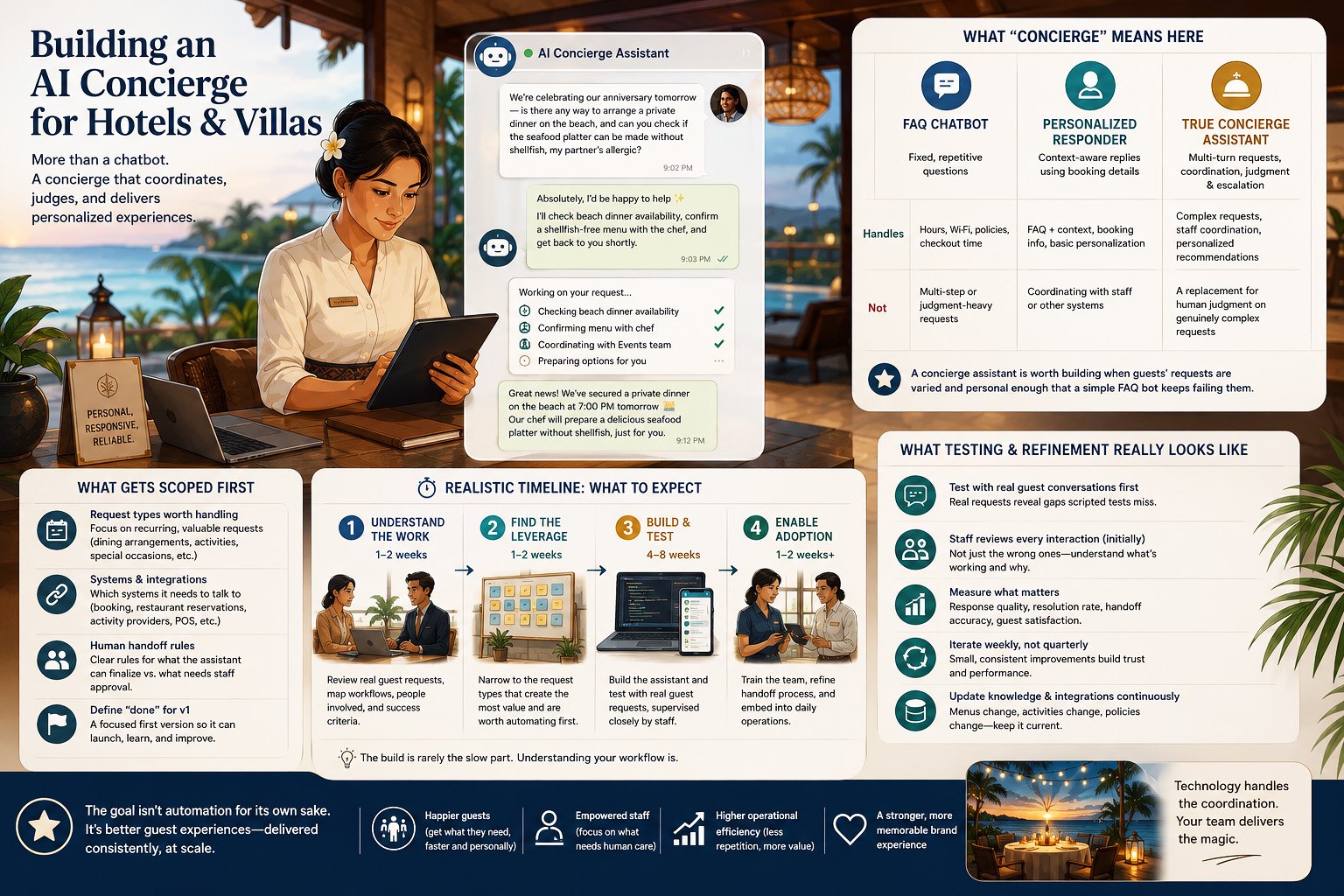
A guest messages a boutique hotel at 9 p.m.: “We’re celebrating our anniversary tomorrow — any way to arrange a private beach dinner, and can the seafood platter skip shellfish? My partner’s allergic.” That’s not a question a simple FAQ bot answers. It needs coordination — kitchen, availability, timing.
This piece breaks down what building a real AI concierge actually involves: what gets scoped first, a realistic timeline, and what “testing and refinement” means in practice — so you know exactly what you’re signing up for before the first conversation about building one.
A guest messages a boutique hotel at 9 p.m.: “We’re celebrating our anniversary tomorrow — is there any way to arrange a private dinner on the beach, and can you check if the seafood platter can be made without shellfish, my partner’s allergic?” That’s not a question a simple FAQ bot answers. It needs coordination — checking with the kitchen, checking beach availability, confirming timing — the kind of judgment a real concierge exercises every day.
That’s the real distinction behind “AI concierge assistant,” and it’s worth being clear about before scoping a build: a concierge assistant isn’t a faster FAQ bot. It’s a system built to handle multi-step, personalized requests with enough judgment to know what needs a human and what doesn’t — which makes it a bigger, more valuable, and more involved project than the guest-facing chatbots covered elsewhere on this site.
The Real Question Behind “Building an AI Concierge”
Most owners asking about this aren’t really asking “can AI do this.” They’re asking whether the investment is worth it compared to simply hiring more front-desk staff, or whether a simpler chatbot would cover most of what they actually need. That’s the right question to ask before scoping anything.
A concierge assistant is worth building when your guests’ requests are varied and personal enough that a simple FAQ bot keeps failing them — not because “concierge” sounds more impressive than “chatbot.”
If most of your guest questions are genuinely repetitive — pool hours, Wi-Fi password, checkout time — a simpler AI chatbots for travel businesses layer solves that more cheaply and faster. A concierge-level build makes sense when requests routinely require coordination, judgment, and a personal touch that a simple FAQ layer can’t provide.
What “Concierge” Actually Means Here
The term gets used loosely, so it’s worth being precise about the tiers.
| Tier | What it handles | What it’s not |
|---|---|---|
| FAQ chatbot | Fixed, repetitive questions (hours, Wi-Fi, policies) | Multi-step or judgment-heavy requests |
| Personalized responder | FAQ plus context-aware replies referencing booking details | Coordinating with staff or other systems |
| True concierge assistant | Multi-turn requests, staff coordination, personalized recommendations, escalation judgment | A replacement for human judgment on genuinely complex requests |
A true concierge assistant sits at the top of that range — it can hold a multi-turn conversation, draw on what a guest has already told it, flag requests that need a human decision (dietary restrictions with real health stakes, anything involving cost approval), and coordinate the practical logistics of a request like the anniversary dinner above, drafting the outreach to relevant staff so a human just has to approve and finalize.
What a Typical Build Actually Scopes First
In Practice: What Gets Scoped First
- The specific request types worth handling — not “everything a guest might ask,” but the recurring categories (dining arrangements, activity bookings, special occasion requests) that come up often enough to justify building for them.
- Which systems it needs to talk to — your booking system, restaurant reservation system, activity providers — since integration complexity is usually the biggest driver of scope and cost.
- Where the human handoff happens — every request type gets a clear rule for what the assistant can finalize versus what needs staff approval.
- What “done” looks like for version one — a deliberately narrower first version, not the full vision, so it can actually launch and be tested against real guests.
Timeline: What to Realistically Expect
Most concierge-assistant builds follow a recognizable shape, even though the specific weeks vary by scope.
The build itself is rarely the slow part. Understanding your actual workflow well enough to build the right thing is what takes the time most owners don’t expect to spend.
Understanding the work comes first — sitting with your team, reviewing real guest requests from the past few months, and identifying which request types are common enough and complex enough to be worth building for. This stage is more conversation than construction, and rushing it is the single most common reason a concierge project ends up solving the wrong problem.
Finding the leverage narrows scope to the specific request types worth automating first — usually a handful, not everything the guest might conceivably ask.
Building and testing is where the assistant actually gets constructed and tried against real, messy guest requests — not hypothetical ones — with staff reviewing every interaction closely during this stage.
Enabling adoption is the final stage, and often the one that determines whether the whole project sticks: staff need to trust the assistant’s judgment about when to hand off, and need an easy way to correct it when it gets something wrong.
What “Testing and Refinement” Actually Looks Like
This phrase gets used vaguely in most vendor pitches, so it’s worth being concrete about what it actually involves.
In Practice: What Testing and Refinement Really Means
- Running the assistant against real guest conversations first, not scripted test cases — real requests are messier and reveal gaps scripted tests miss.
- A staff member reviewing every interaction during the first few weeks, not just the ones that seem to have gone wrong.
- Adjusting the handoff rules based on what actually gets escalated — if the assistant is escalating too much or too little, that’s a sign the rules need tuning, not that the whole approach failed.
- A defined point where daily review scales back — usually once a few consecutive weeks pass without a meaningful correction needed.
This stage typically takes longer than owners expect, and rushing it is the most common reason a concierge assistant ends up either over-escalating everything to staff (defeating the purpose) or confidently mishandling requests it shouldn’t have attempted.
Measuring Whether It’s Actually Working
Success isn’t “the assistant handled X requests” — it’s whether guests are getting faster, more coordinated responses to complex requests, and whether staff are spending less time on logistics and more time on the parts of hospitality that genuinely need a person.
In Practice: What to Track After Launch
- How often the assistant escalates appropriately — neither constantly deferring on things it should handle, nor confidently attempting things it shouldn’t.
- Staff confidence in the assistant’s drafts — are they editing heavily before sending, or mostly approving as-is?
- Guest feedback on complex requests specifically — did the anniversary dinner actually go smoothly?
- Time from request to confirmed arrangement, compared to the manual process it replaced.
If escalation rates and staff confidence both trend the right direction over the first month or two, the assistant is ready to have its scope expanded carefully. If staff are consistently overriding it, that’s a sign to narrow scope and keep testing rather than push forward.
What Determines Cost and Complexity in Your Specific Case
A single-property boutique hotel with a handful of common request types is a meaningfully smaller build than a villa management company running a dozen properties with different amenities, or a hotel needing tight integration with an existing property management and restaurant reservation system. The number of systems it needs to connect to is usually the single biggest driver of cost and complexity — a concierge assistant that only needs to draft messages for a human to send is considerably simpler than one that needs to check live availability across three separate systems and act on it directly.
Language requirements matter too — a property serving a narrow, mostly English-speaking guest base scopes differently than one handling a genuinely multilingual mix, where the judgment about what needs human review gets more conservative. Exact cost and timeline get worked out once these specifics are known, rather than quoted before understanding your actual request volume and systems.
What This Investment Actually Looks Like
It helps to think in three rough tiers rather than a single number. A narrow-scope assistant — a handful of request types, minimal system integration, drafting messages for a human to send — is the lightest and fastest tier, and the right place for most properties to start. A mid-tier build adds direct integration with one or two systems (a restaurant reservation platform, for instance) and a wider range of request types, once the narrow version has proven its value. A full-scope build — deep integration across booking, dining, and activity systems, handling requests with minimal human review — is the most expensive tier by a wide margin, and it’s rarely the right starting point even for larger properties.
Almost no property needs the full-scope build on day one. Most get the bulk of the value from the narrow tier, and only expand once they’ve proven exactly which request types justify the next investment.
Starting narrow isn’t a compromise — it’s the version of this project most likely to actually launch, get tested against real guests, and prove its worth before a bigger investment is considered.
Common Pitfalls
The most common pitfall is scoping the first version too broadly — trying to handle every conceivable guest request type at launch instead of the handful that actually come up often. A close second is skipping staff involvement during the build, which produces an assistant that doesn’t match how your team actually thinks about escalation, and that staff don’t trust once it’s live. The quieter pitfall is treating “testing and refinement” as a formality rather than the stage where most of the real value gets built — the assistant that launches after two weeks of rushed testing behaves very differently than the one that launches after two months of real guest interactions and careful adjustment.
Most disappointing concierge assistants weren’t badly built. They were tested against too few real conversations before going live.
How to Know You’re Ready
In Practice: Signs You’re Ready to Build One
- You can name several recurring, judgment-heavy request types — not just simple FAQ — that come up often enough to justify a dedicated build.
- Your team has capacity to be involved in the understanding and testing stages, not just to receive the finished product.
- You’ve already tried a simpler chatbot layer and outgrown it, or you’re confident your request volume justifies skipping straight to this tier.
- You’re prepared for a genuine testing period before expecting it to run with minimal oversight.
Frequently Asked Questions
How is this different from the chatbot covered elsewhere on this site? A chatbot handles repetitive, single-turn FAQ. A concierge assistant handles multi-step, personalized requests that require coordination and judgment — a meaningfully bigger and more involved build.
How long does a typical build take from start to finish? It depends heavily on scope and integrations, but expect the understanding and scoping stage to take real time upfront — rushing that stage is the most common cause of a mismatched build.
Do we need to integrate with our booking and restaurant systems right away? Not necessarily for version one — many successful first versions draft messages and recommendations for a human to send and finalize, with deeper system integration added once the simpler version is proven.
What happens if the assistant gets a request wrong? A well-scoped assistant should escalate anything it’s unsure about rather than guess — the goal during testing is tuning those escalation rules until they match your team’s actual judgment.
Can this incorporate the personalization we already do for repeat guests? Yes, and it should — this is closely related to personalizing guest communication more broadly, with the same caution about referencing only what a guest would expect you to know.
Does every property need a fully custom build? No — a single boutique property with a narrow set of common requests may do fine with a lighter build than a multi-property villa group with more complex coordination needs.
What’s the most common reason these projects underdeliver? Insufficient real-world testing before launch, and staff who weren’t involved early enough to trust the assistant’s judgment once it’s live.
Should we start with the narrow tier even if we can afford a bigger build? Yes — starting narrow isn’t about budget alone, it’s about proving which request types are actually worth the investment before committing to deeper system integration.
How do we know if our request volume justifies this over just hiring more staff? If the requests are varied enough that no amount of staff scheduling fully solves the coordination problem, or if staff time is dominated by logistics rather than the guest-facing part of the job, that’s usually a sign the investment is justified.
Final Thoughts
The anniversary-dinner guest from the opening got a good outcome not because a system replaced human judgment, but because the assistant handled the coordination — checking availability, flagging the dietary need, drafting the message to the kitchen — quickly enough that a staff member could review and confirm it in minutes instead of making three separate phone calls. That’s what a well-built AI concierge actually does: not replace the personal touch, just clear the coordination work out of the way of it.
This sits within the broader picture of AI for guest experience and AI for the travel industry as a whole. If your property regularly handles requests like the one above and a simple FAQ layer isn’t cutting it anymore, the sensible next step is to discuss building a custom AI concierge and scope what version one would actually look like for your specific property.
Last updated: July 2026