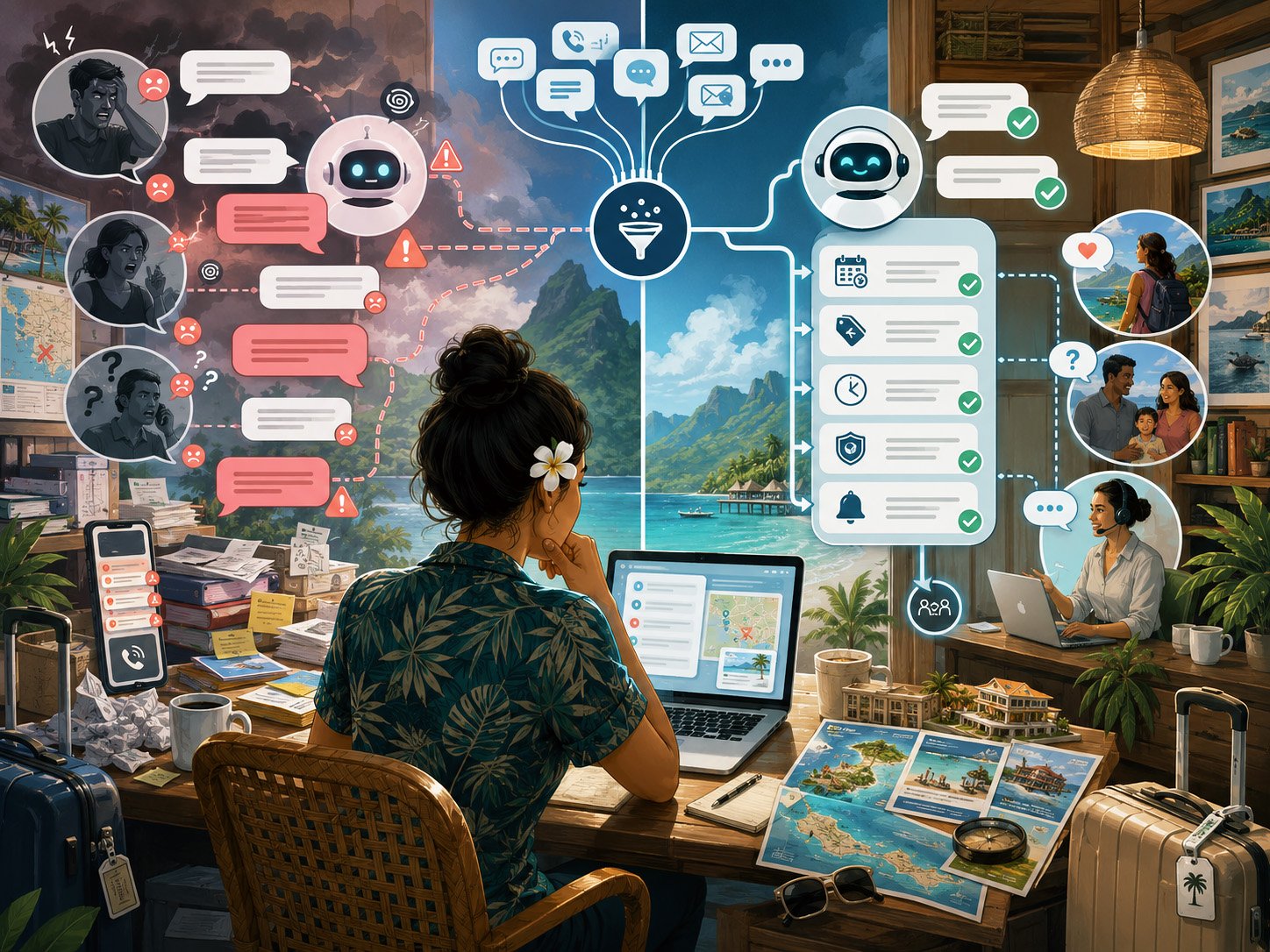
A tour operator opens sixty unanswered messages after a long weekend, spread across Instagram, WhatsApp, and a contact form nobody checks. A vendor’s pitch — “an AI chatbot that handles it all” — sounded like the obvious fix. Six months later, the bot was answering confidently and often wrong, and guests started asking if they were even talking to a real person.
This piece is about telling the difference before you spend the money: real use cases that work, the failure modes that sink most chatbot projects, and how to know if your business is actually ready for one.
A tour operator sits down after a long weekend to find sixty unanswered messages spread across Instagram, WhatsApp, and a contact form nobody checks daily. A vendor had reached out the week before with a pitch: “an AI chatbot that handles it all.” It sounded like the obvious fix. Six months and one abandoned chatbot subscription later, the messages are still piling up — the bot answered confidently, but often wrong, and guests started replying “is this even a real person?” before giving up and calling a competitor instead.
That story repeats constantly in travel and hospitality, in both directions. Some businesses genuinely need a chatbot and wait too long to get one, watching fast-moving bookings go to whoever replies first. Others buy one before asking whether it fits their actual problem, and end up worse off than when they started. This piece is about telling the difference before you spend the money.
Why the Question Matters More Than the Answer
Most chatbot content skips straight to “how to build one.” That’s the wrong starting point. The right one is whether your business’s actual bottleneck is response speed on repetitive questions — which a chatbot solves well — or something else entirely, like inconsistent service, unclear offerings, or a website that doesn’t answer basic questions in the first place, none of which a chatbot fixes.
A chatbot answers messages faster. It doesn’t make your offering clearer, your pricing simpler, or your service better — and it’s worth being honest about which problem you’re actually trying to solve.
Getting this backwards is the single biggest reason chatbot projects disappoint. The tool works as advertised. It was just aimed at the wrong problem.
What an AI Chatbot Actually Is
Strip away the marketing, and “AI chatbot” covers a fairly wide range of actual systems, and the right one for a small or mid-sized travel business is usually simpler than vendors make it sound.
The first tier is a rule-based auto-responder — fixed answers to fixed questions, no real language understanding. Cheap, fast to set up, and it breaks the moment a guest phrases something slightly differently than expected.
The second tier is an AI-assisted responder — it understands a reasonably wide range of phrasing, drafts a first response, and knows when to hand off to a person rather than guess. This is where most small-to-mid travel businesses actually belong.
The third tier is a fully custom assistant, integrated with live booking systems, real-time availability, and payment. Powerful, expensive to build and maintain, and rarely where a business should start — it only makes sense once a simpler version has proven exactly which workflows deserve that level of investment.
Real Use Cases That Actually Work
The honest split, across most small-to-mid travel and hospitality businesses:
| Handles well (bot) | Needs a human |
|---|---|
| Availability and price checks for standard offerings | Custom or multi-part requests |
| First response to a new inquiry, in under a minute | Group bookings with negotiated terms |
| FAQ: hours, policies, what’s included, cancellation terms | Complaints or anything emotionally charged |
| Confirming a booking already agreed on | A guest comparing options and wanting a real recommendation |
| Sending reminders and basic follow-up | Anything involving a returning guest’s history or relationship |
The left column is where most businesses are actually losing time and, sometimes, bookings — not because the answer is hard, but because there aren’t enough hours to type the same six answers dozens of times a day.
Common Failure Modes
Most chatbot disappointments trace back to a small number of repeating mistakes, and they’re worth naming plainly.
Over-scoping at launch. Trying to automate the entire inbox on day one, instead of the handful of repetitive questions actually causing the backlog. This is the single most common failure mode, and it’s almost always avoidable.
No graceful handoff. A bot that keeps guessing at questions it can’t actually answer, rather than recognizing its limits and routing to a person, is worse than no bot at all — guests can’t tell which answers to trust once they’ve caught it being wrong once.
Set-and-forget deployment. The questions guests ask shift over time — seasonally, with new offerings, with changing policies — and a bot that isn’t reviewed regularly starts confidently giving outdated answers.
Tone mismatch. A generic, corporate-sounding bot dropped into a business built on personal service creates a jarring first impression that undercuts the actual brand.
Almost every failed chatbot project failed at the scoping stage, not the technology stage — the tool did exactly what it was set up to do, and what it was set up to do was too much, too soon.
How to Evaluate Whether You’re Ready
In Practice: Questions to Ask Before You Start
- Can you name the five to seven questions that make up most of your repetitive inbound messages? If not, that’s the first thing to figure out — not the bot itself.
- Does someone on your team have time to review flagged conversations daily, at least for the first month? A bot without oversight drifts.
- Are you expecting it to close complex or emotionally sensitive conversations? If yes, recalibrate — those stay with a person regardless of how sophisticated the tool is.
- Do you have a clear escalation path for anything the bot shouldn’t handle, or will unanswered edge cases just pile up somewhere unseen?
If the answers reveal you don’t have a clear repetitive pattern yet, the more useful next step might be fixing how inquiries are organized internally before adding a bot on top of the chaos.
What This Actually Costs
Cost scales with the tier chosen, not with how sophisticated a vendor’s pitch sounds. A rule-based auto-responder is inexpensive and quick to test, but limited to rigid, exact-match questions. An AI-assisted responder — the tier most small-to-mid businesses land on — costs more but handles the natural variation in how guests actually phrase things, and is usually worth testing for a month or two before committing further. A fully custom, booking-integrated assistant is the most expensive tier by a wide margin, and the businesses that benefit from it almost always started at the second tier first and outgrew it with clear evidence, rather than jumping straight there on a vendor’s recommendation.
The cost that matters most isn’t the subscription fee — it’s the hours spent maintaining a tool that was scoped too broadly to begin with.
How to Measure Whether It’s Working
The honest measure of success isn’t “the bot answered X messages.” It’s whether guests are getting a fast, correct first response, and whether your team is spending less time on the repetitive majority and more time on the conversations that actually need judgment.
In Practice: What to Track in the First Month
- Average first-response time, before and after — usually the clearest, fastest signal of whether it’s working.
- The percentage of conversations handled without escalation, compared to what you expected going in.
- Whether flagged conversations actually get picked up promptly — a handoff nobody answers defeats the purpose entirely.
- Any guest feedback that mentions the bot, positive or negative — a small sample, but an early warning either way.
If response time drops and escalations stay manageable, you’re in a good position to expand scope carefully. If escalations climb or guests start commenting on stilted or wrong replies, that’s a signal to narrow scope rather than push forward.
What This Looks Like in Practice
A small activity-tour business tried a chatbot the wrong way first — a vendor-sold, general-purpose bot meant to “handle guest service end to end.” It answered fluently, confidently, and often incorrectly, quoting prices for tours that had changed and describing cancellation terms that were two seasons out of date. Guests noticed within weeks, and trust in the brand’s responsiveness actually dropped.
The second attempt started narrower: five questions only — availability for the three most-booked tours, meeting point, and cancellation policy — with everything else routed straight to a person with the full conversation attached. Response time on those five questions dropped from an average of thirty-plus minutes to under two, and nothing else changed; the harder, judgment-heavy conversations still went to a human, same as before.
The second attempt worked not because the technology improved, but because the scope shrank to match what the business could actually maintain.
The Layered Approach That Actually Works
The businesses that get real value from a chatbot use it as a first layer, not a replacement layer.
In Practice: How the Handoff Should Work
- The bot answers standard FAQ immediately — availability, price, policies — so guests aren’t waiting on a human for the easy majority of questions.
- Anything ambiguous or emotionally loaded gets flagged, not guessed at. The bot should say “let me get you our team,” not attempt a shaky answer.
- The human sees full conversation history, not a bare notification, so there’s no re-asking what the guest already said.
- A regular review catches what the bot got wrong, so answers improve instead of repeating the same mistake for months.
Where This Applies Differently by Business Type
The core logic here — narrow scope, layered handoff, regular review — holds across hotels, tour operators, activity providers, and DMCs, but the specifics shift by context. A hotel’s chatbot deals with a different rhythm than a tour operator’s, and a business in a market with heavy multilingual, high-volume DM traffic faces sharper tradeoffs than one with a smaller, single-language inbox. If you run a tour business in a market like that, how this plays out for Bali tour operators specifically is a useful, concrete example of the same principles applied to a WhatsApp-and-Instagram-heavy, multilingual guest base.
Common Mistakes When Getting Started
Beyond the operational failure modes above, a few decision-level mistakes show up repeatedly. Buying a chatbot because a competitor has one, without first identifying your own actual bottleneck, is the most common. Choosing a vendor based on an impressive demo rather than a test against your business’s real, messy inquiries is a close second — demos are built to show the tool’s best case, not your average Tuesday. And assuming a single chatbot can serve every channel identically, when Instagram DMs, WhatsApp, and email each have different guest expectations and platform quirks, leads to a tool that performs unevenly across channels without anyone quite noticing why.
Signs You Don’t Need One Yet
In Practice: Signs You Don’t Need a Chatbot Yet
- Your inbound volume is low enough that a person already replies within a reasonable window most days.
- Your repetitive questions aren’t actually that repetitive — every inquiry is genuinely different and needs individual judgment.
- You don’t have anyone available to review or maintain it, even for fifteen minutes a day — an unmaintained bot degrades faster than no bot at all.
- Your real bottleneck is something else — unclear pricing, a confusing website, inconsistent service — that automating replies won’t fix.
Being honest here saves the cost and the reputational risk of a rushed, mismatched deployment.
Frequently Asked Questions
Will a chatbot work across Instagram, WhatsApp, and email at once? Most setups can cover multiple channels, but each has its own quirks and limits — this is usually scoped per channel rather than assumed identical.
Can it handle a guest who switches languages mid-conversation? It can attempt to, but this is one of the higher-risk spots for a mistranslated or oddly-phrased reply — worth routing to a person if a conversation gets linguistically messy.
What happens to questions the bot can’t answer? They should be flagged and handed to a team member with the full conversation attached, ideally within minutes rather than sitting in a general inbox.
Do I need a large inquiry volume to justify this? Not huge, but consistent. If the same handful of questions arrive daily and sit unanswered for half an hour or more, that’s usually enough of a pattern.
Will guests know they’re talking to a bot? They should — being upfront, and making the eventual human handoff feel smooth, builds more trust than pretending the bot is a person.
How much ongoing maintenance does this need? More than most people expect. A regular review of what the bot got wrong is the difference between a tool that keeps improving and one that quietly gets worse over time.
Should I build this myself or use an off-the-shelf tool? For most small-to-mid businesses, an off-the-shelf AI-assisted responder is the right starting tier — a fully custom build only makes sense once a simpler version has proven the specific workflows worth the extra investment.
What if my current website or booking process is the real problem, not response speed? Then a chatbot will mask the symptom without fixing the cause — worth being honest about this before spending on a bot at all, since it’s a common reason chatbot projects underdeliver.
How do I know if I should expand my chatbot’s scope after the first month? Expand only into questions that showed up repeatedly in the flagged, human-handled conversations — that’s a more reliable signal of what’s worth automating next than guessing upfront.
Final Thoughts
The tour operator from the opening didn’t need a bot that “handled it all.” She needed the five repeat questions answered fast enough that the harder, more valuable conversations weren’t buried underneath them. That’s usually the honest answer to “do I need an AI chatbot” — not a yes or no, but a question of which specific slice of your inbox is actually worth automating, and which parts should stay exactly where they are, with a person.
If you’re weighing this decision for your own business, it helps to see it in the context of AI for guest experience more broadly, including AI itinerary planning, personalizing guest communication, and building an AI concierge assistant — a chatbot is rarely the only piece worth considering, and sometimes it isn’t even the first one. For the full landscape, see AI for the travel industry.
Last updated: July 2026