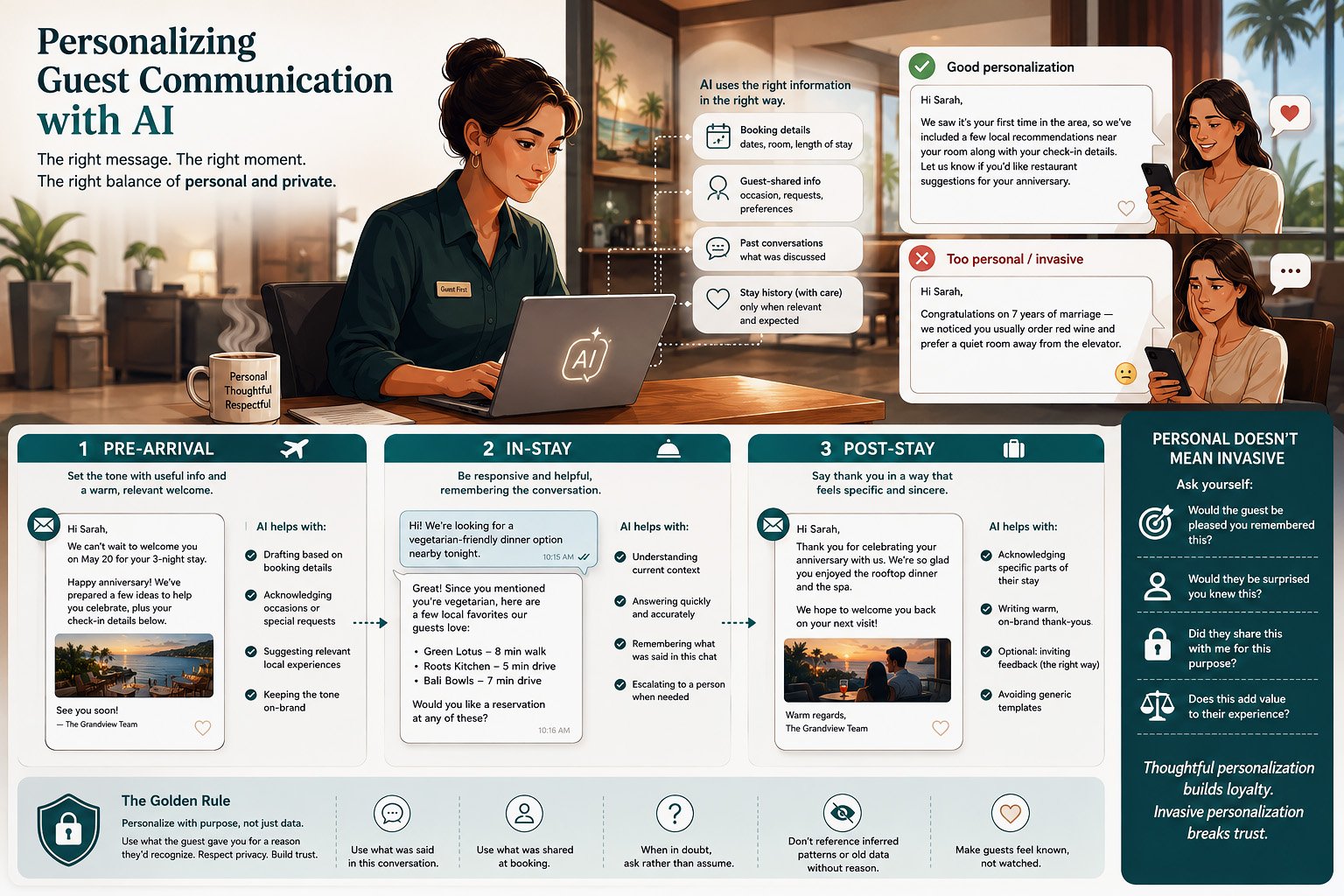
Two guests, two pre-arrival emails. One reads like a form letter: “Dear Guest, we look forward to your stay.” The other: “Hi Sarah — we saw it’s your first time here, so we’ve added local tips along with your check-in details.” One guest feels like a booking number. The other feels expected.
But there’s a third possible email — one that references a guest’s anniversary, usual drink order, and room preference all at once. That one isn’t charming, it’s unsettling. This piece covers where the line actually sits, stage by stage, so personalization reads as attentive rather than surveilled.
Two guests, two hotels, two pre-arrival emails. The first reads: “Dear Guest, We look forward to your upcoming stay. Please find your check-in details below.” The second reads: “Hi Sarah — we saw it’s your first time in the area, so we’ve included a few local recommendations near your room along with your check-in details, and let us know if you’d like restaurant suggestions for your anniversary.” One guest feels like a booking number. The other feels expected, and slightly delighted.
That’s the appeal of AI-personalized guest communication — the second email doesn’t require a staff member to remember every guest’s occasion and preferences by hand. But there’s a third possible email, one that’s easy to accidentally write: “Hi Sarah, congratulations on 7 years of marriage — we noticed you usually order red wine and prefer a quiet room away from the elevator.” That one isn’t charming. It’s unsettling. The same tools that create the second email can, mishandled, create the third.
Why This Decision Matters
Personalization is one of the clearest, fastest ways AI improves guest experience — and one of the easiest to get wrong in a way that actively damages trust. Guests notice both a cold, generic message and an uncomfortably over-familiar one; the difference between delight and unease is often a handful of specific choices about what to reference, when, and how.
Good personalization uses information the guest gave you for a reason they’d recognize. Invasive personalization uses information they forgot they gave you, in a way that makes them wonder what else you’re tracking.
That single distinction is the core of everything below.
The Three Stages, and What Changes at Each
Guest communication has a natural arc, and the right kind of personalization looks different at each stage.
| Stage | What guests expect | Where AI helps |
|---|---|---|
| Pre-arrival | Practical info, a warm welcome, relevant local tips | Drafting based on known booking details (dates, occasion if shared, past stay) |
| In-stay | Fast, helpful answers that remember context from the conversation | Referencing what’s already been said in this conversation, not old data resurfacing |
| Post-stay | A genuine thank-you, not a hard sell | A specific, non-generic acknowledgment of their actual stay |
Pre-Arrival: Using What They Told You, Not What You Inferred
Pre-arrival is the safest stage to personalize, because most of what you’d reference — dates, room type, any occasion mentioned at booking — was information the guest explicitly provided for exactly this purpose.
A good pre-arrival message acknowledges the practical facts of the booking and adds one or two relevant, specific touches: a note about the guest’s stated occasion, a recommendation relevant to their length of stay, a mention of something they asked about in a previous message. It stays warm without reaching for details the guest didn’t hand over directly for this conversation.
If a guest would be surprised you knew something, that’s usually the signal you’ve reached too far — even if the information is technically in your system somewhere.
In-Stay: Personalization Through Memory, Not Surveillance
In-stay communication is where guests most expect a business to “remember” them — but the safest form of that memory is conversational, not systemic. Referencing something the guest said earlier in the same conversation (“since you mentioned you’re vegetarian, here’s what we’d recommend”) feels attentive. Referencing something pulled from an unrelated data source the guest never mentioned to this staff member in this conversation feels like being watched.
In Practice: Where the Line Is
- Reference what was said in this conversation — always safe, always feels attentive.
- Reference what was explicitly shared at booking for a directly relevant purpose (occasion, dietary need, accessibility request) — safe, expected.
- Avoid referencing inferred patterns the guest never explicitly shared with you this trip (past order history, previous room preference) unless you’re transparent that you’re using stay history and the guest would expect it.
- When in doubt, ask rather than assume — “would you like the same room type as your last stay?” feels helpful; silently defaulting to it without asking can feel presumptive.
Post-Stay: A Genuine Thank-You, Not a Templated Upsell
Post-stay is where personalization most often collapses into generic marketing — a thank-you email that’s really just a review request and a discount code wearing a friendly greeting. The stronger version references something specific and true about the actual stay: the occasion they came for, a request the team was glad to help with, an honest note that feels like it came from someone who was actually there.
A post-stay message that could have been sent to any guest who stayed any week this year isn’t personalization — it’s a form letter with a first name inserted.
Where Personalization Tips Into Invasive
The uncomfortable middle example from the opening — referencing a guest’s anniversary, their usual drink order, and a room preference all in one unsolicited message — illustrates the core risk clearly. Each piece of information might be accurate and even collected with good intent, but stacking several inferred details into a single message, unprompted, reads as surveillance rather than service, regardless of intent.
The safest test: would the guest be pleased you remembered, or unsettled that you’re tracking? Information they gave you for this specific purpose, in this specific conversation, almost always lands as the former. Information pieced together from patterns across their history, surfaced without them expecting it, often lands as the latter — even when it’s accurate, even when it’s meant kindly.
In Practice: Personalization That Feels Right
- One relevant detail, not several stacked together — a single warm touch reads as attentive; three at once reads as a dossier.
- Reference recent, explicit context over older, inferred patterns.
- Be transparent when you do use stay history — “since you stayed with us last spring, we thought you might like…” names the source, rather than implying omniscience.
- Let the guest opt into deeper personalization — asking “would you like us to remember your preferences for next time?” turns a potentially invasive assumption into a welcomed offer.
Common Mistakes
The most common mistake is combining multiple pieces of inferred, unshared information in a single message — the anniversary-plus-drink-order-plus-room-preference problem — which almost always reads as invasive even when each detail is accurate. A close second is the opposite failure: writing a “personalized” template so generic it could apply to any guest, which guests recognize immediately and which undercuts the trust a genuine personal touch would have built. The quieter mistake is inconsistency — a warmly personalized pre-arrival message followed by a robotic, clearly-templated in-stay reply breaks the illusion the first message built, and often reads worse than if neither had been personalized at all.
Guest Data: What This Requires You to Handle Responsibly
Personalized messaging necessarily touches guest data — booking details, stated preferences, sometimes payment or identity information adjacent to the conversation. It’s worth knowing, before adopting any personalization tool, where that data is stored, who on your team can access it, and how long it’s retained after the stay ends.
This matters more for personalization specifically than for generic messaging, because the entire premise involves the system recalling and resurfacing personal details. A guest who’s pleased their occasion was remembered can quickly become uneasy if they later wonder how long that detail sits in a database, or who else can see it. Being able to answer that question honestly — and being transparent with guests about it when relevant — is part of what keeps personalization feeling like service rather than surveillance.
Choosing Tools: Simple Templating vs. a Smarter Assistant
A lightweight tool that fills a few named fields (guest name, stated occasion, one local tip) into a warm template covers most of the pre-arrival and post-stay personalization most businesses need, and it’s low-risk because it only ever uses information explicitly entered for that purpose. A more capable assistant that drafts a full, contextual reply based on conversation history is more powerful for in-stay communication, but needs closer review in the early weeks to make sure it isn’t reaching for context the guest didn’t offer in this conversation.
In Practice: Getting Started Without Overreaching
- Start with the simplest tier that covers pre-arrival and post-stay — named-field templating, not a full conversational assistant.
- Add in-stay conversational personalization second, once the simpler layer is trusted.
- Review a sample of messages weekly in the first month specifically for anything that reads as reaching too far.
- Keep a short, written rule of thumb for your team — one relevant, explicitly-shared detail per message — so the standard doesn’t drift as different staff members draft messages.
A Worked Example
A boutique hotel started with a modest pre-arrival personalization layer — pulling only the occasion field from the booking form (when guests chose to fill it in) and one length-of-stay-relevant local tip. Nothing inferred, nothing from outside that single booking record. Guest feedback mentioning the welcome message specifically increased noticeably within the first two months, with several guests commenting that the note felt “thoughtful” rather than automated.
The team resisted the temptation to expand into in-stay personalization using full guest history right away. Instead, they built that layer around conversational memory only — referencing what a guest had said earlier in the same stay, not pulling from past visits — for an additional few months before cautiously testing an opt-in “remember my preferences for next time” feature, which guests could decline without any friction.
The team’s instinct to add cautiously, one layer at a time, mattered more than any specific tool they used.
How to Know You’re Ready
In Practice: Signs You’re Ready to Start
- You already collect a small amount of explicit, purpose-given guest information (occasion, dietary needs) that’s currently going unused in your messaging.
- Someone can review personalized drafts before they go out, at least in the early stages, to catch anything that reads as overreaching.
- You’re prepared to start with one relevant detail per message, not several stacked together.
- You’re comfortable being transparent about what you remember and why, rather than trying to seem all-knowing.
Frequently Asked Questions
Should I personalize every guest message, or just some? Start with high-visibility moments — the pre-arrival welcome and the post-stay thank-you — rather than trying to personalize every single message from day one.
What if a guest didn’t share any occasion or preference information? Then a warm, well-written generic message is the right call — personalization only works with information the guest actually gave you; don’t invent or infer occasions that weren’t shared.
Is it ever okay to use past-stay history? Yes, but be transparent about it rather than presenting it as if you simply remembered — naming the source (“since your last stay with us…”) keeps it feeling like service rather than surveillance.
How do I avoid sounding robotic even with personalization? Keep the personalized detail specific and singular rather than templated and stacked — one genuine, specific touch reads as more human than several generic-sounding “personalized” fields filled in around a template.
Does this apply to villas and tour operators the same way it applies to hotels? Yes — the same pre-arrival, in-stay, and post-stay arc and the same “one relevant detail, transparently sourced” principle apply regardless of property type or business model.
What’s the biggest single thing to avoid? Stacking multiple pieces of inferred, unshared information into one unsolicited message — that’s the fastest way personalization tips into feeling invasive.
Should I tell guests we’re using AI to help draft their messages? It’s not necessary to announce it explicitly for routine drafting, but be transparent about data use specifically — if you’re referencing past-stay history, name the source rather than implying you simply remembered.
How long should we keep guest preference data once personalization is in place? Set a clear retention policy rather than keeping everything indefinitely by default — the shorter and more purposeful the retention, the easier it is to stay on the right side of “remembered” versus “tracked.”
Final Thoughts
The hotel from the opening didn’t need a sophisticated system to make Sarah feel expected rather than processed — it needed one relevant detail, used once, transparently. That’s most of what good personalization actually is: not more data, just better judgment about which single piece of it to use, and when.
This fits into the broader picture of AI for guest experience, alongside AI chatbots for travel businesses and AI concierge assistants — personalization is often the layer that makes both of those feel less like a tool and more like genuine service. For the full landscape, see AI for the travel industry.
Last updated: July 2026