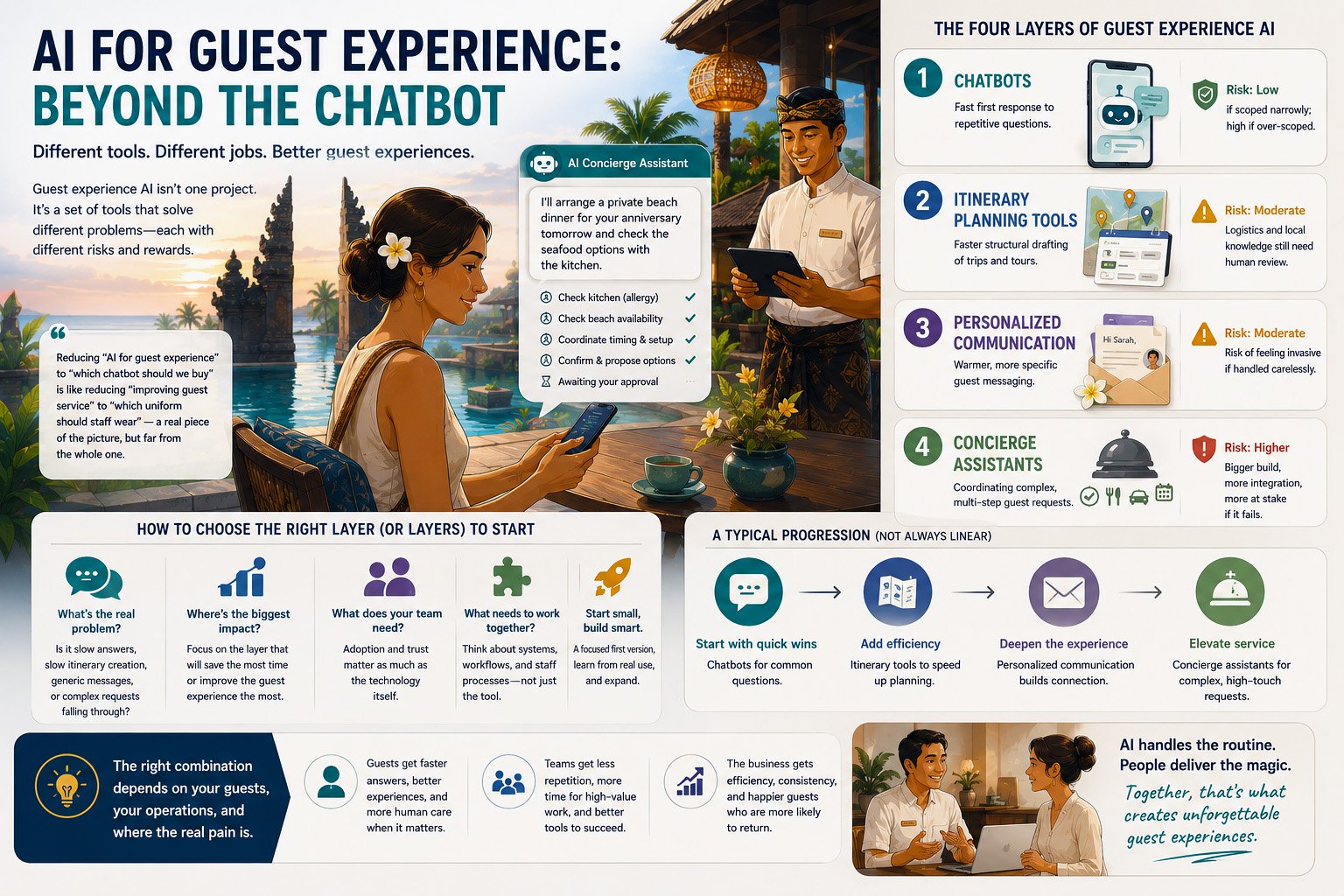
A hotel owner asks about “AI for guest experience” and means a chatbot. A DMC means an itinerary tool. A villa manager means warmer guest messages. A larger property means handling a genuinely complex request. All four are talking about the same thing — and all four mean something different.
Treating “guest experience AI” as one project instead of four related decisions is the most common reason these initiatives disappoint. This piece breaks down all four layers — chatbots, itinerary tools, personalization, concierge assistants — how they connect, and which one your business should actually start with.
A hotel owner asks about “adding AI to guest experience” and means, specifically, a chatbot. A DMC asks the same question and means an itinerary tool. A villa manager means something that drafts warmer guest messages. A larger property means something that can coordinate a genuinely complex request. All four are talking about “AI for guest experience,” and all four are talking about something meaningfully different.
That’s the first thing worth untangling. “Guest experience AI” isn’t one project — it’s at least four related but distinct decisions, each with its own risk profile, its own honest tradeoffs, and its own answer to “is this worth it for my business.” Treating them as one undifferentiated thing called “the AI chatbot project” is the single most common reason guest-experience AI initiatives disappoint: the wrong layer gets built first, or one layer gets over-scoped while a more valuable one never gets considered.
Why This Is Bigger Than a Chatbot
Ask most vendors about “AI for guest experience” and the conversation goes straight to chatbots — understandably, since it’s the most visible and most heavily marketed layer. But a chatbot solves one specific problem: answering repetitive questions faster. It doesn’t touch how well an itinerary is planned, whether a guest message feels personal or generic, or whether a genuinely complex, multi-step request gets handled well.
Reducing “AI for guest experience” to “which chatbot should we buy” is like reducing “improving guest service” to “which uniform should staff wear” — a real piece of the picture, but far from the whole one.
The four layers below cover the real range, and each deserves its own honest evaluation rather than being bundled into a single “AI project” decision.
The Four Layers of Guest Experience AI
| Layer | What it actually solves | Risk profile |
|---|---|---|
| Chatbots | Fast first response to repetitive questions | Low, if scoped narrowly; high if over-scoped |
| Itinerary planning tools | Faster structural drafting of trips and tours | Moderate — logistics and local knowledge still need human review |
| Personalized communication | Warmer, more specific guest messaging | Moderate — risk of feeling invasive if handled carelessly |
| Concierge assistants | Coordinating complex, multi-step guest requests | Higher — bigger build, more integration, more at stake if it fails |
These aren’t competing options where you pick one. They’re different tools solving different problems, usually adopted in roughly this order as a business’s needs and confidence grow — though not always, and not without exception.
Layer One: Chatbots
A chatbot’s job is narrow and specific: answer the repetitive questions fast enough that a guest isn’t waiting, without pretending to handle the requests that actually need a person. The businesses that get real value from this layer scope it deliberately narrow at first — five or six recurring questions, not “handle everything” — and treat it as a first-response filter that hands off cleanly to a human for anything more complex.
The honest tradeoff here is speed versus trust: a chatbot that answers fast but wrong, even occasionally, teaches guests not to trust any of its answers. Getting the scope right — narrow, well-tested, honest about its own limits — matters more than how sophisticated the underlying technology is. The full breakdown of use cases, failure modes, and how to tell whether you actually need an AI chatbot at all is worth reading before assuming this is the layer to start with.
Layer Two: Itinerary Planning Tools
For DMCs and tour operators specifically, itinerary planning is often the more valuable — and more overlooked — layer, because it saves time on the part of the job that’s genuinely repetitive (structural drafting) while leaving the part that actually makes an itinerary good (local timing, reading the client, avoiding oversaturated recommendations) firmly with a person.
The honest tradeoff here is subtler than with chatbots: the risk isn’t an obviously wrong answer, it’s a confidently plausible one. An AI-drafted itinerary that gets the structure right but the timing or local nuance wrong looks polished right up until a guest experiences the mistake on the ground. AI itinerary planning tools covers exactly where the line sits between what these tools handle well and what still needs a human’s judgment.
Layer Three: Personalized Communication
This layer sits underneath both of the others — a chatbot’s first response and an itinerary’s cover email both benefit from feeling personal rather than generic. Done well, personalization is one of the highest-leverage, lowest-cost improvements available: a single relevant, explicitly-shared detail (an occasion, a stated preference) used thoughtfully, once, transparently.
The honest tradeoff here cuts the opposite direction from the other layers — the risk isn’t that it fails to help, it’s that it’s easy to overreach. Stacking several inferred details into one unsolicited message tips quickly from “delighted the guest remembered” into “unsettled by how much is being tracked.” personalizing guest communication covers exactly where that line sits, stage by stage.
Layer Four: Concierge Assistants
This is the most involved layer, and the one businesses should be most deliberate about before committing to. A true concierge assistant handles multi-step, judgment-heavy requests — coordinating a private dinner around a dietary restriction, arranging a custom activity on short notice — rather than simple FAQ. It requires more integration, more testing, and more staff involvement to build well than any of the other three layers.
The honest tradeoff: it’s the layer with the highest ceiling and the highest cost of getting wrong. A well-built concierge assistant clears real coordination work out of a team’s way. A rushed one either escalates everything back to staff, defeating the purpose, or confidently mishandles requests it was never ready to attempt. building an AI concierge assistant covers scope, timeline, and what real testing and refinement actually involves.
How the Four Layers Actually Connect
These layers aren’t four separate projects competing for budget — in a well-run guest experience, they inform each other.
In Practice: How the Layers Connect
- A chatbot’s escalation data tells you what a concierge assistant should eventually handle — the requests staff keep fielding manually are the concierge layer’s natural first scope.
- Itinerary tools set expectations that personalization then has to deliver on — a beautifully personalized pre-arrival email means little if the itinerary underneath it is generic.
- Personalization is the connective tissue across the other three — a chatbot, a concierge assistant, and an itinerary cover note all land better with the same disciplined, one-relevant-detail approach.
- None of the four should be built to maximum sophistication on day one — each starts narrow, gets tested against real guest interactions, and expands only once trusted.
Most guest-experience AI disappointments come from treating these four as one project instead of four related decisions made in the right order.
The Honest Tradeoffs, Side by Side
It’s worth being direct about what each layer costs you if it goes wrong, since the marketing around all four tends to undersell this.
A chatbot that’s over-scoped erodes guest trust the first time it confidently gives a wrong answer — and that erosion is hard to earn back, because guests then distrust even the answers it gets right. An itinerary tool that skips the human logistics review sends a client into a poorly-timed, badly-routed trip with your business’s name on it, and the guest experiences that mistake in real time, on the ground, with no one able to fix it on the spot. A personalization layer that stacks too much inferred detail into one message reads as surveillance rather than service, and that impression is hard to undo even with a sincere apology. A concierge assistant that launches after too little real-world testing either buries staff in escalations or mishandles a genuinely important request — an anniversary dinner, a dietary restriction with real stakes — in a way that’s memorable for the wrong reason.
None of this is an argument against any of the four layers. It’s an argument for scoping each one narrowly, testing it against real guest interactions before trusting it broadly, and being honest about which layer your business actually needs first rather than starting with whichever one sounds most impressive.
Cost and Timeline, Compared
The four layers differ meaningfully in what they cost to build and how long they take to prove out, and it’s worth seeing them side by side rather than pricing each in isolation.
| Layer | Typical cost to start | Typical time to see results |
|---|---|---|
| Chatbots | Low | Weeks |
| Itinerary planning tools | Low to moderate | Weeks to a month |
| Personalized communication | Low | Weeks |
| Concierge assistants | Moderate to high | Months, including a genuine testing period |
The pattern worth noticing: the three lower-cost, faster layers are also the ones most businesses should reasonably start with, and the more expensive, slower layer is the one that benefits most from an organization already having practice testing and trusting a simpler AI tool first.
A Composite Week
Picture a mid-sized hotel three months after adopting a version of all four layers, deliberately in sequence rather than all at once.
The front desk’s chatbot now handles the six most common questions — pool hours, Wi-Fi, parking, checkout time, cancellation policy, and airport transfer options — drafted and reviewed each morning instead of interrupting staff throughout the day. The pre-arrival email a guest receives references their stated occasion and one relevant local tip, nothing more, and feedback mentioning the welcome message has become a regular, unprompted occurrence in guest reviews. When a family requests a custom day trip, the itinerary-drafting layer produces a structural first draft in minutes, which a staff member still finalizes with the timing and local knowledge only they have. And when a couple asks for a private anniversary dinner with a last-minute dietary accommodation, the concierge assistant drafts the coordination message to the kitchen and confirms availability, with a manager approving the final details in minutes instead of making three phone calls.
None of these four things individually looks like “AI transformation.” Together, they add up to a guest experience that feels unusually attentive — because the team finally has the time to be.
That’s the realistic shape of guest experience AI done well: not a single dramatic change, but four modest, well-tested layers that each free up a small amount of time and attention, compounding into something guests actually notice.
Staffing and Adoption Across the Four Layers
Every one of these four layers ultimately depends on staff trusting it enough to actually use it, and trust gets built differently for each. A chatbot earns trust by consistently knowing its own limits and escalating cleanly. An itinerary tool earns it by never skipping the logistics review that catches its mistakes before a client sees them. A personalization layer earns it by staying disciplined about how much it assumes. A concierge assistant earns it slowly, over a genuine testing period, as staff see it make the right escalation calls consistently.
In Practice: Building Team Trust Across Layers
- Involve the staff who’ll actually use each layer during testing, not just during rollout — their early skepticism usually points at real gaps worth fixing.
- Start each layer narrow enough that mistakes are rare and easy to explain, since early trust is fragile and a visible early failure sets adoption back further than a slow, careful start.
- Make correcting the tool easy and normal, not something staff have to escalate to a manager to do — the faster a wrong answer gets fixed, the faster trust rebuilds.
- Revisit adoption progress explicitly after the first month, rather than assuming a quiet rollout means it’s working.
This is closely related to AI adoption roadmaps more broadly — guest experience AI is one of the clearer places where the adoption stage, not the build stage, decides whether the investment actually pays off.
Common Mistakes Across All Four Layers
The most common mistake, by far, is treating “AI for guest experience” as a single project rather than four related decisions — usually meaning a business jumps straight to the most visible layer (a chatbot, or worse, a concierge assistant) without first understanding which layer actually addresses their real bottleneck. A close second is over-scoping the first version of whichever layer is chosen — trying to handle every conceivable guest interaction at launch instead of the handful of cases that are actually common and actually costing time. The quieter mistake is skipping the human review stage once any of these layers “seems to be working” — every one of the four degrades gracefully into producing plausible-but-wrong output if left unmonitored for too long, whether that’s an outdated chatbot answer, a stale itinerary recommendation, an over-personalized message, or a concierge assistant confidently attempting something it should have escalated.
Every guest-experience AI failure this article has described has the same shape: a tool that worked exactly as scoped, and was scoped too broadly, too soon.
Where to Start: A Decision Guide
In Practice: Which Layer to Start With
- If your team is buried in repetitive, simple questions with a slow response time — start with a narrow chatbot layer.
- If itinerary or trip-planning work is eating hours on formatting and structure rather than genuine judgment — start with itinerary drafting assistance.
- If your guest messaging currently feels generic or templated, and you already collect explicit guest information you’re not using — start with personalized communication, since it’s the lowest-cost, fastest layer to test.
- If guests routinely bring complex, multi-step requests that require staff coordination across departments — that’s the signal for a concierge assistant, though it’s the layer worth approaching last, once the others have built trust in how your team scopes and tests AI tools.
There’s no universally correct starting layer — it depends entirely on which bottleneck is actually costing your team the most time and your guests the most friction right now.
How This Fits the Bigger Picture
Guest experience is one piece of a larger picture — see AI for the travel industry overview for the full landscape, including AI revenue and demand management, back-office automation for travel, and AI adoption roadmaps, which shape how any of these four layers actually gets adopted by a real team rather than sitting unused after launch. If your business operates specifically in Bali’s tourism sector, the same four-layer logic applies at a different scale and with different starting priorities — see AI for Bali tour operators for that version of the picture.
How to Know You’re Ready to Start Any of These
In Practice: Readiness Signs Across All Four Layers
- You can name a specific, recurring bottleneck in one of the four areas — not a vague sense that “we should be doing AI,” but an actual pattern costing real time or guest goodwill.
- Someone on your team has time to review and test whichever layer you start with, at least for the first several weeks.
- You’re prepared to start narrow and expand carefully, rather than expecting a complete solution from the first version.
- You’re honest with yourself about which layer is actually the bottleneck, rather than starting with whichever one sounds most impressive to announce.
Frequently Asked Questions
Do I need to build all four layers eventually? No. Most businesses get significant value from one or two layers matched to their actual bottleneck — a well-run boutique hotel might only ever need personalization and a narrow chatbot, while a DMC might lean heavily on itinerary tools and skip a concierge build entirely.
Which layer should a hotel start with versus a tour operator? It depends more on your specific bottleneck than your business type, though hotels and villas often see the fastest win from personalization and chatbots, while DMCs and tour operators often see it from itinerary tools and quoting.
Is it a mistake to start with the concierge layer if we can afford it? Not necessarily a mistake, but it’s the highest-risk, highest-integration layer, and skipping the simpler layers means missing the chance to build organizational trust and testing discipline before tackling the hardest build.
How do these four layers relate to cost? Chatbots and personalization are typically the least expensive to test; itinerary tools sit in the middle depending on how much reference material and structure they need; concierge assistants are the most expensive due to integration and testing requirements.
What’s the single most common reason one of these layers fails to deliver value? Over-scoping the first version — trying to handle too much at launch instead of the narrow, well-tested slice that’s actually causing the problem.
Can these four layers be built by different teams or at different times? Yes, and that’s usually the more sensible approach — treating them as related but separate decisions, rather than one bundled “AI project,” tends to produce better outcomes for each individual layer.
How do we decide if we’re ready for guest-experience AI at all? If you can name a specific, recurring guest-experience bottleneck and have someone available to test and review the first version, you’re likely ready to start with at least one layer — the decision guide above helps identify which.
Should all four layers be built by the same team or vendor? Not necessarily — since they’re different projects with different skill requirements, some businesses use different tools or partners for each, as long as someone is thinking about how they connect.
How does staff turnover affect these projects? Trust in any of these tools is partly built by the specific staff who tested them — plan for a lighter re-onboarding process when new team members join, rather than assuming trust transfers automatically.
What’s a realistic first goal to set for a guest-experience AI project? Pick one measurable thing — response time, a specific guest-feedback theme, hours saved on a specific task — for the single layer you start with, rather than a vague goal like “improve guest experience with AI.”
Final Thoughts
The hotel owner, the DMC, the villa manager, and the larger property from the opening were all asking a version of the same question — “how do we use AI to serve guests better” — but the honest answer was never a single tool. It was four separate decisions, each solving a real but different problem, each with its own risks worth taking seriously before building.
Guest experience AI done well doesn’t feel like AI to the guest at all. It feels like a business that responds quickly, remembers what matters, plans thoughtfully, and handles complexity gracefully — which was always the actual goal, long before any of these tools existed.
Last updated: July 2026