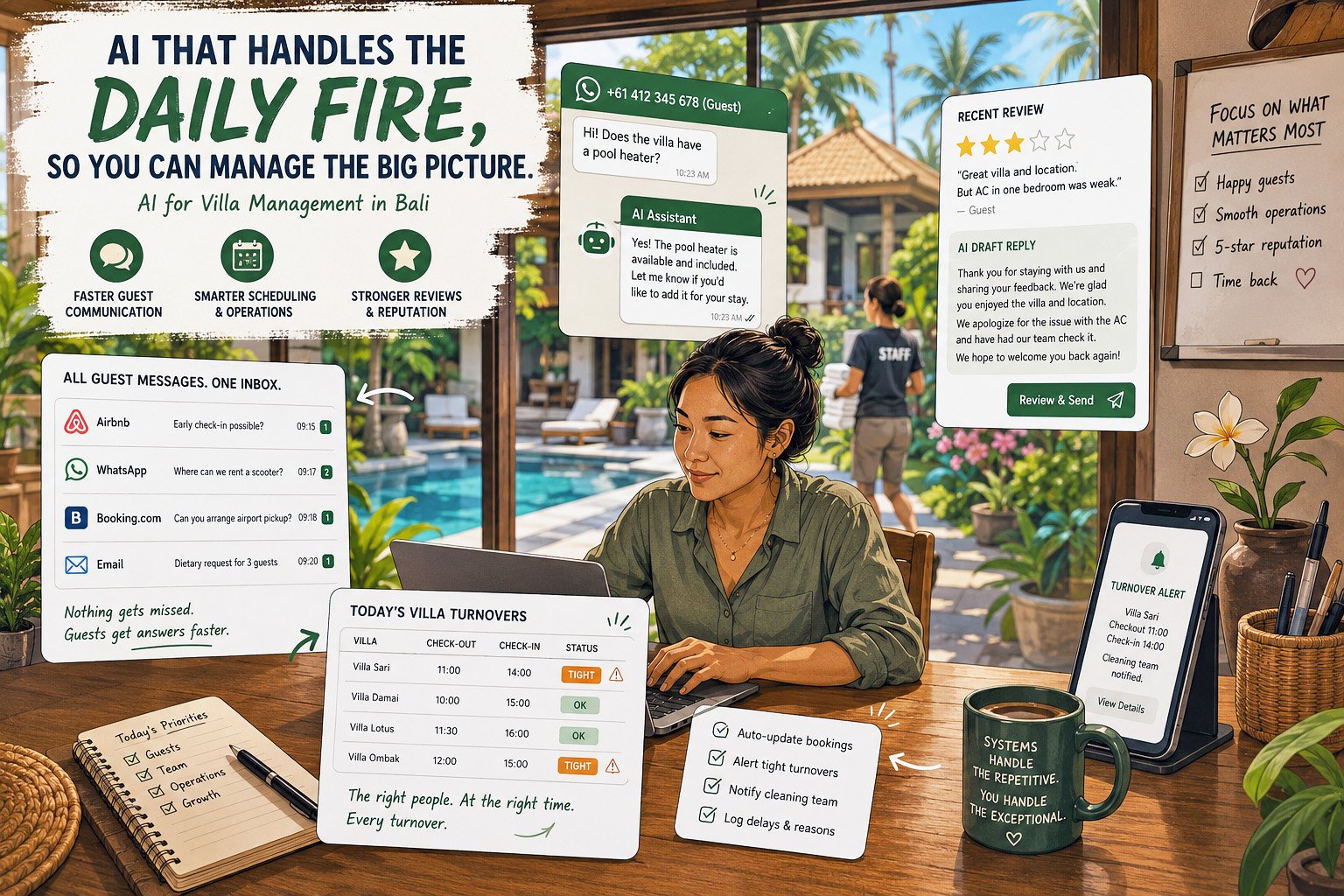
It’s 10:45 a.m. in Canggu — one guest checking out, another checking in at 2, the cleaning crew stuck in traffic, and a three-star review still unanswered. Villa management runs three jobs at once: guest communication, turnover scheduling, and reputation — usually with a team too small to specialize in any of them.
This piece breaks down where AI genuinely helps with each — drafting repeat guest replies, catching tight turnovers before they slip, structuring a calmer review response — and where it doesn’t, so the personal touch that keeps guests coming back stays intact.
It’s 10:45 a.m. in Canggu. A villa manager has one guest checking out at 11, another checking in at 2, and the cleaning crew is stuck behind traffic on Batu Bolong. A WhatsApp message just came in asking whether the pool heater works. Two more are sitting unread. And somewhere in her inbox is a three-star review from last week she still hasn’t answered, because every time she opens it to reply, something more urgent interrupts her.
That’s a fairly ordinary Tuesday for villa management in Bali — three different jobs (host, operations manager, reputation manager) running at once, usually with a team too small to specialize. AI doesn’t fix all three. But it can take real weight off each one, if it’s applied to the actual bottleneck instead of the generic idea of “using AI in hospitality.” This piece is part of a broader look at AI for the travel industry, and specifically at AI for Bali DMCs, villas and tour operators — villa management is its own animal within that, with its own rhythm and its own failure points.
Why This Decision Matters
Villa management in Bali runs on tight, unforgiving timing — a single late checkout can cascade into a late check-in, a missed cleaning slot, and an irritated guest before noon. Layer guest communication and review management on top of that, and it’s easy to see why most villa teams are reactive rather than strategic: there’s rarely a quiet moment to step back and fix the system instead of just surviving the day.
The villa businesses getting real value from AI aren’t the ones automating the most. They’re the ones who worked out which single daily fire was costing them the most time.
That’s the frame for everything below — three distinct areas (guest communication, scheduling, reviews), each with its own realistic use for AI, and each with its own limits.
Guest Communication: What Actually Helps
Villa guest communication has a rhythm — pre-arrival questions, in-stay requests, post-stay follow-up — and each stage has a different mix of what a tool can handle versus what needs a person.
| Stage | Handles well (AI) | Needs a human |
|---|---|---|
| Pre-arrival | Directions, check-in time, what’s included, Wi-Fi details | Special requests (anniversary setup, dietary needs for private chef) |
| In-stay | Answering repeated FAQ (pool heater, AC settings, nearby restaurants) | Anything urgent or physical (a broken appliance, a safety concern) |
| Post-stay | Thank-you message, review request, invoice/receipt follow-up | A guest complaint or refund conversation |
The pre-arrival and FAQ layer is where most villa teams see the fastest relief — the same six or seven questions arrive from nearly every guest, and drafting those replies is exactly the kind of repetitive work that doesn’t need a person’s judgment every single time.
The Multi-Channel Problem
Villa guests rarely come through one channel. A single week might bring a booking from Airbnb, a direct WhatsApp inquiry, a Booking.com reservation, and a guest referred by a travel agent — each with its own inbox, its own notification habits, and its own risk of a message sitting unread because it wasn’t the platform the manager happened to check that hour.
The guest who books through Booking.com and messages through Booking.com is often the one who waits longest for a reply — simply because that inbox gets checked last.
This is where a consolidated view genuinely helps, separate from the question of whether AI drafts the reply at all. Pulling messages from Airbnb, Booking.com, WhatsApp, and direct email into one place — even without any AI involved — often fixes half the response-time problem on its own. AI-drafted first responses are the second layer, applied once the messages are actually all visible in one place.
Housekeeping & Maintenance Scheduling
This is the part of villa management that rarely gets discussed in AI conversations, and it’s often the tighter bottleneck than guest messaging.
A single villa with an 11 a.m. checkout and 2 p.m. check-in has a three-hour window for cleaning, laundry, restocking, and any minor maintenance — and that window shrinks fast if a guest checks out late or a cleaner is delayed. For a company managing eight or ten properties, that’s not one schedule to juggle, it’s eight or ten, shifting daily based on real bookings.
Most villa scheduling problems aren’t solved by adding software — they’re solved by finally seeing all the turnovers in one place instead of in someone’s head.
In Practice: Automating the Turnover Schedule
- Pull checkout and check-in times automatically from your booking channels instead of checking each platform separately.
- Flag tight-turnaround properties first — anything under a three-hour gap gets surfaced, not buried in a long list.
- Auto-notify cleaning and maintenance staff as soon as a checkout time is confirmed, not after someone remembers to tell them.
- Keep a simple log of what’s actually late and why — this is what tells you whether the bottleneck is staffing, traffic, or something else.
None of this replaces your cleaning team or your maintenance staff. It replaces the mental spreadsheet a manager currently keeps in her head, which is usually the actual point of failure when something slips.
Review & Reputation Management
Reviews are where villa management’s reputation actually gets built, and it’s also where AI is most likely to backfire if it’s used carelessly.
A drafting tool can genuinely help here — turning a rough reply into something polished, catching a defensive tone before it goes live, or drafting a first response to a three-star review so a manager isn’t starting from a blank page while frustrated. What it shouldn’t do is generate the entire reply unreviewed, especially for anything negative or specific.
A review reply that reads like a template is worse than a slightly imperfect one that clearly came from a person who read the actual complaint.
Guests can tell the difference between a genuinely considered response and a generic, AI-smoothed non-answer — and a villa’s review section is public, permanent, and often the first thing a prospective guest reads before booking.
There’s also a monitoring problem underneath the writing problem: villa reviews land across Google, TripAdvisor, Airbnb, and Booking.com, each with its own notification habits, and it’s easy for a review on a less-checked platform to sit unanswered for weeks without anyone noticing.
In Practice: Staying on Top of Reviews Across Platforms
- Consolidate new-review alerts across Google, TripAdvisor, Airbnb, and Booking.com into one place someone actually checks daily.
- Flag negative reviews for same-day attention — speed matters more here than almost anywhere else in villa management.
- Use a draft as a starting point, never a final answer, especially for anything with specific guest complaints.
- Track recurring themes across reviews, not just individual ones — three guests mentioning slow Wi-Fi is a maintenance issue, not a communication issue.
How the Three Pieces Fit Together
Guest communication, scheduling, and reviews aren’t really three separate projects — in a well-run villa operation, they’re connected. A tight turnover affects whether a guest’s early-arrival request can be honored, which affects the in-stay conversation, which affects the eventual review.
In Practice: How the Three Pieces Fit Together
- Guest messaging surfaces requests (early check-in, late checkout) that scheduling needs to know about immediately, not at the end of the day.
- Scheduling data informs what guest communication can honestly promise — don’t offer an early check-in the cleaning schedule can’t support.
- Review patterns point back to operational issues — if “slow response time” shows up repeatedly, that’s a scheduling or staffing problem wearing a communication complaint’s clothes.
This is close to what a proper AI concierge setup does when it’s built around the whole guest journey rather than just one message thread — see building an AI concierge assistant — the value compounds when the pieces talk to each other instead of running as separate tools.
A Worked Example
A villa management company running eight properties in the Berawa area started with just the pre-arrival FAQ layer — six templated questions, reviewed by a manager before sending. Within a month, the same manager who used to spend the first hour of her day answering repeat questions had that hour back, and used it instead to walk the properties before check-in — catching two maintenance issues before guests noticed them.
The scheduling piece came next, once the team trusted the messaging layer: an automatic turnover flag for any property with under a three-hour gap, which cut same-day cleaning delays roughly in half over the following season. Reviews were the last piece added, and deliberately so — the team wanted a full season of real guest conversations logged before trusting a drafting tool to help with responses.
The order mattered more than the tools. Fixing the loudest daily fire first is what made the rest worth doing.
Guest Data: The Part Worth Getting Right Early
Villa guest communication touches passport details, payment references, arrival times, and sometimes health or dietary information — the kind of data that deserves more care than a general chatbot project usually gets. Before any AI tool touches guest messages, it’s worth knowing where that data is actually stored, who can access it, and whether the tool retains conversation history longer than you’d want it to.
This isn’t a reason to avoid AI in villa communication — it’s a reason to ask the question upfront rather than after a guest asks where their passport scan ended up. A drafting tool that only sees the message text it needs, rather than a guest’s full booking record, is usually the safer starting point.
Common Mistakes
The most common one is starting with review management, because it feels like the most visible, reputation-critical piece — and ending up with polished-sounding but generic replies that guests notice are hollow. A close second is ignoring the seasonal reality of Bali villa staffing: a scheduling system built around dry-season cleaning capacity falls apart the moment wet-season traffic or staff availability changes, and needs to flex rather than assume a fixed team size year-round. The quieter mistake is over-automating the in-stay conversation specifically — this is the stage where a guest most wants to feel like they’re talking to someone who actually knows the villa, not a script.
Choosing Between a Simple Tool and a Full System
A single villa with an owner-manager rarely needs more than a lightweight FAQ-drafting tool and a simple shared calendar. A management company running a dozen or more properties usually reaches a point where a connected system — messaging, scheduling, and review tracking talking to each other — pays for itself in the hours it saves a coordinator who’d otherwise be manually cross-referencing three tools. There’s no fixed threshold where one becomes the other; it’s usually obvious once the manual coordination itself starts eating a full working day each week. If you’re managing a DMC alongside villa properties, the starting point looks a little different — see AI tools for Bali DMCs for that side of the business.
How to Know You’re Ready
In Practice: Signs You’re Ready to Start
- The same handful of guest questions arrive constantly, and answering them is eating time that should go to actually managing the property.
- Turnover scheduling lives in someone’s head or a messy spreadsheet, not a system anyone else on the team could pick up.
- Reviews are piling up unanswered for longer than a guest would consider reasonable.
- Someone on your team has time to review drafts daily, at least for the first month — this isn’t a install-and-forget fix.
Frequently Asked Questions
Will guests notice they’re getting an AI-drafted reply? They shouldn’t, if it’s reviewed and adjusted before sending — the goal is a faster first draft in your own voice, not a visibly automated response.
Can this replace my housekeeping coordinator? No. It removes the manual cross-referencing between booking platforms and staff schedules — the coordinator still makes the judgment calls, just with better information in front of them.
Is this only useful for management companies with many properties? No, though the payoff scales with the number of properties. A single-villa owner-manager usually benefits most from the guest communication layer alone.
What about guests who message in a language other than English? Basic templated FAQ can work across languages reasonably well, but treat anything ambiguous or emotionally loaded the same way you would in English — route it to a person rather than trusting an automatic translation.
How do I handle a genuinely bad review? A drafting tool can help structure a calm, specific first response, but the actual judgment — what to acknowledge, what to offer, what tone to strike — should stay with a person who knows the guest’s stay.
Do I need to overhaul everything at once? No — the worked example above started with one layer (guest FAQ) and added the others only once each one was trusted. That’s the more reliable order for most villa operations.
What if my season is highly variable? Build the scheduling piece to flex around your actual staffing calendar, not a fixed assumption — this is one of the more common places villa AI projects quietly fail.
Is my guests’ data safe if I use an AI tool for messaging? Ask specifically where message data is stored and how long it’s retained before adopting any tool — this matters more in villa management than in most hospitality contexts, given how much personal detail guest messages tend to contain.
Can one system handle both a villa and a DMC side of the business, if I run both? Often yes, though the workflows are different enough that it’s worth scoping them as related but separate projects rather than assuming one setup serves both.
Final Thoughts
The Canggu manager from the opening didn’t need her whole day automated. She needed the six repeat questions off her plate so she could actually walk her properties before check-in — and that one change gave her back the hour she needed to catch problems before guests did.
If your days look like hers — one eye on WhatsApp, one on the cleaning schedule, one on a review you haven’t answered yet — the sensible next step is working with an AI consultant in Bali who can help you find which of these three areas is actually costing you the most, before building anything.
Last updated: July 2026