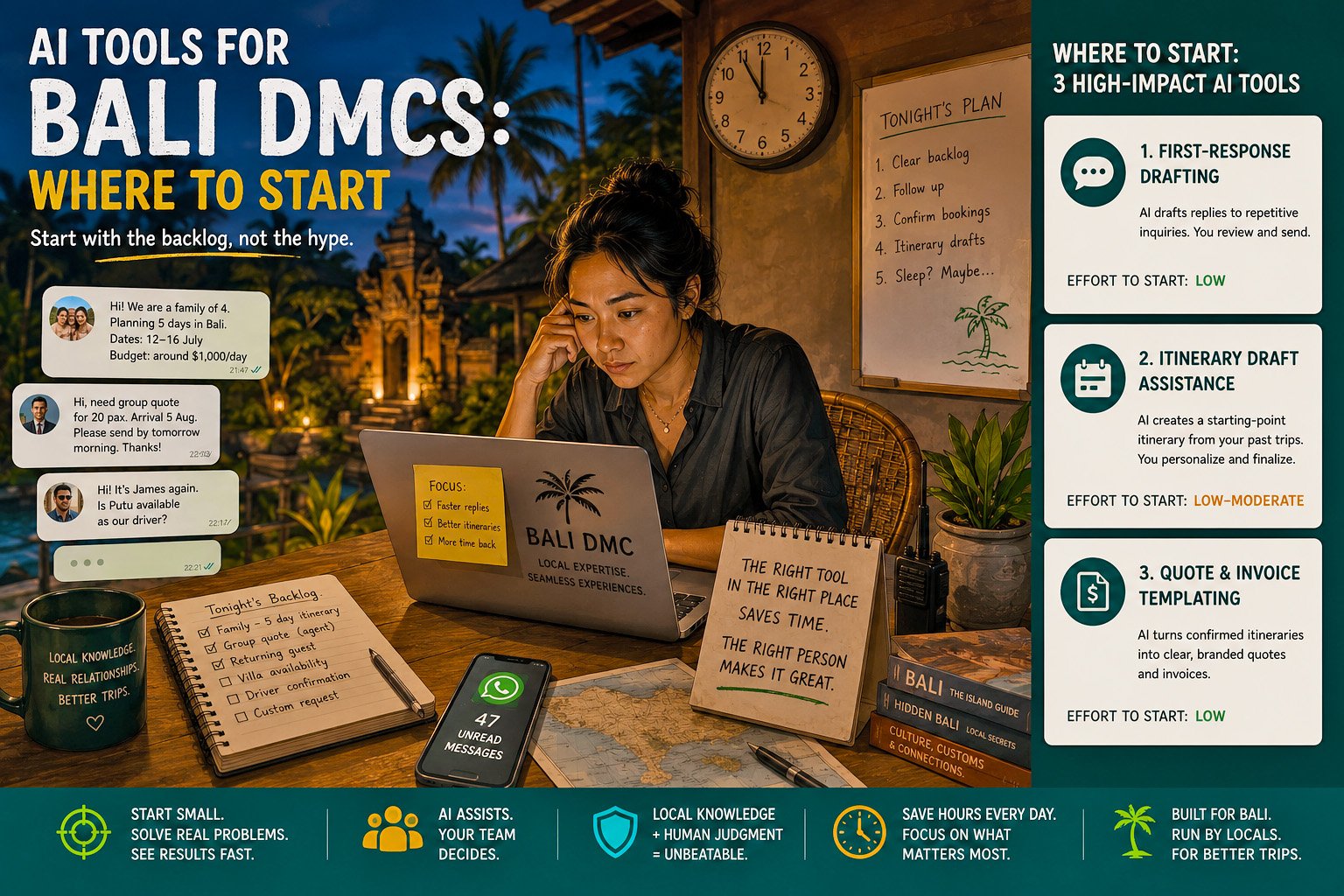
It’s 11 p.m. and a Sanur DMC owner is still replying to WhatsApp — a family wanting a 5-day itinerary, an agent in Jakarta needing a group quote by morning, a returning guest asking for the same driver. The backlog doesn’t stop because the office closed.
Most AI advice for this points DMCs toward platforms built for a 200-person OTA — the wrong tool for a 3-person team. This piece covers where a Bali DMC should actually start: drafting replies, not full automation, and why the itinerary work that makes you you should stay firmly in your hands.
It’s 11 p.m. and a DMC owner in Sanur is still replying to WhatsApp inquiries — three families asking for a 5-day Bali itinerary, one agent in Jakarta wanting a group quote by morning, and a returning guest asking if the driver from last time is available again. None of this stops because the office closed six hours ago. By the time she’s done, it’s past midnight, and the same backlog will be waiting again tomorrow.
That backlog — not a lack of “innovation” — is usually the actual starting point for AI in a Bali DMC. The question isn’t which tool is most advanced. It’s which part of that nightly pile-up is costing the most time for the least judgment required.
Why “Where to Start” Matters More Here
Most AI advice aimed at DMCs comes from global travel-tech vendors who assume a call center, a CRM team, and a marketing department. A typical Bali DMC has none of that — often it’s an owner-operator and two or three staff, running quotes and confirmations through WhatsApp, with local knowledge that no software has.
The tool that works for a 200-person OTA is usually the wrong tool for a 4-person DMC — not because it’s bad, but because it assumes a team you don’t have.
That mismatch is why a lot of Bali DMCs try an “AI travel platform,” use it for a month, and quietly drop it. The tool wasn’t wrong for travel. It was wrong for how this specific business actually runs — WhatsApp-first, relationship-driven, and dependent on a small number of people who know the island well enough to route around traffic, ceremony closures, and which driver fits which client.
Where the Real Leverage Is
For most Bali DMCs, the backlog breaks down into three layers, and they’re not equally good places to start.
| Layer | What it actually does | Typical effort to start |
|---|---|---|
| First-response drafting | Drafts a reply to a repetitive inquiry for a human to check and send | Low — days, not weeks |
| Itinerary draft assistance | Produces an internal starting-point document from past itineraries | Low to moderate |
| Quote & invoice templating | Turns a confirmed itinerary into a formatted quote without re-typing | Low |
In Practice: Where Most Bali DMCs Should Start
- First-response drafting, not full automation — a tool drafts a reply to a repetitive inquiry (dates, group size, rough budget), and a human checks and sends it in seconds instead of minutes.
- Itinerary draft assistance for internal use — a starting-point document pulled from your own past itineraries, which a human still finalizes and personalizes.
- Quote and invoice templating — turning a confirmed itinerary into a formatted quote without re-typing it from scratch each time.
Full booking automation and guest-facing chatbots come later, once these first-layer workflows are actually working — that’s its own topic, covered in AI chatbots for Bali tour operators, since guest-facing tools carry more risk if they go live before the backend is solid.
A Closer Look at First-Response Drafting
This is almost always the right place to start, because it’s the layer with the least risk and the fastest visible payoff. Most inbound WhatsApp inquiries fall into a handful of repeating shapes — a family asking for a multi-day itinerary at a rough budget, an agent requesting a group quote, a returning guest wanting the same driver or villa as before.
A first-response drafting tool doesn’t decide anything on its own. It reads the inquiry, drafts a reply covering the obvious next questions (available dates, rough pricing tiers, what information is still needed), and hands that draft to a person to review before it goes out. The judgment stays with the owner or staff member. What changes is that the blank-page problem — staring at a WhatsApp thread at 11 p.m. trying to compose a reply from scratch — disappears.
A Closer Look at Itinerary Draft Assistance
This is the layer where it’s most tempting to over-trust the tool, and where the caution matters most.
An itinerary draft from AI is a starting point for someone who already knows Bali. It’s a liability for someone who doesn’t.
A drafting assistant, fed your own past itineraries, can produce a reasonable first pass — a suggested day-by-day structure, rough timing, common pairings of sights and activities. What it can’t do is the part that actually makes a Bali itinerary good: knowing that a particular temple visit should happen before 9 a.m. to avoid both heat and tour buses, that a specific route floods during rainy season, or that this client’s vague request for “something cultural but not too touristy” means a specific handful of places and not others. That judgment stays entirely with your team. The tool’s job is to save the ten minutes of formatting and structuring, not the fifteen years of knowing the island.
In Practice: Preparing Your Itinerary Library
- Pull together your 10–15 best past itineraries before starting — the tool is only as good as the examples it learns structure from.
- Note which ones worked well and why, not just what they contained — that context matters more than the raw document.
- Skip anything outdated — a itinerary built around a since-closed restaurant or an old price list will quietly resurface if it’s included.
A Closer Look at Quote & Invoice Templating
This is the least glamorous of the three, and often the one that saves the most raw hours. Once an itinerary is confirmed, turning it into a client-ready quote — with correct line items, currency, and terms — is pure formatting work that a template-driven tool handles well, freeing up the time that used to go into re-typing the same structure for every booking.
This kind of admin-layer automation isn’t unique to DMCs — it overlaps with reducing admin work with AI more broadly across tour operations generally, and it’s usually worth tackling early precisely because it’s low-risk: a formatting mistake is easy to catch before a quote goes out, unlike a guest-facing error that a client sees in real time.
Handling Multiple Markets and Languages
A Bali DMC’s inquiries rarely come from one market. A single week might bring a direct family booking from Australia, a group quote request from a Jakarta-based agent, and a returning guest writing in accented but workable English from a previous trip. Each of these has different quoting conventions — currency, typical group sizes, the level of detail an agent expects versus what a direct family wants to read.
A first-response and quoting layer can be set up with market-specific templates — one tone and structure for agent quotes, another for direct family inquiries — without needing separate tools for each. What it can’t safely do is handle a genuinely ambiguous or poorly-translated inquiry on its own; those still deserve a person’s read before a reply goes out, the same caution that applies to guest-facing chatbot conversations.
What Comes Later
Once first-response drafting, itinerary assistance, and quoting are running smoothly — usually a matter of a few weeks of testing — the next layer worth considering is guest-facing tools: a chatbot that can answer simple, repeatable questions directly, without a draft-and-review step in between. That’s a bigger jump in both capability and risk, and it deserves its own decision process rather than being bundled into the starting point. If your team is already handling high DM volume and wondering whether that’s the next move, AI chatbots for Bali tour operators covers what that stage actually looks like.
What This Looks Like in Practice
A DMC handling roughly 15–20 inbound inquiries a day doesn’t need a system that “handles guest communication end to end.” It needs the midnight reply drafted by 7 a.m., so the owner reviews and sends it over coffee instead of writing it from scratch.
The Sanur owner from the opening started exactly there — five templated inquiry types, drafted overnight, reviewed each morning. Within three weeks, her average reply time during business hours dropped from just over an hour to under fifteen minutes, not because anything got faster to write, but because there was nothing left to write from a blank page. The itinerary and quoting layers came a month later, once the team trusted the first layer enough to build on it.
Most of the value showed up in the first layer, long before anything more sophisticated was even tried.
Common Mistakes
The most common one is buying an all-in-one “AI-powered DMC platform” before testing whether AI even fits the actual bottleneck — these platforms often assume a scale and staffing structure a small Bali DMC doesn’t have, and the fit shows up as frustration within a month. A close second is assuming AI can write a Bali itinerary the way a local expert would, when in reality it produces a reasonable first draft that still needs the routing, timing, and local judgment only your team has. The quieter mistake is skipping the review step once the tool “seems to be working” — a drafting tool that goes a few weeks without oversight starts drifting toward outdated pricing or seasonal details nobody caught.
A drafting tool left completely unreviewed for a month is quietly answering with last month’s information.
How to Know You’re Ready
In Practice: Signs You’re Ready to Start
- Inquiries come in consistently enough that a pattern is obvious — the same five questions, in slightly different words, several times a week.
- Someone on the team has 20–30 minutes a day to review drafts rather than write everything from scratch.
- You already have a reasonable back-catalog of past itineraries and quotes the tool can learn structure from — this makes the drafting layer far more useful from day one.
Choosing Tools: Off-the-Shelf vs. Custom-Built
For a team of two or three, a lightweight, off-the-shelf drafting tool layered onto WhatsApp is usually enough — it’s fast to set up, cheap to test, and easy to drop if it doesn’t fit. A larger DMC handling higher volume, or one juggling both a DMC and villa or tour-operator side of the business, often reaches a point where a more tailored setup — one that understands your specific itinerary templates, pricing tiers, and quoting rules — pays for itself in the hours it saves versus adapting a generic tool to fit around them.
There’s no fixed headcount where one becomes the right answer over the other. It’s usually clear once the manual workarounds needed to make an off-the-shelf tool fit your process start taking as long as the task itself.
Frequently Asked Questions
Do I need a big travel-tech platform to use AI in my DMC? No. Most of what’s described here can start with a lightweight assistant layered onto WhatsApp and your existing quoting process — not a platform migration.
Will this replace my local knowledge? No. It drafts the parts that are repetitive so your judgment goes into the parts that actually need it — routing, timing, and the personal touches that make an itinerary yours.
What about group quotes for agents, not just direct guests? The same first-response and quoting layer applies — group quotes just need a bit more structure in the template since they involve more variables.
Should I start with a guest-facing chatbot instead? Usually not first. Backend drafting and quoting is lower-risk and shows results faster; a guest-facing chatbot is worth doing once that foundation is solid.
How long before I’d see a difference? Most DMCs notice a change in response time within two to three weeks of testing a first-response drafting tool against real inquiries.
Can I use this for a very small operation — just me and one other person? Yes — the smaller the team, the more a blank-page drafting tool tends to help, simply because there’s no one else to share the after-hours reply load with.
What if my past itineraries aren’t well organized? It’s worth spending a few hours consolidating your best past itineraries before starting the drafting layer — the tool is only as useful as the examples it can learn structure from.
Do I need separate tools for agent quotes versus direct family bookings? Not usually — market-specific templates within the same tool tend to work better than juggling separate systems for each audience.
How do I handle an inquiry in a language my team doesn’t speak well? Treat it the same caution as any ambiguous inquiry — have a person confirm the details before a quote goes out, rather than trusting an automatic translation on something this consequential.
Final Thoughts
The Sanur DMC owner from earlier didn’t need a platform overhaul. She needed the 11 p.m. replies drafted before she opened her laptop, so review took five minutes instead of forty. That’s a small, specific fix — and it’s usually the right place for a Bali DMC to start, within the broader picture of AI for Bali DMCs, villas and tour operators and AI for the travel industry more generally.
If your evenings look like hers, book an initial conversation and we’ll figure out where your actual backlog is before talking about any tool at all.
Last updated: July 2026