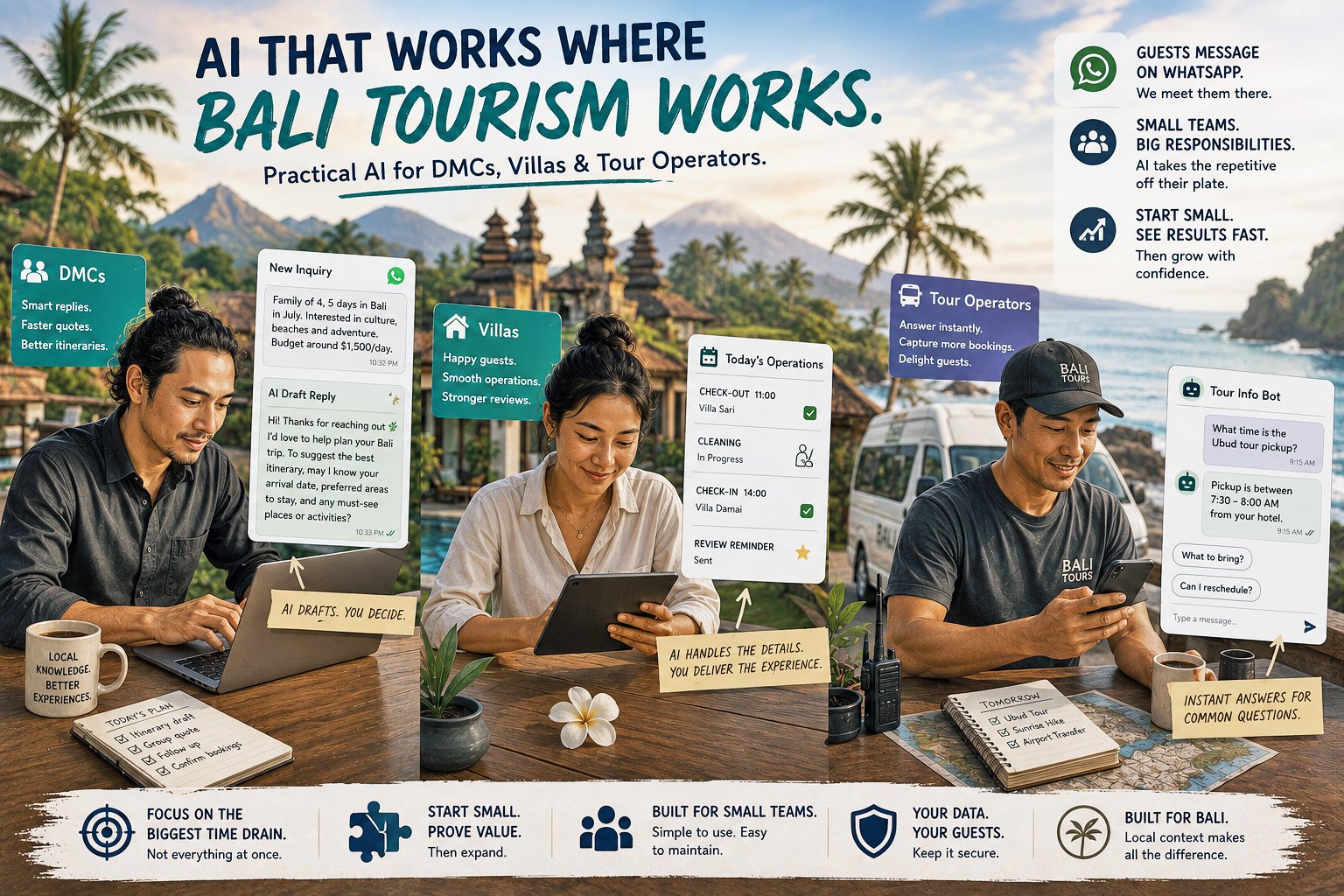
A DMC owner in Sanur replying to inquiries at midnight. A villa manager in Canggu juggling a checkout, a check-in, and an unanswered review. A tour operator in Ubud staring at 47 unread Instagram DMs. Three different businesses, one shape: small team, several jobs each, guest communication running almost entirely through WhatsApp.
Most AI-for-tourism advice is written for hotel chains and OTAs with dedicated IT teams — not this. This piece covers what actually changes when a Bali tourism SME adopts AI: budget, staffing, seasonality, and where each type of business should genuinely start.
A DMC owner in Sanur replying to inquiries at midnight. A villa manager in Canggu juggling a checkout, a check-in, and an unanswered review, all before lunch. A tour operator in Ubud staring at 47 unread Instagram DMs before the day has properly started. Three different businesses, three different corners of Bali’s tourism industry — and the same underlying shape: a small team, doing several jobs at once, with guest communication running almost entirely through WhatsApp and Instagram rather than a call center or CRM.
Most AI-for-tourism content isn’t written with that shape in mind. It’s written for hotel chains, OTAs, and travel-tech companies with dedicated IT teams and marketing departments — useful, but built for a scale most Bali tourism businesses don’t operate at and don’t want to. This is the version written for the businesses that actually make up Bali’s tourism economy.
Why Bali Is Different
The difference isn’t the technology. AI tools work the same way here as anywhere else. The difference is the operating context they get dropped into.
A global AI-for-travel guide assumes a team that doesn’t exist at most Bali tourism businesses — and the advice quietly fails the moment it meets a 3-person operation running everything through WhatsApp.
A Bali DMC, villa management company, or tour operator is usually run by an owner-operator with a handful of staff, wearing several roles each. There’s rarely a dedicated IT person to evaluate software, rarely a marketing team to manage a rollout, and rarely slack in the schedule to spend a week testing something new. Whatever gets adopted has to work inside that reality, not the one assumed by a generic enterprise AI playbook.
The Three Realities of Running an AI Project Here
Three things shape almost every AI decision for a Bali tourism SME, and they’re rarely addressed honestly in generic guides.
Budget. Most Bali tourism SMEs aren’t working with an enterprise software budget, and shouldn’t need one. The tools that make sense here are ones with a low cost of entry and a fast, visible payoff — not a year-long enterprise platform rollout. If a proposed AI project can’t show a difference within a month, it’s probably scoped for the wrong kind of business.
Staff capacity. There usually isn’t a dedicated person to manage an AI tool full-time. Whatever gets adopted needs to fit into the existing rhythm of a small team’s day — a few minutes of review here, a quick check there — rather than requiring someone new to be hired just to run it.
Seasonality. Bali’s tourism businesses live with real seasonal swings, and a system built assuming dry-season staffing and volume will strain or break the moment the season shifts. Anything built here needs to flex, not assume a fixed team size or inquiry volume year-round.
Guest Communication Everywhere: The WhatsApp Reality
Whether it’s a DMC quoting an itinerary, a villa answering a pool-heater question, or a tour operator confirming tomorrow’s pickup time, the conversation almost always happens on WhatsApp or Instagram DM — not email, not a booking portal’s internal messaging system. That’s not a limitation to work around. It’s the actual channel guests expect to use here, and any AI tool that assumes otherwise (built for an email-first or portal-first business) is starting from the wrong assumption entirely.
The AI tools that actually get used in Bali are the ones built to live inside WhatsApp, not the ones that expect WhatsApp to be replaced by something more “professional.”
This is the common thread across all three business types, even though the specific messages differ — a DMC’s itinerary inquiry, a villa’s in-stay request, a tour operator’s availability question all arrive the same way, at the same pace, often outside business hours.
Where Each Type of Business Should Start
The right starting point differs by business type, even though the underlying approach — start small, test against real conversations, expand only once it’s trusted — is the same everywhere.
In Practice: Where Each Business Type Should Start
- DMCs — first-response drafting for repetitive inquiries, then itinerary draft assistance and quote templating. See AI tools for Bali DMCs for the full breakdown.
- Villas — the pre-arrival guest FAQ layer first, then turnover scheduling, then review management last, once the team trusts the earlier layers. See AI for villa management.
- Tour operators — a narrow chatbot handling three to five repeat questions (availability, pickup time, cancellation policy), with everything else routed to a human. See AI chatbots for Bali tour operators.
Across all three, the mistake to avoid is the same: trying to automate the whole guest journey at once, instead of the one specific bottleneck that’s actually costing the most time right now.
A Day in the Life, Before and After
Picture the same three businesses from the opening, three months after each started with the narrow first layer above.
The Sanur DMC owner still writes every itinerary herself — that hasn’t changed, and it wasn’t supposed to. What changed is that her 11 p.m. WhatsApp session is gone; the repetitive first-response questions are drafted overnight and reviewed over coffee instead of written from scratch at midnight. The Canggu villa manager still walks her properties every morning — but she does it because she chose to, not because she’s scrambling to catch a maintenance issue before a guest complains, since the turnover schedule now flags tight gaps before they become a problem. The Ubud tour operator’s Instagram inbox isn’t quiet — it’s sorted, with the easy 70% answered in under two minutes and the harder 30% landing in front of a person with context already attached.
None of these three businesses got smaller teams or bigger budgets. They just stopped spending their most valuable hours on the most repetitive part of the job.
That’s a realistic picture of what “AI for a Bali tourism SME” actually looks like in practice — not a transformed business, just a team with a few specific hours back each week, spent on the parts of the job that actually need a person.
Data and Trust at Bali SME Scale
Guest conversations in all three business types carry real personal detail — passport numbers, payment references, arrival times, sometimes health or dietary information. It’s worth asking, before adopting any tool, where that data is stored, who can access it, and how long conversation history is kept — a question that matters more here than it might seem, given how much of a Bali tourism business’s communication happens informally over WhatsApp rather than a more controlled booking portal.
This isn’t a reason to avoid AI tools. It’s a reason to ask the question upfront, the same way you’d ask before handing a new staff member access to guest records. A tool that only processes the specific message it needs, rather than pulling a guest’s entire booking history unnecessarily, is usually the more cautious starting point.
What This Actually Costs at Bali SME Scale
Exact cost depends on scope, but the shape is fairly consistent across all three business types:
| Stage | Typical scope | Typical payoff timeframe |
|---|---|---|
| First layer (drafting, narrow FAQ, scheduling flags) | A single workflow, reviewed by a person | Weeks |
| Second layer (expanded FAQ, multi-property scheduling) | Once the first layer is trusted | 1–2 months |
| Broader system (connected messaging, scheduling, reviews) | Usually only for larger, multi-property operations | Ongoing |
Most Bali tourism SMEs never need to move past the first layer to see a real difference in their daily workload — the bigger investment, if it happens at all, comes later, once a first layer has proven itself and there’s a specific reason to go further.
Staffing: Building AI Into a Team That Wears Many Hats
A Bali DMC’s “operations manager” is often also the person answering WhatsApp at 11 p.m. and reviewing tomorrow’s driver schedule. A villa’s “guest relations” person might also be doing the books. Whatever AI tool gets introduced has to fit into that reality — a few minutes of review each day, not a new full-time role.
This is exactly why the starting layers recommended above are review-based rather than fully autonomous: a person still checks the draft, still makes the judgment call, still owns the relationship with the guest or client. The tool removes the blank-page problem, not the person’s role in the conversation.
Seasonality: Building for the Off-Season, Not Just Peak
A system designed only around high-season volume and staffing will either sit underused for half the year or, worse, keep behaving as if peak-season assumptions still apply once the season turns. A villa’s turnover-scheduling assistant needs to flex with actual staff availability, not an assumed fixed roster. A DMC’s first-response drafting tool needs review cadence that scales down in the quiet months rather than assuming the same daily inquiry volume year-round.
Most AI tools built for Bali tourism businesses aren’t tested against the low season at all — and that’s usually where they quietly stop being useful first.
Building this flexibility in from the start is cheaper than retrofitting it after a system has already been running on peak-season assumptions for a year.
How This Connects to the Bigger Picture
Everything above is a Bali-specific version of ideas that apply to the travel industry more broadly — see AI for the travel industry overview for the full landscape. The same fundamentals that shape AI for guest experience, AI revenue management, back-office automation, and AI adoption roadmaps at a global, enterprise scale apply here too — they just look different at the scale of a 3-to-10-person Bali operation than they do at a hotel chain or an OTA. The mechanics are the same. The starting point, the budget, and the pace are not.
Common Mistakes
The most common mistake is adopting a tool built for a business that isn’t yours — a platform designed around a call center and a marketing department, dropped onto a 3-person DMC that runs on WhatsApp and local knowledge. A close second is trying to automate guest-facing communication before the backend (quoting, scheduling, admin) is solid, which usually means the guest sees the rough edges first. The quieter mistake, and the one that causes the most long-term drift, is building a system around peak-season assumptions and never revisiting it once the season changes.
How to Know You’re Ready
In Practice: Signs Your Business Is Ready
- You can name a specific, repeating bottleneck — not a vague sense that “we should be doing AI,” but an actual daily pattern costing real time.
- Someone on the team has a small amount of time daily to review drafts or flagged conversations, at least for the first month.
- You’re prepared to start small and test, rather than expecting a complete solution on day one.
Getting Started
In Practice: A Realistic First Step
- Pick the one workflow costing your team the most time this month — not the most impressive-sounding project.
- Time it manually for a week first, so there’s a real baseline to compare against.
- Test the AI layer against real conversations, not hypothetical ones, before deciding whether to expand it.
- Review weekly for the first month, then settle into a lighter monthly cadence once it’s stable.
Frequently Asked Questions
Is this only relevant if I run a DMC, villa, or tour company? The specific examples are drawn from those three, but the underlying approach — small-team, WhatsApp-first, start-small-and-test — applies to most Bali tourism SMEs.
Do I need to pick one of the three starting points, or can I combine them? Most businesses genuinely fit one category more than the others, but a business that runs both villas and tours, for instance, usually benefits from tackling them as related but separate projects rather than one combined system.
How is this different from generic AI-for-hospitality advice? Generic advice assumes a team, budget, and channel mix that most Bali tourism SMEs don’t have. Everything here is scoped to a small, WhatsApp-first operation instead.
Will this work during low season, or just peak? It should work in both, but only if it’s built to flex with actual staffing and volume rather than assuming a fixed, peak-season shape — that’s addressed directly above.
What if my team is resistant to using a new tool? Start with something that removes a task they already dislike doing, rather than introducing something new for its own sake — adoption is far easier when the tool is solving a problem the team already feels.
Do I need outside help to get started, or can I do this myself? Some of this — like consolidating a first FAQ list — a team can do alone. Scoping which workflow has the most leverage, and setting a system up to flex with seasonality, is usually where outside experience helps most.
Is my guest data safe if I start using AI tools for WhatsApp communication? Ask specifically where message data is stored and how long it’s kept before adopting any tool — worth doing regardless of business type, given how much personal detail passes through these conversations.
What’s different about getting help from someone based in Bali versus a remote consultant? Local experience means the recommendations already account for seasonality, WhatsApp-first communication, and the small-team reality described throughout this piece — rather than that context needing to be explained from scratch.
Final Thoughts
The DMC owner, the villa manager, and the tour operator from the opening aren’t running the same business, but they’re solving a version of the same problem: too many repetitive tasks, too little time, and a guest on the other end of WhatsApp who expects a fast, human-feeling reply. AI doesn’t change what makes a Bali tourism business good — local knowledge, a fast response, a personal touch. It just gives a small team back the time to keep doing that well.
If that’s the position you’re in, the practical next step is working with an AI consultant in Bali who already knows this scale of business — or simply discuss your Bali business’s AI opportunity directly and we’ll start from what’s actually slowing your team down.
Last updated: July 2026